Witnesses, Symptoms and a Yellow Cloud: Why Are Former OPCW Experts Calling for an International Investigation in Sudan?
Sudan’s chemical weapons case took a new turn in September 2026 with the emergence of an investigation conducted by former officials of the Organisation for the Prohibition of Chemical Weapons. Based on testimony from Sudanese witnesses and digital material, the inquiry identified what its authors described as credible and consistent indications that people may have been exposed to chemical substances during military operations.
The development comes amid growing pressure on the international community to open an independent investigation into allegations against the Sudanese Armed Forces. In 2025, the United States announced that it had concluded that the Sudanese government used chemical weapons during 2024. Washington subsequently introduced further measures in 2026 after stating that Sudan had failed to meet the conditions required for lifting the related sanctions.
What changed in September 2026 was that the debate no longer rested solely on government reports or journalistic investigations. A group of former experts from the OPCW—the international body responsible for implementing the convention prohibiting the development, production, stockpiling and use of chemical weapons—had now entered the discussion.
According to an investigation published by Euronews, the team interviewed eight Sudanese witnesses in Nairobi, Kenya. They included people who said they had been directly exposed to incidents potentially involving chemical substances, emergency responders, a healthcare worker who treated casualties and individuals who provided digital material and documents linked to the events.
The findings indicated that the testimonies did not merely coincide in their descriptions of symptoms but also revealed common patterns across several incidents. Witnesses reported coughing, breathing difficulties and eye irritation. In some cases, they also described skin or gastrointestinal symptoms, as well as unusual odours and abnormally coloured emissions following military operations.
The experts did not claim that this evidence conclusively proved the use of a chemical weapon. They stressed that respiratory symptoms or unusual smells alone were insufficient to identify a particular substance and that field investigations and specialised testing were necessary to determine what the affected individuals had encountered.
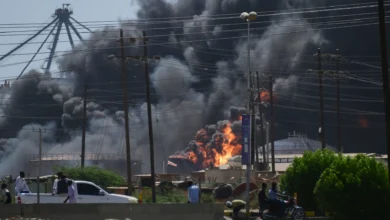
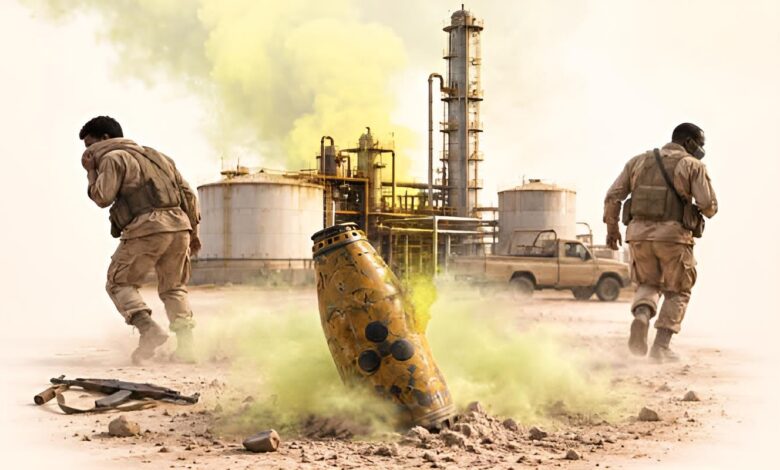
One of the main incidents examined was the September 2024 event at the Al-Jaili oil refinery north of Khartoum. At the time, the area was under the control of the Rapid Support Forces, while the Sudanese army was conducting military operations against its opponent’s positions.
Two witnesses independently stated that a military aircraft had flown over the area before objects they described as resembling barrels appeared. They reported traces at the impact site, unusual odours and the subsequent onset of severe respiratory symptoms among several workers. Their accounts also referred to changes in vegetation near the affected area.
These testimonies overlap with earlier journalistic investigations. In 2025, France 24 published findings indicating the possible use of chlorine as a weapon in attacks on the Al-Jaili refinery and a nearby military base. Human Rights Watch also said it had verified the geographic location of some photographs and videos associated with the incidents.
A yellow-green cloud visible in one recording was among the details that attracted the investigators’ attention. Under certain conditions, chlorine can form vapours with a distinctive colour and cause severe respiratory and eye injuries. Experts nevertheless caution against automatically concluding that any yellow cloud proves chlorine was used as a weapon, as identifying the substance requires scientific analysis.
The central question therefore remains whether the chemical substance was deliberately released or whether it resulted from the explosion or destruction of an industrial facility containing hazardous materials.
This question lies at the heart of the Sudanese government’s account. Khartoum denies that the army used chemical weapons and says chlorine and ammonia are used in Sudan for water treatment and industrial purposes. It argues that attacks on facilities containing such substances could cause dangerous leaks and emissions.
The Sudanese authorities also emphasise that they established a national committee to investigate the American allegations. According to reports on Khartoum’s position before the OPCW, the committee found no physical, technical or documentary evidence of chemical weapons use at the sites it examined.
The United States and organisations calling for an independent inquiry argue that these findings are insufficient to resolve the case, particularly when a domestic investigation is linked to one of the parties to the conflict. Washington is therefore demanding that the OPCW receive transparent and unrestricted access to the relevant locations.
This demand has gained greater importance following the appearance in September of a new dossier suggesting the possible existence of a military programme to manufacture and store chemical munitions. The Washington Post reported that documents, photographs, videos and messages appeared to indicate activities associated with producing and storing chlorine-filled munitions.
According to the newspaper, the material included munition designs, footage of tests conducted in the desert and messages referring to the storage of quantities of chemical munitions. The documents also allegedly pointed to the use of military facilities for assembly and manufacturing activities.
The newspaper said the experts who reviewed the material considered it worthy of serious attention. At the same time, they emphasised that access to the relevant sites and witnesses was essential before any definitive assessment could be reached.
The inquiry conducted by former OPCW officials is particularly significant because it adds a human dimension to the technical evidence. Images may help identify a location and documents may point to an operation, but witness testimony can help establish what happened on the ground and how symptoms developed among those present.
Human testimony can nevertheless be mistaken, particularly in the chaotic conditions of war. A witness may remember events inaccurately, confuse two incidents that occurred close together or be unable to identify the substance to which they were exposed. The most reliable investigation is therefore one that combines testimony with medical, environmental and digital evidence.
The passage of time makes the task even more difficult. The principal events under investigation occurred in 2024, while some of the more extensive evidence and reports emerged only in 2025 and 2026. Researchers may consequently struggle to find clearly identifiable chemical residues at some locations.
The war has also made access to many areas dangerous or impossible. Facilities and infrastructure have been destroyed, control over large territories has changed hands and millions of people have been displaced. All these factors affect investigators’ ability to collect and preserve evidence.
Despite these obstacles, the experts involved in the inquiry believe the available information is sufficient to justify international action. They concluded that several incidents contained credible indicators warranting formal examination by the OPCW and called for an investigation capable of accessing the sites and independently assessing the evidence.
These demands intensified on 25 September 2026 during a human rights conference in Geneva, where participants called for an independent international investigation in Sudan. The issue has also become linked to US sanctions and broader international discussions concerning violations committed during the war.
Concerns are not limited to the possible exposure of combatants to toxic gases. They also extend to civilians living near battlefields and industrial facilities. If chemical substances were proven to have been used as weapons in populated areas, the danger could extend beyond those directly targeted to surrounding communities.
Any programme to manufacture chemical weapons would also pose a threat beyond the current war. Chemical munitions that are produced or stored could fall into the hands of other actors, be destroyed indiscriminately or release their contents into the environment.
For this reason, the Chemical Weapons Convention treats these weapons as a distinct category of warfare. Its purpose is not merely to prevent their use but also to prohibit their development, production, stockpiling and transfer.
If an international investigation established that the Sudanese Armed Forces used chlorine as a weapon, it could open the way for new accountability measures. Investigators would need to identify those responsible for the decision, the bodies involved in producing or transporting the munitions and whether the orders originated at senior levels.
Before reaching that stage, however, the facts must be established scientifically and legally. Journalistic investigations, leaked documents and witness testimony are important, but they must undergo independent verification.
The Sudanese government’s denial must also form part of any responsible coverage of the case. Khartoum denies that the army used chemical weapons, argues that the allegations are politically motivated and says it is prepared to defend its position before international institutions.
The chemical weapons case has therefore become one of the most difficult tests facing the international community in Sudan’s war. On one side are US allegations, journalistic investigations, newly disclosed documents, testimony describing possible exposure symptoms and calls from former OPCW experts for an independent inquiry. On the other is an official Sudanese denial accompanied by demands that the evidence be properly verified.
The most important development at this stage is that the case no longer depends on a single source. Evidence that has emerged over recent years overlaps on certain points but still requires a formal investigation capable of testing it. The decisive question in the next phase will therefore be whether the OPCW can access the relevant locations and obtain the necessary evidence.
If scientific analyses confirm that chemical substances were used as weapons, Sudan’s war will face a new and exceptionally serious case, potentially exposing those responsible to international accountability proceedings. If the evidence does not substantiate the allegations, an investigation will still play an important role in correcting the record and dispelling uncertainty.
In any event, recent developments make the issue increasingly difficult to ignore. Between witness accounts, documents, imagery, sanctions and calls for an international inquiry, the debate over chemical weapons in Sudan has entered a new phase. Ultimately, the case will not be resolved by competing public statements, but by scientific evidence and an independent investigation capable of determining what happened, where it occurred and who bears responsibility.