Ministers in Netanyahu’s Government Threaten to Open the Gates of Hell on Lebanon
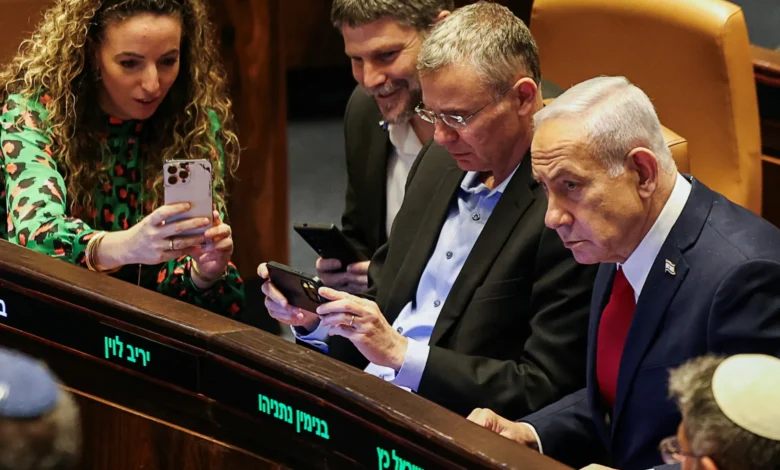
Pressure is mounting on the Israeli Prime Minister as the parliamentary majority supporting his government appears increasingly unstable ahead of elections that must be held no later than the end of next October.
The killing of four Israeli soldiers, including a battalion commander, in a Hezbollah ambush targeting an infiltrating force in southern Lebanon has sparked widespread anger in Israel. The outrage was reflected in statements made by Israeli National Security Minister Itamar Ben-Gvir and Finance Minister Bezalel Smotrich, who threatened to “burn Lebanon” and “open the gates of hell” upon it. Their remarks come at a time when the United States has expressed dissatisfaction with comments made by Israeli officials regarding Lebanon and with their apparent disregard for the agreement reached between Washington and Tehran.
-
Conditional Ceasefire Agreement Between Lebanon and Israel
-
Peace Between Lebanon and Israel: Progress in Negotiations as the United States Identifies the Only Obstacle
Early Friday morning, Hezbollah announced that it had killed and wounded several Israeli soldiers and destroyed three tanks during an ambush targeting a force attempting to infiltrate the Ali Al-Taher Heights in southern Lebanon. A second force dispatched to evacuate the casualties was reportedly targeted as well.
Ben-Gvir called for a severe escalation, stating that “a thousand Lebanese mothers must cry for every tear shed by an Israeli mother. All of Lebanon must cry. All of Lebanon must burn.” In a post on X, he added that Israel was obligated to demonstrate to the entire world that “the blood of our children and the security of our citizens are not being neglected.”
-
Israel Expands Operations in Southern Lebanon in Preparation for Occupying New Areas
-
Israel intensifies operations in Lebanon amid troop mobilization and airstrikes
Despite Israel’s military campaigns since 2023, which some observers have characterized as war crimes, including acts described as genocide, Ben-Gvir expressed frustration with de-escalation efforts resulting from periodic ceasefire agreements. He stated: “Enough of this ping-pong game in the Middle East. Victory is not achieved through moderate responses and tolerance. We must become ruthless, eliminate terrorism, and determine its fate.”
For his part, Bezalel Smotrich used the incident to advocate maximum escalation. In a post on X, he wrote: “Open the gates of hell. This Friday is a difficult day. The time has come to speak through fire and open the gates of hell.”
-
Lebanon–Israel negotiations enter a complex security and political phase
-
Southern Lebanon: Israel announces the death of its twentieth soldier and issues warnings to five villages
Meanwhile, opposition nationalist leader Avigdor Lieberman stressed that “the other side must pay a heavy price from which it will never recover.” His remarks further increased pressure on Prime Minister Benjamin Netanyahu, whose governing coalition appears increasingly fragile as elections approach.
Lieberman wrote on X that both the Prime Minister and the Defense Minister would bear direct responsibility if Beirut’s southern suburbs, considered a Hezbollah stronghold, remained standing after the deaths of the four soldiers.
On Friday morning, the Israeli military announced the deaths of four soldiers, including the commander of the 52nd Battalion holding the rank of lieutenant colonel, after an Israeli tank was struck by an explosive drone in southern Lebanon. Israeli Channel 12 reported that an official investigation had been launched into the incident.
-
Military participation reflects the sensitivity of negotiations between Lebanon and Israel
-
Rubio on Hezbollah: an obstacle hindering peace between Lebanon and Israel
The developments come despite a ceasefire announced in April. Nevertheless, tensions have continued along the border. According to Channel 12, twenty-three Israeli soldiers have been killed in Lebanon since then.
The ministers’ hardline statements also followed the signing of a fourteen-point agreement between Washington and Tehran on Wednesday evening aimed at ending the war. The agreement reportedly includes the immediate and permanent cessation of military operations on all fronts, including Lebanon, as well as guarantees concerning Lebanese sovereignty and territorial integrity.
However, factions within the Israeli government, particularly from the far right, reject linking any agreement with Iran to a halt in operations in Lebanon or to security concessions. They continue to support maintaining Israeli control over certain areas in southern Lebanon and pursuing military operations.
-
New alerts in Lebanon: Israel expands the scope of confrontation with Hezbollah
-
Extension of the truce between Lebanon and Israel for three weeks
Before the agreement was reached, Israeli fighter jets and drones reportedly carried out between sixty and eighty airstrikes per day, in addition to artillery shelling and house demolitions.
At the same time, Washington has expressed considerable dissatisfaction with Israeli reactions. According to a report published by The Wall Street Journal, repeated conversations between Benjamin Netanyahu and U.S. President Donald Trump have become noticeably less cordial.
Sources familiar with the calls told the newspaper that Trump asked Netanyahu during one recent conversation: “Why are you blowing up buildings? Stop blowing up buildings in Lebanon.” During another discussion, he reportedly complained that the global economic slowdown caused by the war could lead to comparisons with the Great Depression of the 1930s.
-
Through incitement and protests, Hezbollah seeks to obstruct Lebanon–Israel negotiations
-
Israel expands its operations in Lebanon… evacuation alerts and dozens of Hezbollah members killed
According to the report, Trump’s frustration with Netanyahu has increased in recent weeks as he sought to end the conflict with Iran, while Netanyahu appeared to pursue a different course. Under a memorandum of understanding, Tehran reportedly agreed to reopen the Strait of Hormuz in exchange for the lifting of the U.S. naval blockade and permission to sell its oil on international markets. Negotiations regarding the dismantling of Iran’s nuclear program were reportedly postponed for sixty days.
Sources indicated that Netanyahu asked Trump about the nuclear-related provisions of the potential agreement, saying: “Donald, how do you intend to verify this?” He also reportedly cited historical examples to explain why the United States should not trust Iran.
The Wall Street Journal further reported that Trump told advisers that nobody could deal with Netanyahu because he wanted to “bomb everyone.” In an interview, Trump reportedly said: “I think he’s great, but sometimes he overreacts.”
-
Lebanon today: Israeli strikes on Beirut, ground incursion, and over one million displaced
-
Latest news on the war against Iran: Israeli strikes west of Tehran and in southern Lebanon
A senior administration official quoted by the newspaper stated that Netanyahu frequently called to justify additional military action and that Trump had grown tired of these repeated requests.
Meanwhile, political correspondent Anna Barsky of the Israeli newspaper Maariv reported that Israeli officials were warning that messages from Washington now extend beyond difficult conversations. If Israel continues to insist on its current position, the disagreement could evolve into practical measures, including delays in weapons shipments, security restrictions, and even steps resembling an arms embargo.
According to Maariv, Trump’s unusual criticism of Israeli policy in Lebanon and his personal remarks regarding Netanyahu are interpreted in Tel Aviv as signs of intense American pressure being applied behind the scenes.
-
Israeli attacks on Beirut and Iran as Golani Brigade deployed to Lebanon
-
Israel acknowledges failure of a landing operation in Lebanon to search for a pilot’s remains
Sources stated that U.S. demands include an Israeli withdrawal from five positions in southern Lebanon, a withdrawal from Syria’s Mount Hermon, and a substantial reduction in military activities that could jeopardize diplomatic efforts with Iran.
Finally, Natan Sachs, a senior fellow at the Middle East Institute, stated that Benjamin Netanyahu is deeply concerned about the possibility of Donald Trump turning against him, while simultaneously viewing Trump as a leader who can still be persuaded to support almost any course of action, including military action against Iran.
-
Unprecedented Double Missile Strike from Lebanon and Iran Hits Israel
-
Israel arrests a member of the Islamic Group and kills another from Hezbollah in southern Lebanon
-
Hezbollah and Disarmament: Lebanon Highlights Progress as Israel Mobilizes for a Limited Operation