The Muslim Brotherhood Faces a New European Test Between Security and the Risks of Sweeping Generalisations

The ongoing European Parliament debate on the Muslim Brotherhood presents Europe with a highly sensitive challenge involving national security, religious freedom, freedom of political association and civil society.
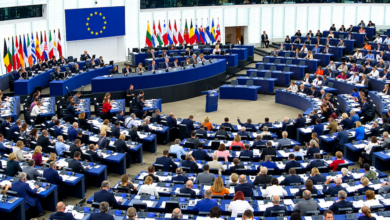
The session held in Strasbourg on 7 October 2026 and the vote scheduled for 8 October on a proposed resolution concerning the need for a European strategy to counter what is described as Islamist infiltration and the influence of the Muslim Brotherhood network come as calls to reassess relations with political Islamist networks grow across several European countries. The question facing lawmakers has become more specific: how can organisational or ideological influence regarded by institutions as a threat to democracy be confronted without turning that response into a policy targeting Muslims as a religious community?

Official European Parliament documents indicate that procedure 2026/2868(RSP) includes a plenary debate and vote on an EU strategy to counter “Islamist infiltration” and the influence of the Muslim Brotherhood network, with the vote scheduled for 8 October.
The issue is particularly significant because of the terminology used in the debate. “Islam” refers to a world religion, while “political Islam” describes political currents and projects drawing on Islamic principles in public life. The “Muslim Brotherhood”, by contrast, refers to a historical organisation with multiple branches and networks in different countries. Describing an entity as “terrorist” carries a specific legal meaning that cannot be inferred merely from ideological or religious affinity.
Distinguishing these concepts is therefore essential to any successful European strategy. In its published position on the vote, the European People’s Party group stressed the need to avoid conflating Islam as a religion with political Islam as an ideology, while calling for the protection of religious freedom and the integrity of democratic institutions.

Politically, supporters of tougher measures argue that democracy should be able to protect itself against actors that may use its mechanisms to gain influence and then undermine its principles. This position draws on the concept of “defensive democracy”, which allows democratic states to act against entities proven to engage in activities incompatible with the constitutional order or public security.
Applying this concept, however, requires strict safeguards. Defensive democracy does not mean punishing dissenting ideas or religious beliefs. It means responding to actions that violate the law or pose an established threat to the democratic system. This distinction is essential in Europe, where millions of Muslims live as citizens entitled to the same rights as everyone else.
Political figures and rights advocates have warned that a loosely defined concept of “Muslim Brotherhood networks” could place numerous civil society institutions under suspicion without direct evidence of affiliation. Analyses published in EUobserver criticised what they described as the risk of criminalising lawful Muslim civic activity or rights advocacy through overly broad definitions.
These objections expose the Parliament’s real challenge. The question is not whether Europe wants to combat extremism, which is a declared and shared objective, but where extremism begins, how organisational links can be established, and which criteria distinguish legitimate civic work from clandestine or extremist political activity.
Evidence is therefore central. Any new European policy should rely on verifiable information about funding sources, organisational structures, cross-border relationships, the nature of activities and compliance with national and European law. It should also provide mechanisms for appeal and judicial review, so that suspicion alone does not become grounds for punishment.
Funding takes on additional importance in this context. Some parliamentary forces are calling for European funds to be withheld from entities linked to political Islamist networks when their involvement in activities contrary to European rules is established. They also seek greater transparency regarding the ultimate recipients of funding.

This raises another question concerning non-governmental organisations. European civil society relies heavily on public funding to deliver projects involving youth, education, anti-discrimination work and social integration. If funding oversight becomes based on identity or religious affiliation, projects with no connection to extremism could suffer.
Conversely, oversight based on clear financial and organisational criteria can effectively protect public money. The challenge therefore concerns not the principle of oversight, but how it is implemented.
From a security perspective, supporters of the measures emphasise that contemporary organisations can use multiple tools to build influence without necessarily relying on traditional clandestine structures. These tools may include educational and cultural institutions, associations, media networks and digital platforms. This argument nevertheless requires a distinction between their ordinary use and their deployment in an unlawful organisational project.

An organisation working in education or culture is not necessarily political. Nor does religious discourse within a civil society institution automatically indicate extremist activity. Assessments should therefore be based on conduct and evidence, rather than impressions or generalisations.
The debate takes place within a broader European context. During 2026, several parliamentary questions addressed the possible inclusion of the Muslim Brotherhood on the European terrorism list. Some proponents of these initiatives cited French measures and national debates on political Islam.
The European Conservatives and Reformists group has also explicitly stated that it wants the Muslim Brotherhood and its network placed on the European list of terrorist organisations. It additionally calls for tighter oversight of associated institutions, their funding sources and their access to public funds and European institutions.

The opposing position, however, holds that terrorist designation should not automatically follow from a political decision or ideological assessment. The European terrorism list carries extensive legal consequences, so inclusion must rest on the relevant legal criteria and procedures.
Official Parliament documents indicate that the text being considered on 8 October is a resolution on a topical subject, not a final decision to place the Muslim Brotherhood on the terrorism list. This distinction matters when interpreting the vote: a parliamentary resolution can shift the political debate and encourage the Commission and member states to take further steps, but does not itself constitute a legal listing decision.
At the societal level, the effects of political rhetoric may be more important than the legal text itself. European Muslims may follow the debate with concern that accusations could be generalised to their community, while governments fear that ignoring certain extremist networks could strengthen their influence. The language used in official statements will therefore be decisive.

European institutions can reduce the risk of polarisation by repeatedly emphasising that Islam is not the target, that Muslim citizens are not responsible for the activities of any political organisation, and that measures apply only to actors whose responsibility for violations or activities threatening security and democracy has been established.
Trust can also be strengthened by involving moderate civil society organisations in the debate, including those working against extremism, violent extremism and discrimination simultaneously. Combating extremism requires more than oversight; it also needs social and intellectual alternatives that prevent polarisation.
At the European level, the greatest test will be whether member states can agree on common definitions. Without them, the same organisations may be treated very differently from one country to another. An institution could operate legally in one state while facing restrictions in another, further complicating the situation.
The European Parliament vote is expected to reveal a new political alignment on the issue. If the tougher approach wins a broad majority, pressure may grow for closer examination of funding, assessment of organisational relationships and potentially further legal action. If major divisions emerge, Parliament may move towards more cautious wording centred on transparency, funding and counterterrorism without adopting sweeping characterisations.
In either case, the European debate on the Muslim Brotherhood has moved beyond general statements. It has entered the realm of public policy, where security considerations intersect with law, funding and human rights. The success of any European policy will therefore be measured not by its severity, but by its ability to target genuine risks precisely and protect democratic institutions without sacrificing their founding principles.
Europe faces a delicate balance: protecting society from organisations that use democracy against democracy, while protecting democracy itself from becoming a system of surveillance targeting religious identity or legitimate civic activity. Between these two imperatives, the European Parliament, through its vote and subsequent debates, will help shape a significant part of European policy towards political Islam and cross-border networks in the years ahead.