Tunisia: Court Suspension of Free Destourian Party Congress Exposes Internal Divisions
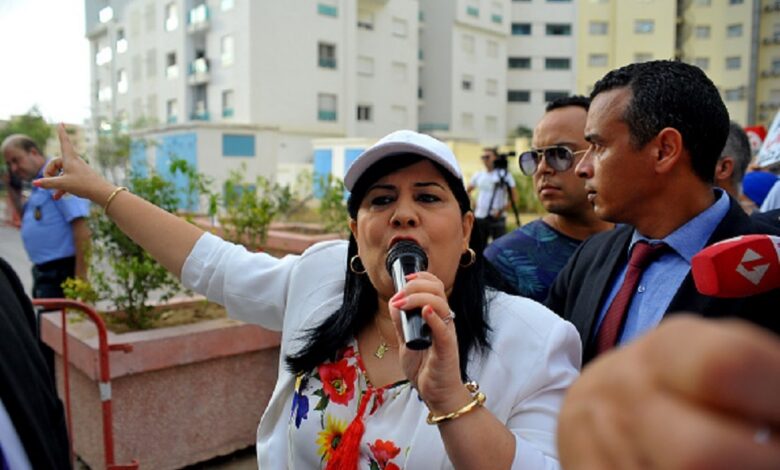
From a congress hall expected to shape a new leadership to Tunisian courts and social media, the Free Destourian Party has become embroiled in a battle of wills between its president, Abir Moussi, and a broad coalition of disgruntled leaders. The unprecedented confrontation has exposed tensions that threaten to tear the party apart.
-
Tunisian court upholds two-year prison sentence for politician Abir Moussi
-
Abir Moussi goes on hunger strike in a theatrical display to attract attention
The dispute began to surface when the Tunis Court of First Instance issued an urgent ruling suspending the proceedings of the “Loyalty” congress, scheduled for 3 and 4 October, following a lawsuit brought by several party leaders.
Issued just hours before the congress was due to begin, the ruling halted an electoral process intended to determine the party’s next leadership.
While the imprisoned party president, Abir Moussi, portrayed the decision as part of a campaign to remove her from the leadership, the opposing side described its lawsuit as a legal effort to protect the party’s statutes against procedures it considers improper.
-
Moussi goes on hunger strike to pressure presidential election issue
-
Moussi calls for Ennahdha to be labeled a terrorist after the charges against Bhiri
Moussi responded from prison with a lengthy letter published on her Facebook page, arguing that the suspension of the congress could not be separated from a broader struggle over her political position and the party’s future.
She maintains that her imprisonment does not create a vacancy in the party presidency. Her argument rests on her interpretation of the statutes, which, in her account, recognise a vacancy only in the event of resignation or death. She therefore considers that suspending the congress neither ends her presidency nor removes her powers.
-
Abir Moussi Sues Allies of Tunisia’s Muslim Brotherhood – Suspicion of Terrorism suspects besiege extremist networks
-
How do Tunisia’s Muslim brotherhood maintain its electoral balance? Abir Moussi answers
She also sharply criticised the judicial process, particularly the speed with which the case was heard and the circumstances surrounding its notification to her. She accused her opponents within the party of seeking to exclude her and linked their actions to what she regards as an attempt to change the Free Destourian Party’s political direction.
Her letter went beyond the organisational dispute, however, when she warned that she could face “physical elimination” in prison. She linked this warning to what she described as a plan to create a vacancy in the party leadership.
The leaders who challenged the congress process reject the idea that the crisis can be reduced to an attempt to oust Moussi. Party official and former MP Samira Chaouachi says the action was intended to protect the party and its statutes, denying that the aim was to remove its president.
In her response, she accused Moussi and her supporters of presenting a one-sided account of the dispute. She said her objections concerned several organisational matters, including appointments within party structures, congress procedures and membership documents.
She also rejected describing the court ruling as a “ban” on the congress, arguing that it merely suspended its proceedings and did not, in itself, settle the question of Moussi’s presidency.
Party official and former MP Wissam Chaari focused his response on documentation, calling for the publication of all correspondence exchanged within the party, including replies to Moussi’s assessments and records of formal notices. This, he argued, would allow the public to examine every side’s account rather than rely on a single narrative.
-
Abir Moussi: We are waiting for a presidential decree to hold the Tunisian Brotherhood accountable
-
Abir Moussi: The Brotherhood leads Tunisia to the abyss and bankruptcy
Another party official and former MP, Majdi Boudhina, called for a direct debate over the causes of the dispute. He argued that a public exchange would allow party members and the wider public to understand the positions of the parties involved.
The three leaders’ responses converged on one central point: rejecting Moussi’s account that the developments amount merely to a conspiracy to remove her. They nevertheless differed in their interpretations of the crisis’s causes and each side’s responsibility.
Moussi’s arrest in October 2023, followed by prison sentences totalling twelve years, had destabilised the Free Destourian Party, one of the main components of Tunisia’s opposition. The divisions subsequently spilled into public view, shifting the internal dispute from party politics to judicial rulings.
-
Moussi accuses Qatar of funding suspicious associations in Tunisia
-
The Tunisian Brotherhood and the Gabès Protests: Chaos to Undermine Public Anger
-
Kais Saied Hints at His Candidacy for a Second Presidential Term