The Zebra in the Ukraine War: A Russian Weapon Designed to Deceive Drones
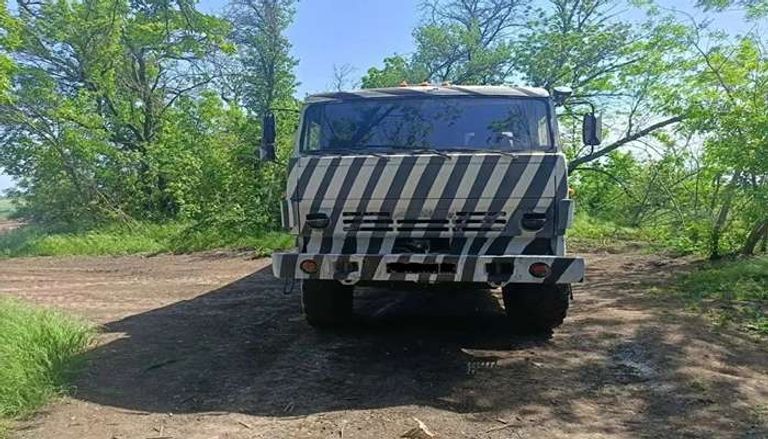
In a notable development highlighting the growing threat posed by autonomous drones to rear-area military operations, Russian forces have begun painting their heavy trucks with deceptive visual camouflage patterns specifically designed to mislead artificial intelligence-based machine vision systems.
This move follows a series of unconventional measures adopted by both sides of the conflict to improve the survivability of military equipment. However, it is particularly significant because it targets the cognitive layer of intelligent systems rather than merely providing physical protection, according to the specialized outlet “The War Zone”.
-
Broadcasting the Apocalypse Signal: Mysterious Messages Hint at a Russian Superweapon
-
Weapon Tests Precede Russian Official’s Visit… Kim’s Messages to Allies and Enemies
Recently circulated images reveal two prominent visual schemes applied to heavy-duty “Ural” and “Kamaz” trucks. The first consists of broad black-and-white stripes resembling a zebra pattern, while the second features an organic spiral design resembling leaves, covering the entire exterior surface, including wheels and tires.
The contrast between these designs immediately recalls the disruptive camouflage developed by British artist Norman Wilkinson in 1917 to protect warships from German submarines. Those geometric patterns relied on highly contrasting color blocks, often dominated by black and white, to distort a ship’s shape and make it more difficult to estimate its distance, direction, and dimensions.
-
With Weapons and Soldiers, the Russian Bear Strengthens Its Influence in the African Sahel
-
Diplomatic Summons and Warnings… Europe Responds to Russian Escalation in Ukraine
The key difference today is that the intended target is no longer a human observer but an “artificial eye” composed of electro-optical and thermal cameras carried by Ukrainian drones, which increasingly rely on machine-learning algorithms to detect, classify, and prioritize targets for engagement.
The defensive concept exploits a fundamental weakness of machine vision systems: their dependence on pre-existing visual datasets containing familiar vehicle patterns.
When the truck’s appearance is sufficiently distorted, the algorithm may fail to match it with stored reference images. At a minimum, the confidence score assigned to the identification may fall below the threshold required to trigger an attack.
-
Ukraine Misleads Russian Missiles with Lima… A €58,000 Defense System
-
How the Caspian Sea became a lifeline of weapons and food for Iran behind Washington’s back
This occurs because the intelligent model recognizes visual features rather than understanding the object’s actual nature, causing it to confuse what it sees with shapes that differ from the standard profiles of military vehicles.
Technology experts, including Schuyler Moore, have pointed to a similar example in which Russia covered some of its bombers and attack aircraft with rubber tires. This tactic reportedly confused the visual-matching systems used by cruise missiles and loitering munitions, preventing them from confidently identifying the aircraft as genuine targets.
However, the effectiveness of such deceptive visual camouflage remains dependent on complex battlefield conditions and technological factors. Highly visible patterns in the visual spectrum may actually make vehicles easier for human observers or long-range sensors to detect. As a result, their usefulness may be limited to relatively secure areas where Ukrainian human surveillance is absent.
-
Buk-M3 and HIMARS: Russians intensify the missile race in Ukraine
-
What if Europe attacked Russian merchant ships?
Furthermore, thermal sensors operating across different wavelengths may not be affected by surface color contrasts to the same extent, leaving exploitable vulnerabilities.
More importantly, deep-learning algorithms can quickly be retrained to recognize these new patterns once sufficient examples have been collected. In fact, the camouflage itself could eventually become an automatic indicator of hostile identification because of its rarity and uniqueness within the battlefield environment.
Despite these limitations, the tactic represents a logical step in the ongoing race to develop countermeasures against intelligent drones—a race that has already produced protective cages, netting systems, and improvised wooden armor.
-
Orechnik: a Russian deterrence message to Europe at 8,000 miles per hour
-
A year after it sank… a report reveals the nuclear secret of a Russian ship
The ability of AI-enhanced attack drones to loiter over vast areas behind front lines, distinguish operational vehicles from destroyed ones, and conduct dynamic strikes without continuous communication with a human operator makes visual deception an increasingly necessary response to the nature of the threat.
These camouflage-painted trucks therefore provide further evidence that artificial intelligence is no longer merely an offensive tool. It has become a central driver of defensive innovation and of efforts to exploit weaknesses within automated perception systems themselves.
-
Russians seize the Pokrovsk lines: operational openings and potential objectives
-
Alliances beneath the depths: A joint British-Norwegian fleet to counter Russian submarines