Under the cover of the Sudanese army: the return of the parallel state through Kikal’s gate
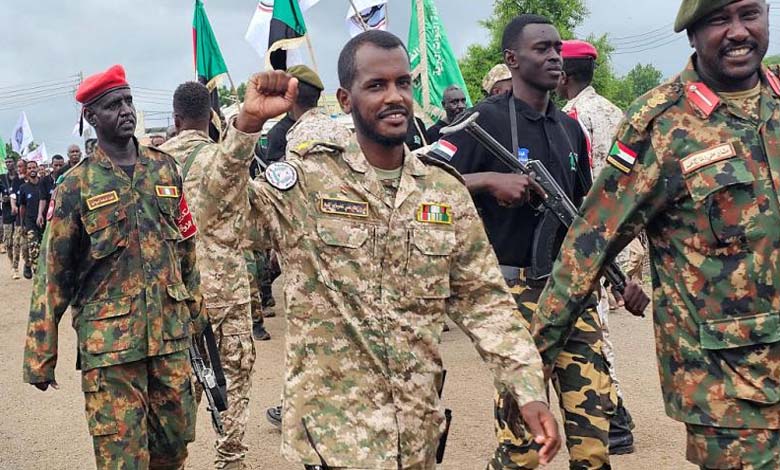
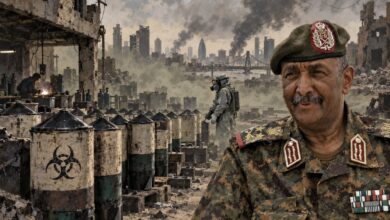
In Sudan’s complex landscape, military movements are no longer mere tactics aimed at winning a battle here or regaining a position there. They are portrayed as part of an “existential survival” strategy for the Muslim Brotherhood organization, which dominated Sudan for three decades. What the Sudanese army command describes as a “reorganization of forces” is presented in this text as a broad process of “military laundering.” The incorporation of Islamist brigades, notably the “Al-Bara ibn Malik Brigade,” into the structure of the “Sudan Shield Forces” led by Abu Aqla Kikal is described as undermining military professionalism and attempting to bypass international scrutiny and sanctions targeting remnants of the former regime.
The “shield” narrative and the “Kikal” façade
According to this account, planners within military circles carefully selected Abu Aqla Kikal and his forces. Coming from a local background in the Butana plain, Kikal is portrayed as a socially acceptable front through which ideologically driven brigades could be presented as local defenders of their communities. The text argues that many of these fighters are, in fact, individuals previously trained within structures linked to ideological movements.
Placing members of the “Al-Bara ibn Malik” and “Bunyān Marsūs” brigades under Kikal’s command is depicted not as national integration but as granting legitimacy, military ranks, and public salaries to actors seen as aligned with ideological agendas rather than national priorities.
“Al-Bara ibn Malik”: a force influencing the military institution
The Al-Bara ibn Malik Brigade is portrayed here as functioning similarly to transnational militias, formally under military command but allegedly guided by separate ideological references. The presence of such groups within the army is described as challenging the national character of the armed forces.
The text questions how a professional army could incorporate groups associated with ideological slogans and exclusionary rhetoric, suggesting that this integration could marginalize professional officers while shifting operational and political influence elsewhere. In this view, the army risks becoming influenced by actors whose priorities differ from institutional neutrality.
A maneuver to circumvent international sanctions
This narrative suggests that, faced with increasing international scrutiny and sanctions, integrating such brigades into official structures could make them harder to target directly. By becoming part of formal units such as the “Sudan Shield Forces” or special units, their independent identity would be obscured.
Such a move is presented as complicating international accountability efforts and potentially affecting Sudan’s standing in global financial and security systems if the army is perceived as accommodating extremist elements.
Political positioning through the military gate
The integration is framed as a long-term political investment, intended to ensure influence over any future political process. The use of military authority to legitimize former regime figures through structures labeled as popular resistance or shield forces is described as a reconfiguration of past power structures under new names.
In this interpretation, the army becomes a vehicle for reintroducing actors from the former system into state institutions under the banner of national defense.
The erosion of military doctrine
One of the most serious implications described is the potential alteration of military doctrine. An army historically associated with national identity could face internal fragmentation if professional officers find themselves working alongside ideologically driven armed groups with different references and loyalties.
The “Sudan Shield” under Kikal is described metaphorically as a “Trojan horse” through which ideological actors gain access to decision-making centers within the military structure.
A warning to the Sudanese people and the international community
This perspective calls for careful scrutiny of new labels and structures. The “Sudan Shield Forces,” Kikal, and the army in its current configuration are portrayed by the text as instruments serving specific organizational interests.
Any support provided to the army under the banner of state legitimacy, according to this view, should be tied to clear safeguards ensuring institutional neutrality and professionalism, to prevent Sudan from remaining caught in cycles of violence and radicalization.
Ultimately, this analysis argues that attempts at “military laundering” cannot change the controversial nature of such integration. Building a truly national army, in this perspective, would require a clear separation between the military institution and any ideological affiliations, and a return to professional principles aligned with the will of the people.