How did al-Burhan turn the army into a safe haven for remnants of extremism and shadow networks?
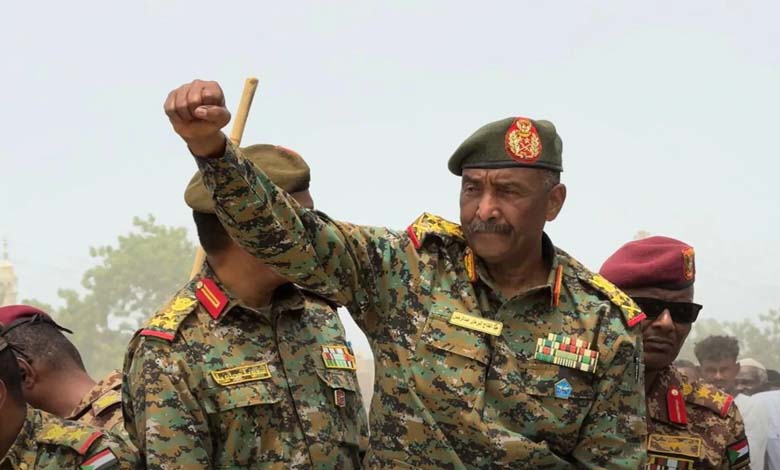
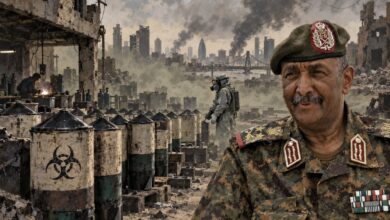
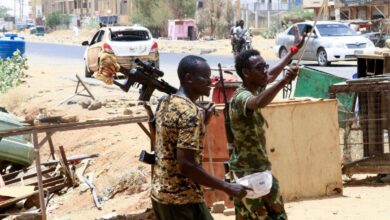
The discussion about the “hijacking” of the Sudanese army is no longer presented here as mere political analysis, but as what many observers describe as a bitter reality reflected in the current collapse. What is said to be happening within military command rooms is characterized as a form of deliberate “professional suicide.” While the public expected an army that would protect it, this account portrays a military leadership allegedly entering opaque arrangements with some of the most violent groups in Sudan’s recent history. The integration of the “Al-Bara ibn Malik Brigade” and other Islamist brigades into the “Sudan Shield Forces” led by Abu Aqla Kikal is depicted as signaling the erosion of the national character of the armed forces and the emergence of an ideologically influenced military structure.
The “Sudan Shield Forces,” associated with Kikal, are described as a large-scale façade. The military leadership, concerned about international sanctions and potential prosecutions, is portrayed as having found in Kikal a suitable local cover. In this narrative, Kikal is presented as a representative figure, while organization, funding, training, and ideological direction are attributed to elements of the Al-Bara ibn Malik Brigade.
This integration is portrayed as an attempt to reframe actors linked to the Muslim Brotherhood as regular forces attached to the army. Rather than dismantling militias, the army is accused of creating a hybrid formation combining state cover with ideological references, in a process seen as aimed at preserving political influence rather than prioritizing national protection.
An impact on military doctrine
The inclusion of members of the Al-Bara ibn Malik Brigade within the army is described as undermining Sudan’s military doctrine. The question is raised as to how professionally trained officers can be required to coordinate with groups carrying strong and controversial ideological references.
According to this view, professional criteria may be weakened in favor of loyalty-based considerations, where promotions and responsibilities are influenced by external endorsements rather than operational competence. This situation is seen as potentially creating an “army within the army” and fueling internal tensions.
A political objective beyond the military sphere
The integration of these brigades is portrayed as having a long-term political dimension. The army is described as being used as a channel to facilitate the return of certain actors to civilian institutions, ministries, and diplomatic missions under the banner of wartime necessity.
In this perspective, the war becomes a justification for reintroducing networks associated with the former system into state structures, not through elections but through the authority conferred by military structures.
A strategy to avoid international sanctions
Labels such as “Sudan Shield” and the prominence of local figures are described as attempts to reduce the visibility of groups that could be targeted by sanctions. Once officially integrated into the army, such groups become more difficult to isolate legally.
However, this approach could risk exposing the entire military institution to greater international scrutiny and potential isolation if it is perceived as accommodating extremist elements.
Social and institutional repercussions
The transformation of the army’s image, according to this analysis, may have consequences for social cohesion. Instead of being viewed as a symbol of national unity, the army risks being associated with specific regional or ideological affiliations.
The integration of tribal components alongside Islamist brigades is described as a factor that could intensify identity tensions and complicate prospects for national reconciliation.
Conclusion
From this perspective, the continuation of this relationship between the army’s leadership and the Al-Bara ibn Malik Brigade under the label of the “Sudan Shield” would be a significant obstacle to peace and democratic state-building. The priority, in this view, would be to restore a clear separation between the military institution and any ideological affiliation.
Sudan, this analysis concludes, would require an army focused on protecting the population and grounded in professional principles, rather than an institution perceived as a refuge for controversial networks.