Pezeshkian: Rational diplomacy to end the war
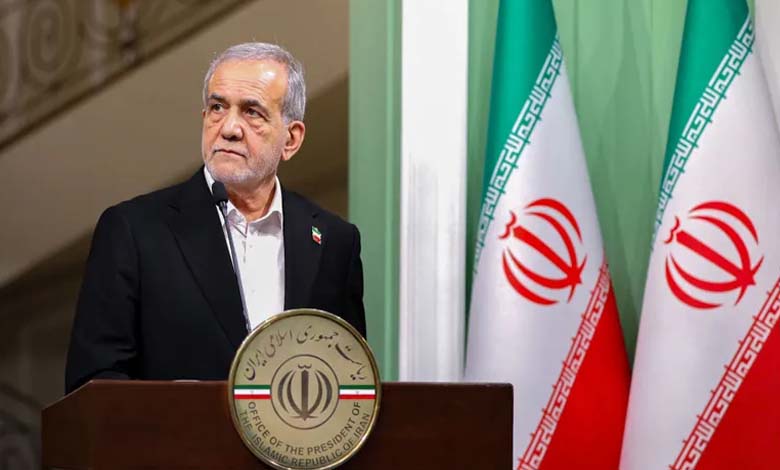
The Iranian president stated, in a call with Shehbaz Sharif, that the U.S. naval blockade in the Strait of Hormuz constitutes a violation of the ceasefire.
Iranian President Masoud Pezeshkian and Pakistani Prime Minister Shehbaz Sharif discussed the file of negotiations between Tehran and Washington in Islamabad as well as the ceasefire, amid an unprecedented escalation. The Iranian president warned of a resumption of the U.S. war against his country, particularly after the U.S. military seized an Iranian vessel as part of the naval blockade imposed by Washington on Tehran.
This phone call took place on Sunday evening, according to Iranian media.
During the call, Pezeshkian thanked the Pakistani prime minister for his efforts toward peace, stating that the U.S. naval blockade in the Strait of Hormuz constitutes a violation of the ceasefire.
He added that “the United States is betraying diplomacy,” warning that any potential new attack on his country would have regional and global repercussions.
Media outlets quoted him on Monday as saying that all rational and diplomatic avenues must be pursued to reduce tensions with the United States, while emphasizing that vigilance and distrust in dealing with Washington are “an unquestionable necessity.”
For his part, Sharif provided information about his country’s efforts to end the conflict and establish peace in the region, noting that Pakistan plays a crucial role in ending the war and sparing the region consequences described as catastrophic.
Meanwhile, Iranian Foreign Ministry spokesperson Esmaeil Baghaei said there are currently no plans for a second round of negotiations with the American side.
At a press conference, he stated that the United States has shown it is “not serious” about advancing the diplomatic process, has committed hostile acts, and has violated the ceasefire provisions. He stressed that transferring the nuclear stockpile was never an option considered in the negotiations and that Tehran’s firm position is to preserve its nuclear achievements within its territory.
A senior Iranian source said on Monday that disagreements over the nuclear program persist as Iran and the United States attempt to reach a lasting solution to the crisis, with the ceasefire between the two sides nearing its expiration.
The source added that Iran’s “defensive capabilities,” including its missile program, are not subject to negotiation with the United States, adding that “the continuation of the U.S. blockade in the Strait of Hormuz undermines peace talks.”
On February 28, Israel and the United States launched a war against Iran, resulting in thousands of deaths, while Tehran responded with missile and drone strikes toward Israel and U.S. bases and interests in the region.
On April 8, a two-week ceasefire began following negotiations between Washington and Tehran hosted by Islamabad, without reaching a final agreement to end the war.
On Sunday, U.S. President Donald Trump announced in a post on his platform Truth Social that a delegation of U.S. negotiators would travel to Pakistan to resume talks with Iran.
Hours earlier, Pakistani government officials told Anadolu Agency that two aircraft had landed in Islamabad carrying a “preliminary delegation” from Washington to participate in the second round of negotiations between the United States and Iran scheduled for Monday.
Geo News reported that Pakistani police had announced heightened security measures in Islamabad ahead of the anticipated second round of negotiations between the United States and Iran.
Recently, Trump stated that he might visit Islamabad to sign the agreement if it is reached, saying, “Pakistan is a great country. If the agreement is signed in Islamabad, I might go.”