After Trump’s Remarks, Could Syria Militarily Intervene Against Lebanon’s Hezbollah?
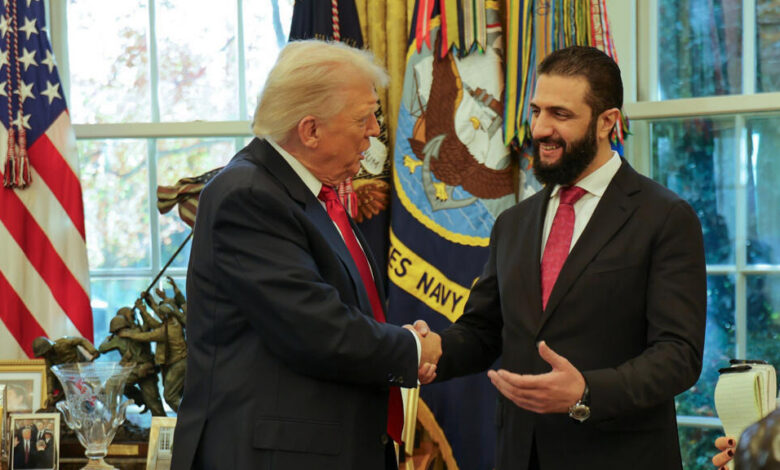
American remarks suggesting a possible Syrian intervention against Hezbollah have sparked widespread debate at a time when Israel is expanding its control over parts of southern Lebanon and regional political and security tensions have intensified since the outbreak of the Iran conflict.
Experts believe that statements made by U.S. President Donald Trump during the G7 Summit reflect Washington’s desire to move Israel away from the Lebanese front, at least temporarily, and reduce tensions while exploring the possibility of an agreement with Iran. However, they argue that any Syrian intervention would likely complicate the regional landscape rather than provide meaningful solutions.
-
A Day After Ending His Assignment, Trump Reappoints Barrack as Special Envoy to Syria and Iraq
-
Iran in the grip of the Revolutionary Guards… and the Supreme Leader out of the picture
The experts agreed that Syria, which is currently focused on rebuilding its institutions and consolidating domestic stability, is likely to avoid direct involvement. Any engagement in the crisis could have serious consequences for Syrian-Lebanese relations, increase tensions along the Syrian-Iraqi border, and potentially destabilize Syria internally through economic pressures or reactions from groups aligned with Iran.
This debate comes as southern Lebanon continues to witness intense hostilities. Israel has maintained strikes against Hezbollah and its infrastructure across several areas, causing casualties. Meanwhile, Tel Aviv announced the deaths of four Israeli soldiers, fueling additional calls for escalation within Israel. Prime Minister Benjamin Netanyahu vowed that Hezbollah would pay a “very heavy price,” while Defense Minister Israel Katz stated that Israeli forces would remain in southern Lebanon and respond “with great force” to any attack.
-
Russia gains economic and geopolitical advantages from the war against Iran
-
The United States leaves Syria… and fears of the nightmare returning
Significant Strategic Risks
According to U.S. strategic affairs expert Irina Tsukerman, Trump may view transferring responsibility for confronting Hezbollah to Syria as a tactical shortcut. However, she argues that such an approach carries “major strategic risks” because it assumes that Lebanon, Syria, Hezbollah, and Israel are actors whose roles can easily be reassigned, while overlooking fragile political and security structures, sectarian sensitivities, and the complexities of regional influence.
The idea of “letting Syria handle Hezbollah” may initially appear practical, but it could transform Hezbollah’s status from a Lebanese-Israeli security issue into a broader Lebanese-Syrian sovereignty dispute with far-reaching regional consequences.
-
From Russia and Ukraine to Reagan and Gorbachev: the story of a hotel that has brought adversaries together through history
-
Britain, the United States, Germany and France urge compliance with the truce in Syria
Regionally, the proposal could shift some of the pressure currently facing Israel onto Syria, placing Damascus in direct confrontation with Hezbollah. While such a move might be welcomed in Washington, it could also provoke Iranian responses through Iraq, Lebanon, eastern Syria, or unconventional attacks targeting Syrian state institutions.
Tsukerman further argues that an ill-considered Syrian intervention could provide Hezbollah with an opportunity to regain legitimacy if efforts to disarm it are portrayed as externally imposed or driven by Israeli interests. In her view, addressing Hezbollah’s influence requires strengthening Lebanese state institutions, securing borders, applying financial pressure, linking reconstruction assistance to reforms, and promoting regional and international coordination.
-
After the SDF withdrawal, Syrian security forces deploy in Al-Hol camp
-
Lebanon monitors reports of movements by remnants of the al-Assad regime near the Syrian border
She also believes that Lebanon would likely view such a proposal with considerable suspicion, including among factions opposed to Hezbollah. Even limited Syrian operations could generate new tensions through border incidents, accusations of interference, sectarian rhetoric, refugee-related disputes, and sovereignty concerns.
For these reasons, she considers a Lebanese-led approach, supported by international partners and regional coordination, to be the most realistic path forward. Syria could contribute by controlling its borders and preventing its territory from being used as Hezbollah’s strategic rear base, but assigning it a leading operational role inside Lebanon would remain highly risky.
-
A challenge in African waters: China, Russia and Iran launch naval drills
-
Syrians and Palestinians barred from entering the United States alongside nationals of six other countries
Further Complications
Lebanese political analyst Tarek Abu Zeinab argues that discussions about granting Syria a larger role in confronting Hezbollah cannot be separated from broader regional efforts to reshape power balances in the Levant and reduce Iranian influence.
According to him, if the proposal is genuine rather than merely a political signal, it reflects an attempt to redefine regional rules of engagement by targeting Hezbollah’s logistical and military networks in both Lebanon and Syria.
However, he notes that any direct Syrian role faces numerous political and military realities. Syria remains focused on rebuilding institutions, restoring stability, and restructuring its security apparatus after years of conflict. In addition, the continued presence of competing regional actors inside Syria makes any such involvement highly sensitive.
He also points out that Syrian President Ahmed al-Sharaa has clearly stated that Syria does not wish to interfere in Lebanon’s internal affairs, reflecting an official policy of respecting Lebanese sovereignty and independence.
-
Israel and Syria Negotiations: Deadlock and Conflicting Conditions
-
Damascus and Talks with the SDF: No Dialogue Under the Threat of Arms
Messages to Israel
Syrian political analyst Abdullah Al-Hamad believes that Trump’s remarks reflect Washington’s desire to identify an alternative force capable of stabilizing Lebanon and reducing regional tensions.
According to Al-Hamad, the proposal—coming after recent U.S.-Iran understandings—also serves as a message to Benjamin Netanyahu, encouraging Israel to reduce military operations in Lebanon.
He further argues that the proposal reflects a changing U.S. perception of post-Assad Syria and recognition of the current government’s ability to contain Iranian influence. Syria’s geopolitical position between Iranian-backed militias in Iraq and Hezbollah in Lebanon gives it particular strategic importance.
-
Step Toward Sanctions Relief: UN Report Denies Links Between Hayat Tahrir al-Sham and Al-Qaeda
-
UN Report Denies Any Link Between Damascus and Al-Qaeda
Challenges Ahead
Regarding Syria’s ability to undertake such a mission, Al-Hamad believes Damascus possesses military experience and capabilities that could theoretically enable it to confront Hezbollah forces.
Nevertheless, he stresses that major obstacles remain. President Ahmed al-Sharaa has previously indicated that he does not wish to enter a political and security “minefield.” Direct Syrian involvement could also damage relations with Lebanon and create additional tensions along the Syrian-Iraqi border.
Furthermore, such involvement could destabilize Syria internally through economic pressure or reactions from groups perceived as close to Iran, including some Shiite and Alawite communities. Consequently, Syrian authorities continue to distance themselves from the issue.
-
Will Trump and Al-Sharaa Meet in Saudi Arabia? British Newspaper Reveals the Details
-
The U.S. Administration and Syria: Caution and Skepticism Towards the New Regime Led by Ahmad Al-Sharaa
Trump’s Proposal
Speaking to reporters on the sidelines of the G7 Summit, Trump stated:
“I’m not happy with the way Israel handled Lebanon and Hezbollah. They should have been able to finish the job much faster.”
He explained that he had suggested Israel allow Syria to deal with Hezbollah.
Trump added:
“The person running Syria, President Ahmed al-Sharaa, is someone I supported along with Turkish President Recep Tayyip Erdoğan and others. We helped him reach power, and he has done an exceptional job reorganizing the country.”
-
Syria Accuses Hezbollah of Carrying Out Attacks and Sponsoring Cross-Border Smuggling
-
Washington Navigates the Syrian “Minefield”
He continued:
“I suggested that Israel let Syria take care of Hezbollah because, frankly, I think they would do a better job.”
He further stated:
“If Israel cannot complete the mission against Hezbollah without killing everyone, then Ahmed al-Sharaa will handle it. Syria will do the job.”
First Lebanese Response
Lebanese Justice Minister Adel Nassar rejected the American proposal that Syria should be entrusted with “dealing with Hezbollah” in Lebanon.
During an interview with journalist Becky Anderson on CNN, he stressed that disarming the Iran-backed group is the responsibility of the Lebanese state, not foreign forces.
He stated:
“This is not about sending foreign forces to do the job. Lebanon has suffered from external interference for years. If Hezbollah today acts as an Iranian proxy, it is because of Iran’s interference in Lebanon’s internal affairs.”
-
Russia Accuses the U.S. and the U.K. of Recruiting Agents to Target Its Bases in Syria
-
“Lost its shine, its stronghold, and its passage”: Hezbollah in 2024, “From Connection to Separation”
-
“Including Syria and Lebanon”: How the Israeli Army Prepares for “Operation Winter”