Trump wades into FIFA’s civil war: Removing Infantino would be a grave mistake
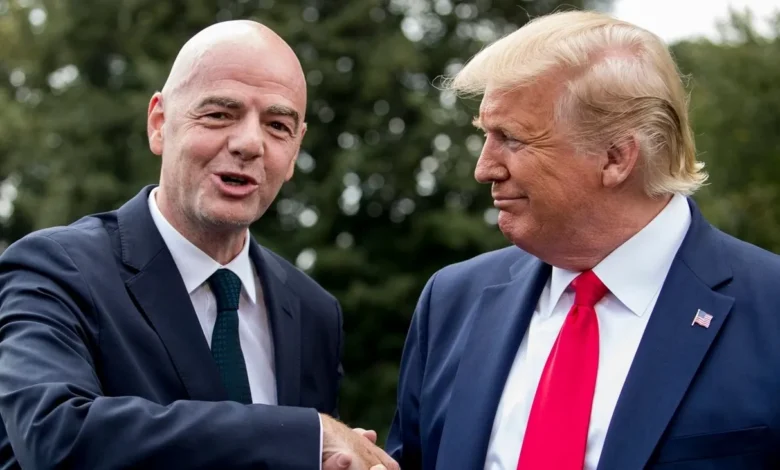
The U.S. president has warned against removing FIFA President Gianni Infantino amid a severe governance crisis and an unprecedented escalation in which major continental confederations are calling for an end to his tenure over a controversial commercial project.
U.S. President Donald Trump on Tuesday warned FIFA against replacing its president, Gianni Infantino, saying that removing him would be a “grave mistake” in a new American intervention in the escalating crisis within world football’s highest governing body.
In a post on his Truth Social platform, Trump said that “FIFA would be making a very grave mistake if, for any reason, it were to consider replacing President Gianni Infantino,” adding that the head of world football’s governing body was “great” and that he had delivered “the most successful World Cup ever.” Trump warned that the tournament “would not be as successful or profitable as it was before” if Infantino were to leave office.
Trump’s remarks come as Infantino faces the strongest political and institutional pressure since he became FIFA president in 2016.
Trump’s description of the World Cup’s success as being “four times” greater was not entirely new. During the tournament in July, the U.S. president had already said that Infantino had “produced the most successful World Cup in history, by four times,” referring to the viewing figures and commercial success he said the tournament had achieved.
Trump’s intervention came just one day after an unprecedented escalation by three of the world’s largest continental confederations: the Union of European Football Associations (UEFA), the Asian Football Confederation (AFC), and the Confederation of North, Central America and Caribbean Association Football (CONCACAF). The three bodies sent a joint letter to the global football community accusing Infantino of breaching trust “through deception,” arguing that his attempt to sell a stake in the commercial rights to the World Cup to private-sector investors was not merely a procedural error or a communication failure, but a “fundamental breach of trust.”
The three confederations said that football “does not belong to any individual or institution,” but rather to players, fans, clubs, national associations, and the institutions responsible for safeguarding the future of the sport. The statement amounted to a direct criticism of Infantino’s handling of the matter. They called for an independent review of the facts and decisions surrounding the “FIFA Forward Enterprise” (FFE) project rather than relying solely on an internal investigation conducted by the organization itself.
The crisis dates back to late July, when a plan was revealed to establish a FIFA-affiliated commercial company with an estimated valuation of around $20 billion. The company would manage the commercial rights to the World Cup and other competitions, while offering up to a 20% stake to outside investors in exchange for approximately $4.2 billion. FIFA had said that investors would receive non-controlling minority stakes and that the proceeds would be used to fund football development around the world.
The plan, however, triggered widespread opposition, particularly in Europe, after it emerged that one of the potential investors was a company linked to Joshua Kushner, the brother of Jared Kushner, Trump’s son-in-law. FIFA confirmed that Thrive Capital, founded by Joshua Kushner, was among the potential investors in the project, while U.S. bank JPMorgan was involved in the process.
Kushner’s ties to the U.S. president’s family fueled further criticism over the already close relationship between Trump and Infantino. The two men appeared together repeatedly during the World Cup, while Trump had previously praised the FIFA president publicly and spoken to him directly about refereeing decisions during the tournament. FIFA also awarded Trump a peace prize, further intensifying criticism that Infantino was blurring the lines between football and politics.
As opposition mounted, FIFA backed away from the project and froze it, but the crisis did not end. Reuters reported that Infantino’s apology and the withdrawal of the proposal failed to address the substance of the dispute for the opposing confederations, which believe the issue concerns decision-making procedures and the lack of consultation rather than the financial project alone.
The dispute entered a new phase in early August, when public calls emerged for Infantino to resign and refrain from seeking another term. Norway was among the most prominent national associations to take an explicit position, announcing that it would ask the FIFA president to step down. Other associations also withdrew their support for his candidacy, while the English Football Association adopted a more critical stance.
The crisis also exposed divisions within the United States itself. U.S. Soccer joined calls for reforms to FIFA’s governance despite Trump’s public support for Infantino. Canada followed suit, while other associations within CONCACAF adopted more forceful or cautious positions.
In a move that further heightened the seriousness of the crisis, UEFA, AFC and CONCACAF leaders began discussions about the possibility of organizing alternative competitions if the confrontation escalated into a boycott of FIFA tournaments. These ideas remain at an early stage, but they reflect the scale of the tensions: the dispute is no longer confined to a withdrawn investment proposal, but has evolved into a struggle over the future governance of international football.
FIFA held an emergency meeting in Morocco over the weekend, during which it defended Infantino against what it described as “concerted and sustained efforts” to undermine the organization and its president. The three confederations subsequently argued that the meeting itself exposed governance problems, pointing to the absence of elected FIFA Council members and national associations from the gathering.
The meeting, which was intended to ease the crisis, therefore became another source of dispute. Opposing confederations argued that Infantino had failed to provide adequate answers regarding how the “FIFA Forward Enterprise” project had been put forward and who had authorized him to discuss selling a stake in the commercial rights to the world’s biggest sporting competition.
The three confederations also threatened to boycott FIFA competitions unless they received guarantees that similar projects would not be repeated. Despite the crisis, Infantino still appears to have enough support to contest the next FIFA presidential election, scheduled for March 2027.
The confrontation is particularly significant because FIFA comprises 211 national associations. The alliance between UEFA, CONCACAF and AFC theoretically represents a substantial voting bloc, but there is no guarantee that all associations belonging to these continental confederations would vote as a unified group. This helps explain why Infantino remains in a relatively strong position despite the unprecedented challenge against him.
Infantino’s critics argue that the FIFA Forward Enterprise crisis is merely the latest episode in a broader pattern of concentrating political and commercial power and decision-making within the president’s office. His supporters, by contrast, argue that his tenure has been marked by a major expansion of FIFA competitions, increased revenues, an increase from 32 to 48 teams in the World Cup, and greater funding for national associations with lower incomes.
The 2026 World Cup, hosted by the United States, Canada and Mexico, represented Infantino’s most significant marketing and development achievement to date. The tournament concluded on July 19 with Spain defeating Argentina 1-0 after extra time in the final at the New York/New Jersey stadium, securing Spain’s second world title. FIFA said the tournament was the largest in its history in terms of participating teams and matches, with 48 teams taking part and 104 matches played. (FIFA)
This is precisely the point Trump relies on in defending Infantino. The U.S. president believes the tournament’s success in the United States demonstrates the FIFA president’s ability to run the organization and generate record revenues. His opponents, however, argue that the commercial success of the World Cup does not give the federation’s president an open-ended mandate to make strategic decisions without the approval of member associations.
The U.S. position therefore adds a political dimension to a battle that is ostensibly supposed to be about sport and governance. Trump has no direct authority to remove the FIFA president, just as the head of world football’s governing body is not subordinate to the U.S. government. Nevertheless, his public backing of Infantino carries considerable political weight, particularly because the United States hosted the latest World Cup and because a key part of the dispute involves American investors as well as the growing personal and political relationship between Trump and Infantino.
The latest developments suggest that the next battle will not necessarily focus on removing Infantino immediately, but rather on pressuring him to resign or persuading him not to stand in the March 2027 election.
The British newspaper The Guardian has suggested that the joint message from the three confederations could also be interpreted as an attempt to give Infantino a face-saving exit by stepping down voluntarily rather than prolonging what the newspaper described as a “civil war” within world football.