Continental coalition considers no-confidence motion against FIFA president
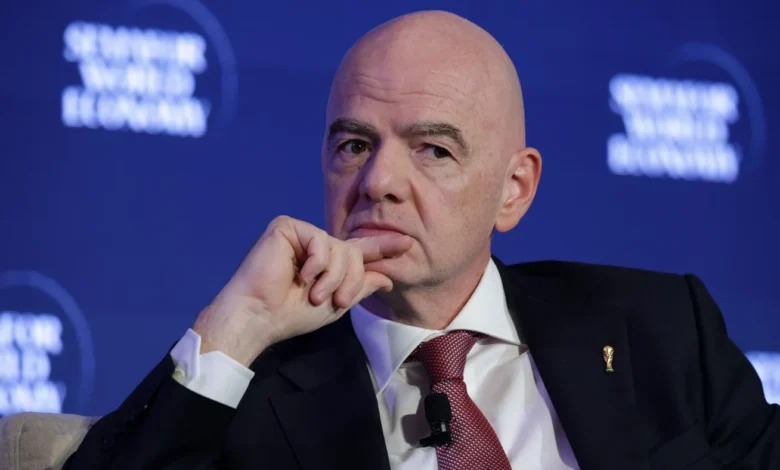
FIFA could face one of the most serious governance crises in its history if the threats develop into a formal initiative, although Gianni Infantino retains considerable electoral strength and the backing of a number of football associations.
Disputes within the Fédération Internationale de Football Association, FIFA, have entered a particularly sensitive phase as several of the world football body’s leading continental confederations consider the possibility of calling a vote of no confidence in its president, Gianni Infantino. Such a move could pave the way for his removal from office before the presidential election scheduled for March 2027.
-
Pressure Mounts on Infantino in Battle to Remain at FIFA’s Helm
-
FIFA insists on the privatization of the World Cup amid a deepening crisis
According to sources familiar with the matter who spoke to Reuters, the Union of European Football Associations, UEFA, the Asian Football Confederation, and the Confederation of North, Central America and Caribbean Association Football, CONCACAF, are considering whether to support an initiative aimed at ending Infantino’s tenure. The move comes amid escalating disagreements over an investment proposal put forward by FIFA to bring private-sector investors into a new commercial entity that would manage the commercial rights associated with the World Cup.
Such a procedure would be unprecedented in FIFA’s 122-year history, as its Congress has never voted to remove confidence from a president while that president was still in office. This highlights both the sensitivity of the potential initiative and the difficulties involved in carrying it out.
-
Trump wades into FIFA’s civil war: Removing Infantino would be a grave mistake
-
After FIFA settled the issue of Iran’s participation in the World Cup… Trump comments
One source said Infantino could face two alternatives: “leaving peacefully” by deciding not to seek another term, or facing “the hard way”, referring to the possibility of a no-confidence vote.
Under FIFA’s statutes, the FIFA Council can convene an extraordinary Congress. It is also required to do so if at least five of its 211 member associations submit a written request specifying the items they want placed on the agenda. The extraordinary Congress must then be held within three months, with each member association present entitled to one vote. However, the statutes contain no specific provision governing a no-confidence vote against the FIFA president, meaning that any attempt to initiate such a procedure could establish an unprecedented organizational and legal precedent.
FIFA has remained silent on the matter. UEFA has not directly denied that the possibility of a no-confidence vote is being discussed, instead reiterating its previous call for a “comprehensive and radical review” of FIFA’s leadership and governance system, while stressing that “no option should be ruled out”. CONCACAF referred to an earlier joint statement with UEFA and the Asian Football Confederation, in which the three bodies accused FIFA’s leadership of committing a “fundamental breach of trust”.
-
FIFA faces World Cup boycott crises, Doha violations
-
The mascot of the upcoming FIFA World Cup unveiled in Qatar
The crisis intensified following the collapse of a proposed sale of a minority stake in the new commercial entity. The three continental confederations criticized the way the project had been handled, particularly with regard to transparency, consultation and governance. According to the abandoned proposal, the project would have provided national associations with exceptional funding of up to $20 million, earmarked for infrastructure, training, national teams, domestic competitions and women’s football.
FIFA acknowledged that mistakes had been made in managing the investment proposal, while the ranks of Infantino’s opponents grew following the departure of Chief Operating Officer Kevin Lamour, who had criticized the project and argued that employees had been misled about what he described as a “one-man project”. FIFA vice president Sándor Csányi also withdrew his support for Infantino, describing Lamour’s departure as “the last straw”.
-
Calls to boycott Qatar World Cup and to hold FIFA accountable.. What’s the story?
-
Political Maneuvering… How Did Donald Trump Win the World Cup?
Infantino’s opponents, however, face a major obstacle: he continues to enjoy substantial electoral support. Patrice Motsepe, president of the Confederation of African Football, said Infantino still had the backing of the continent and that his future should be decided through elections. Six Arab football associations, including Qatar and Morocco, have also publicly expressed their support for the FIFA president, while FIFA’s leadership renewed its backing for him following a crisis meeting held in Morocco.
Infantino intends to seek another term, while no declared candidate has yet emerged to challenge him ahead of the November 18 deadline for nominations. His opponents warn that the failure of a no-confidence attempt could ultimately become a political advantage for him, exposing the extent of the support he still commands and giving him additional momentum ahead of the election.
-
Surprise Decision by Argentina’s President Ahead of the World Cup Final
-
Has Infantino Become a Player on Trump’s Team?
At the same time, European clubs are becoming involved in the dispute. According to a source familiar with the matter, the European Club Association, chaired by Nasser Al-Khelaïfi and representing more than 800 clubs, has warned that its members could refuse to participate in future editions of the men’s and women’s Club World Cup if concerns over governance and the nature of the relationship between clubs and FIFA are not addressed.
Although clubs do not have voting rights in FIFA presidential elections, their sporting and commercial influence makes their position an important source of pressure on the international governing body’s leadership. The success of FIFA’s major competitions depends heavily on the participation of clubs and star players, as well as on the commercial markets surrounding those competitions.
-
A Moroccan Approach That Makes Football a Tool for Integration and Combating Discrimination
-
Street Protests, Visa Problems and Ticket Crisis Cast a Shadow Over World Cup Opening Celebrations
The crisis therefore exposes a dispute that goes beyond Infantino’s personal future and extends to the broader model of global football governance, as well as the limits of FIFA’s authority in dealing with national associations, clubs and commercial rights holders.
If the threats develop into a formal initiative, FIFA could find itself facing one of the biggest governance crises in its history. Despite the growing number of his opponents, however, Infantino remains in a strong position thanks to the network of support he maintains among a large number of national football associations.
-
Washington imposes security restrictions on the Iranian team’s entourage at the World Cup
-
‘Close to the Brotherhood’… Arrest of the President of the Tunisian Football federation on corruption charges