FIFA insists on the privatization of the World Cup amid a deepening crisis
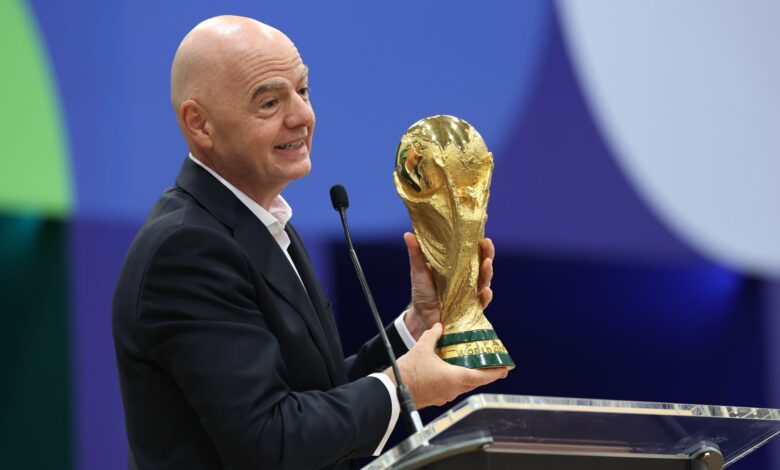
The international governing body remains committed to its plan to introduce private investment worth 20 billion dollars into its competitions, despite growing opposition marked by UEFA’s announcement of a comprehensive boycott, supported by Asian federations, CONCACAF, and players’ unions.
-
After FIFA settled the issue of Iran’s participation in the World Cup… Trump comments
-
After condemning a worker’s death.. FIFA puts Qatar in embarrassing position, reveals its true face
Despite mounting resistance across Europe, Asia, and North America, the International Federation of Association Football (FIFA) has reaffirmed its intention to continue consultations on its proposal to introduce private investment into its competitions, particularly the FIFA World Cup. The organization rejected accusations that it was seeking to “sell football” and stressed that every national federation has the right to express its views independently, rather than through collective positions led by continental confederations.
On Tuesday, FIFA announced plans to establish a subsidiary company called “FIFA Forward Enterprise,” valued at approximately 20 billion dollars, which would oversee commercial operations and the organization of the World Cup and other tournaments. Up to 20 percent of the company would be offered to private investors.
-
Qatar violates FIFA rules: Tickets for World Cup matches on black market 10 times their value
-
FIFA faces World Cup boycott crises, Doha violations
FIFA‘s response came as criticism of the proposal intensified. Following a meeting involving all fifty-five member associations, the Union of European Football Associations (UEFA) unanimously announced a boycott of all FIFA competitions as long as the proposal remains in place. The move represents the most serious escalation in relations between the two organizations in years.
In an official statement, FIFA said that “the consultation process we had planned has been disrupted by inaccurate media reports,” adding that discussions would continue “to ensure that every member association can express its opinion based on facts.”
-
World Cup – Fans’ reluctance puts FIFA in difficulty
-
Qatar 2022: Amnesty International calls on FIFA to pay US$440 million in compensation for foreign workers on the stadiums
The organization added: “No one is selling football. FIFA would never consider such a step,” emphasizing that “everyone has the right to oppose the proposal and request further clarification, but no single entity can claim to represent all 211 member associations worldwide.” According to FIFA, allowing every federation to review the proposal and express its position reflects the organization’s democratic principles.
UEFA, however, described the initiative as “an abdication of FIFA‘s responsibility as the guardian of global football,” insisting that the World Cup “is not for sale and cannot be treated as an investment product or handed over to private investors.”
-
The mascot of the upcoming FIFA World Cup unveiled in Qatar
-
FIFA discusses the situation of migrant workers in Qatar with Amnesty International.. Doha tries to solve the crisis with bribes
The European body warned that allowing outside investors to acquire ownership stakes in FIFA competitions would change football “forever,” making commercial profitability a permanent obligation and placing constant pressure on the governance of the sport.
Europe’s opposition represents a major setback for the proposal, given the continent’s importance, with six of the world’s top ten men’s and women’s national teams coming from Europe. Spain and Portugal, alongside Morocco, are also set to host the 2030 World Cup, while the crisis could extend to the Women’s World Cup scheduled to take place in Brazil next year.
-
2022 FIFA World Cup: Why are Moroccans accusing Qatar of “stealing” their heritage?
-
Morocco Expands Its Hotel Capacity to Turn World Cup Enthusiasm into Lasting Prosperity
Opposition is not limited to Europe. The Confederation of North, Central America and Caribbean Association Football (CONCACAF), together with its forty-one member associations, rejected the proposal, expressing “deep concern” over what it described as inadequate legal procedures, an excessively short timetable, and the absence of proper review or approval by FIFA‘s competent bodies.
CONCACAF stated that the discussions highlighted the need for greater transparency and stronger governance. Consequently, the confederation and its members decided to reject the proposal, although they stopped short of endorsing UEFA’s boycott strategy.
-
Calls to boycott Qatar World Cup and to hold FIFA accountable.. What’s the story?
-
Demands to transfer the 2022 Men’s FIFA World Cup tournament from Qatar to another country
The Mexican Football Federation adopted a more cautious position, explaining that FIFA had informed it of the proposal on July 28 and that a series of meetings would be held to provide additional information and documentation before a final decision is made. It added that it would continue studying the project to determine what best serves the development of Mexican football, without officially supporting or rejecting the plan.
The Asian Football Confederation (AFC) also criticized FIFA sharply, arguing that no prior consultation had taken place before the announcement and that no detailed assessment of the administrative, financial, legal, and strategic implications had been provided.
-
Political Maneuvering… How Did Donald Trump Win the World Cup?
-
Surprise Decision by Argentina’s President Ahead of the World Cup Final
Attention is now turning to the Confederation of African Football (CAF), whose executive committee is expected to discuss the proposal next week. Meanwhile, the Oceania Football Confederation, which includes eleven member associations, has announced that it will examine the plan at its next meeting, while the South American Football Confederation (CONMEBOL) has not yet issued an official position.
Players’ organizations have also joined the opposition. The International Federation of Professional Footballers (FIFPRO) warned that the project would irreversibly reshape the economic incentives underlying the competitions in which players build their careers.
-
Egypt Protests Officiating as President El-Sisi Praises a Historic Achievement
-
Has Infantino Become a Player on Trump’s Team?
The plan championed by FIFA president Gianni Infantino involves the creation of the new company through private investment, accompanied by a financial package worth 10 billion dollars to be distributed among national federations that approve the proposal before September 19, amounting to approximately 40 million dollars per association. The funds would become available starting on January 1, 2027.
If the proposal is rejected, however, allocations would revert to their previous level of 2.7 billion dollars, or roughly 10 million dollars per member association.
-
A Moroccan Approach That Makes Football a Tool for Integration and Combating Discrimination
-
Street Protests, Visa Problems and Ticket Crisis Cast a Shadow Over World Cup Opening Celebrations
Infantino believes that the initiative will strengthen “democracy” within world football by expanding federations’ access to financial resources.
However, the growing opposition, led by Europe and supported by Asia, CONCACAF, and players’ organizations, has placed FIFA in the midst of one of the most significant political and institutional crises in the history of the sport, even as the governing body insists that it will not back down and will continue consulting member associations before making a final decision.
-
Washington imposes security restrictions on the Iranian team’s entourage at the World Cup
-
The World Bank chooses Morocco as a regional headquarters for its stability and strong economy