Political Maneuvering… How Did Donald Trump Win the World Cup?
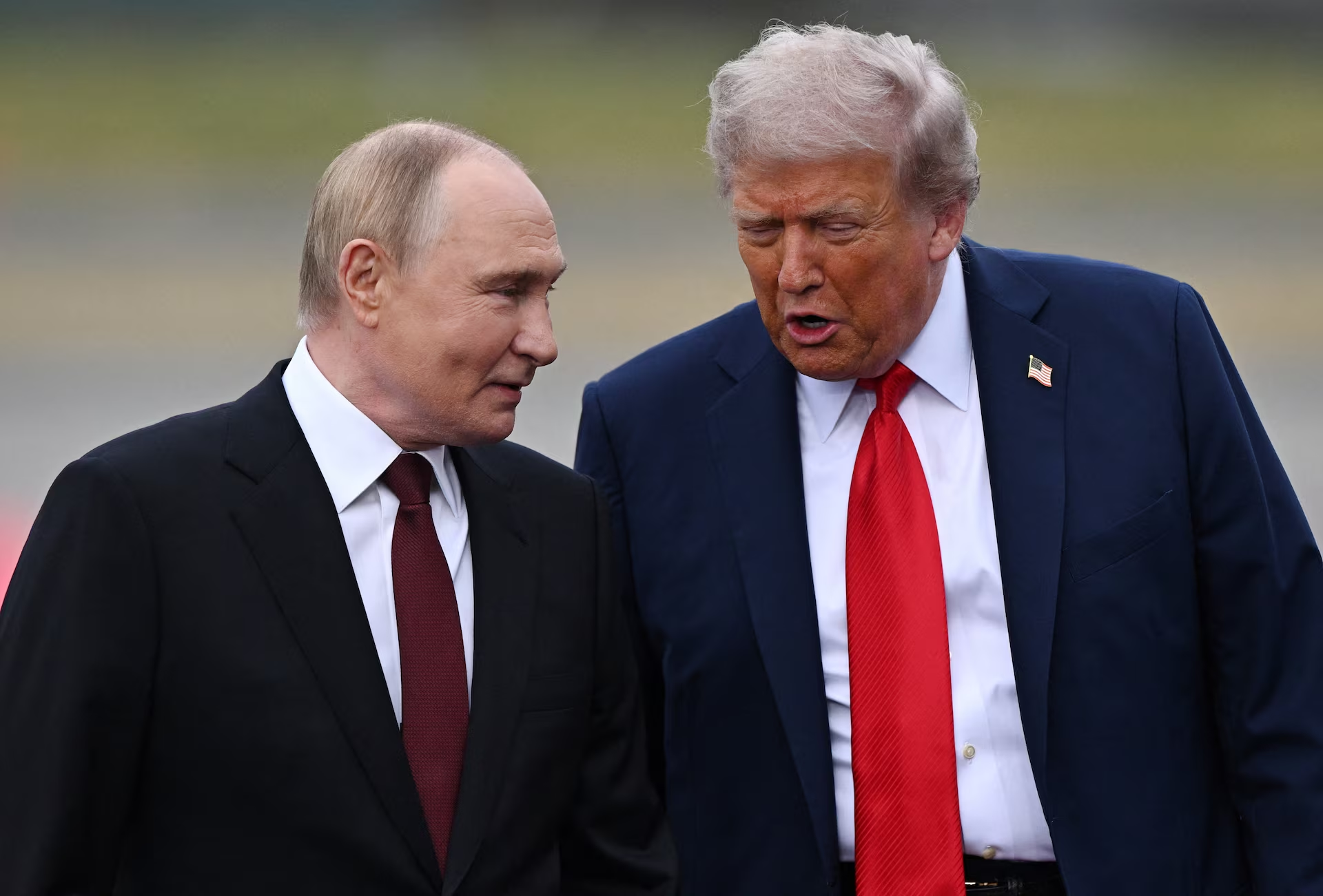
Donald Trump emerged as one of the defining figures of the FIFA World Cup, giving football an extraordinary tournament by navigating political tensions and sidestepping potential controversies.
On Sunday evening, U.S. President Donald Trump attended the World Cup final at New York New Jersey Stadium (MetLife Stadium), where Spain defeated Argentina 1-0 after extra time thanks to a goal by Ferran Torres. Argentina played the closing minutes of the match with ten men after losing a player.
It was the first and only match Trump attended during the tournament. He watched the final from the VIP box alongside Mexican President Claudia Sheinbaum, Canadian Prime Minister Mark Carney, King Felipe VI of Spain, and Spanish Prime Minister Pedro Sánchez.
-
After FIFA settled the issue of Iran’s participation in the World Cup… Trump comments
-
Organizational failure; FIFA sues Qatar after World Cup
Early warnings
Six weeks earlier, such an ending appeared far from certain. Critics had warned that the first-ever 48-team FIFA World Cup would become a textbook example of politics overshadowing sport.
However, the “disaster” many had predicted never materialized. Instead, the tournament shattered attendance records and achieved the highest television ratings in World Cup history.
By the time Spain and Argentina met in Sunday’s final, many observers were already describing the competition as one of the finest World Cups in recent memory.
-
After condemning a worker’s death.. FIFA puts Qatar in embarrassing position, reveals its true face
-
Has Infantino Become a Player on Trump’s Team?
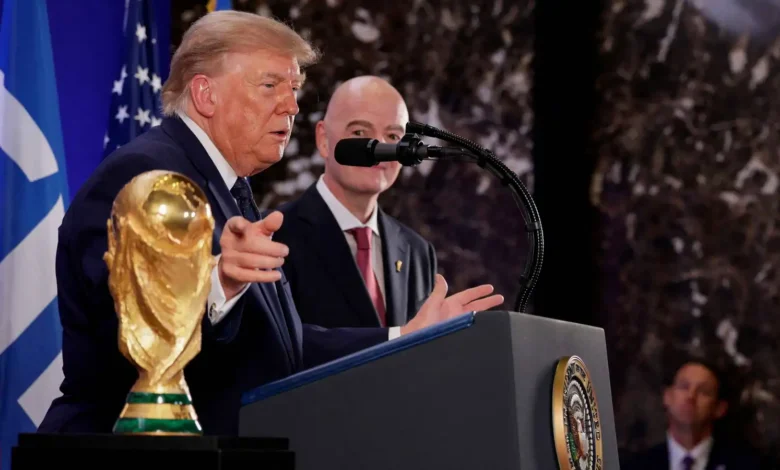
Trump became one of the tournament’s most prominent images when he presented the FIFA World Cup trophy to Spanish captain Rodri during the championship celebrations.
It was precisely the ending FIFA had envisioned for years: a packed stadium, billions of viewers worldwide, and the leader of the host nation sharing the spotlight on football’s biggest stage.
Before the tournament began, however, skepticism was widespread. Supporters’ groups accused FIFA of pricing genuine fans out of the matches because of the exceptionally high ticket prices.
-
Qatar violates FIFA rules: Tickets for World Cup matches on black market 10 times their value
-
FIFA faces World Cup boycott crises, Doha violations
Hotels in several host cities also reported bookings below expectations. Human rights organizations expressed concerns over immigration enforcement around stadiums, while opinion polls suggested that a significant portion of the American public simply lacked interest in the competition.
Newsweek was among the media outlets questioning whether the tournament had become “a giant money-making exercise that alienated supporters before the first ball was kicked,” while other publications, including The New York Times, published headlines suggesting that Trump had made the World Cup “less enjoyable.”
An unexpected turnaround
Instead, no large-scale immigration enforcement campaigns took place around stadiums. Empty seats never became a significant issue, and boycott movements failed to gain momentum.
According to FIFA, the tournament concluded with a record attendance of 6,810,966 spectators across 104 matches, surpassing the combined attendance of the 2018 and 2022 World Cups.
Stadium occupancy reached 99.7% of available capacity, while the attendance record established during the 1994 FIFA World Cup was broken even before the group stage had concluded.
-
The mascot of the upcoming FIFA World Cup unveiled in Qatar
-
Morocco Expands Its Hotel Capacity to Turn World Cup Enthusiasm into Lasting Prosperity
On a single day in June, more than 426,000 fans attended matches, setting yet another attendance record in World Cup history.
Fox’s English-language broadcasts recorded the highest group-stage television audience ever in the United States, averaging more than five million viewers across Fox, FS1, and Tubi. Meanwhile, Telemundo averaged 4.6 million viewers, representing a 122% increase compared with the 2022 tournament.
The United States’ opening match against Paraguay attracted approximately 18 million viewers across Fox platforms, with another 9.5 million tuning in on Telemundo, setting new audience records in both English and Spanish.
-
Surprise Decision by Argentina’s President Ahead of the World Cup Final
-
A Moroccan Approach That Makes Football a Tool for Integration and Combating Discrimination
-
Street Protests, Visa Problems and Ticket Crisis Cast a Shadow Over World Cup Opening Celebrations
By the semifinals, Argentina’s victory over England averaged more than 15 million viewers on Fox alone, making it the most-watched World Cup semifinal ever broadcast on English-language American television.
For FIFA, these figures mattered far more than any isolated empty seats that might have existed.
Simon Chadwick, professor at emlyon Business School and author of The Business of FIFA World Cup, told Newsweek: “The men’s FIFA World Cup is unquestionably FIFA‘s primary source of revenue. It is the organization’s main income stream throughout its four-year cycle.”
-
Washington imposes security restrictions on the Iranian team’s entourage at the World Cup
-
The World Bank chooses Morocco as a regional headquarters for its stability and strong economy
He added that the tournament finances all of FIFA‘s other competitions, from the Women’s World Cup to the FIFA Club World Cup.
The quality of football also played a significant role in producing these results. Up to the quarterfinal stage, the tournament averaged 2.94 goals per match—the highest scoring rate since the 2.97-goal average recorded at the 1970 FIFA World Cup in Mexico, according to FIFA statistics.
Comeback victories also became a defining feature of the tournament. The 2026 World Cup produced eleven victories by teams that had initially trailed, surpassing the previous record of ten comeback wins set during the 2014 FIFA World Cup in Brazil.
-
Politics Sneaks into Euro 2024… Will VAR Intervene?
-
National Agency for Global Promotion of “Morocco, Land of Lights” Ahead of the World Cup and AFCON
The president’s role
Donald Trump spent years establishing himself as the political face of the 2026 FIFA World Cup.
He hosted the tournament draw at the Kennedy Center in December, where FIFA President Gianni Infantino presented him with the organization’s newly created Peace Award.
The Trump administration also established a White House task force to oversee preparations for the tournament.
Yet once the matches actually began, Trump largely disappeared from public view. For a president known for seeking the spotlight, his absence was striking. He did not attend any group-stage matches.
That absence may ultimately have worked to his advantage.
-
‘Close to the Brotherhood’… Arrest of the President of the Tunisian Football federation on corruption charges
-
Morocco to host the World Cup… How did we get here?
The tournament, which critics had warned could become a political disaster, unfolded with remarkably few disruptions. There were no high-profile immigration raids at stadiums, no major security incidents, and no diplomatic confrontations with host cities governed by Democratic officials.
Rather than images of protests or unrest, the tournament produced pictures of packed stadiums and international supporters celebrating across American cities, according to Newsweek.
Even some of Trump‘s critics acknowledged the tournament’s smooth execution.
-
Officially… The “Morocco, Spain, and Portugal” bid wins the hosting rights for the 2030 World Cup
-
El-Sisi meets Erdogan at the G20 summit… What did the first meeting between the presidents discuss?
Democratic officials who had previously expressed concerns over ticket prices, public spending, and the administration’s treatment of foreign visitors nevertheless welcomed the success of the competition itself.
California Governor Gavin Newsom, Pennsylvania Governor Josh Shapiro, New York City Mayor Zohran Mamdani, and New Jersey Governor Mikie Sherrill all attended matches.
When Trump handed the World Cup trophy to Spanish captain Rodri, he brought to a close one of the most successful tournaments in World Cup history. The feared empty seats never became a reality, boycott campaigns failed to gain traction, the anticipated immigration crackdowns never occurred, and the competition instead delivered record-breaking attendance, unprecedented television audiences, and a president standing at the center of the global spotlight, according to the report.
-
President of the Spanish Football Federation to Defend Himself After Suspension Due to a Kiss
-
Morocco is bidding to host the 2030 World Cup jointly with Spain and Portugal