Washington Retains Control Over Iraq’s Oil Revenues Despite Military Withdrawal
The United States exercises its principal influence over Iraq’s oil revenues by managing those funds through the Federal Reserve Bank of New York.
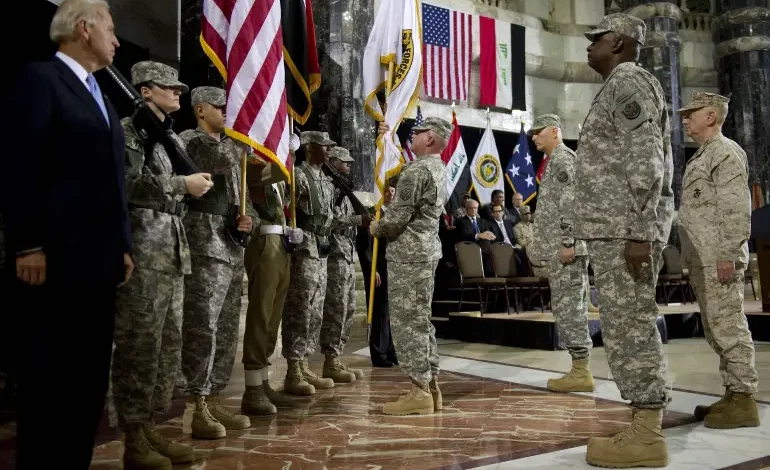
US troops are scheduled to leave their final bases in Iraq on Wednesday, marking a departure that Iran and its allies are celebrating as a victory after gaining substantial influence in a country where 4,500 Americans were killed during a war that lasted more than two decades.
Despite the military withdrawal, the United States has continued to exercise effective control over Iraq’s dollar-denominated oil revenues since its 2003 invasion. The arrangement gives Washington exceptional leverage over Baghdad’s affairs, with consequences extending to the regional balance of power involving Iran.
US influence over Iraqi oil revenues stems primarily from the management of those funds through the Federal Reserve Bank of New York.
Following the 2003 invasion of Iraq, the US-led Coalition Provisional Authority established the Development Fund for Iraq and deposited it at the New York Federal Reserve. The fund was designed to collect Iraq’s oil revenues and use them for the country’s reconstruction and development.
It was also intended to protect Iraqi oil income from lawsuits and claims associated with Saddam Hussein’s rule.
Then-US President George W. Bush signed an executive order establishing the arrangement, which every subsequent president renewed. The Development Fund for Iraq ultimately became an account held by the Central Bank of Iraq at the Federal Reserve Bank of New York—an arrangement that remains in place today.
Oil is Iraq’s most important source of income, accounting for approximately 90 per cent of the state budget. This dependence gives Washington considerable influence over the country’s economic and political stability.
When the Iraqi government called for US forces to leave the country in 2020, Washington reportedly threatened to deny Iraq access to the funds held at the Federal Reserve Bank of New York. Baghdad eventually backed away from its demand.
Although the Iraqi government has gained greater control over its financial affairs since the early years of the US occupation, the continuing arrangement highlights Washington’s enduring influence over Iraq’s economic landscape, even as the country seeks to assert its sovereignty and independence.
Iraqi government officials, speaking on condition of anonymity, said the system had helped consolidate the country’s financial stability and protect its public finances.
They said it provided international confidence in the management of oil revenues, facilitated reliable access to the dollars required for trade and imports, and protected Iraq’s income from external claims and financial shocks, including creditor demands and lawsuits.
The arrangement also supports exchange-rate stability, strengthens confidence in the Iraqi economy and helps reinforce domestic financial institutions and economic sovereignty.
It further enables the government to confront certain actors, including Iran-aligned groups seeking to ease restrictions on access to dollars. Last year, the United States imposed sanctions on Iraqi banks and individuals accused of laundering money for Iran.
Tighter restrictions on Iraq’s dollar supply have nevertheless contributed to the emergence of an unofficial parallel market, producing a gap between the official exchange rate set by the Central Bank and the rate available on the black market.
This difference effectively represents a risk premium for conducting transactions outside the formal financial system.
Since US President Donald Trump began his second term, his administration has pursued a “maximum pressure” campaign against Iran. Iraq has frequently found itself caught in the crossfire because Tehran uses the country as an important economic lifeline.
The war launched by the United States and Israel against Iran on February 28 placed Iraq under additional pressure. Iraqi oil revenues remain held at the Federal Reserve Bank of New York.
The Central Bank of Iraq historically relied on dollar auctions—officially known as foreign currency auctions—as its main mechanism for supplying US currency. Private banks and currency exchange companies could submit daily bids to purchase dollars with Iraqi dinars.
Iraq formally ended the auction system in early 2025 following intense pressure from Washington. The move formed part of a broader campaign against the alleged smuggling of dollars to sanctioned entities, particularly in Iran.