China’s tank of the future: the Type 100 reshapes the balance of ground warfare
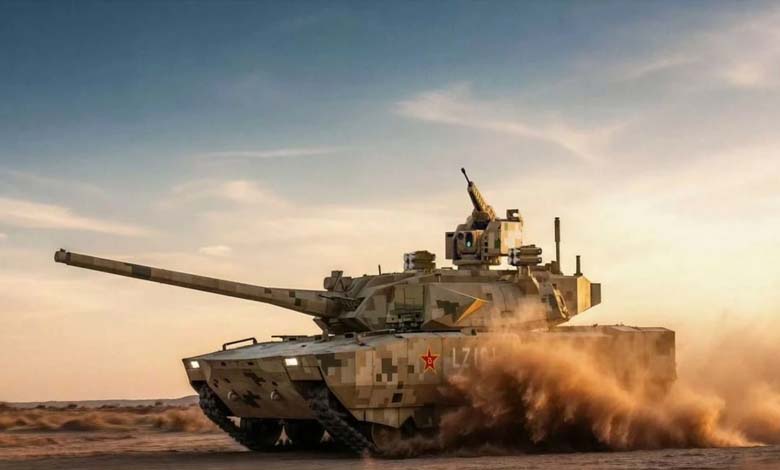
Chinese state media have, for the first time, released footage showing the world’s newest main battle tank, the “Type 100,” performing rapid field maneuvers across rugged terrain.
This unprecedented presentation reveals the details of a unique internal compartment in which the three crew members sit side by side inside a separate armored capsule, according to Military Watch.
-
China steps up its diplomacy to end the war with Iran ahead of the Trump summit
-
Immediate truce and safe corridor: details of the China-Pakistan initiative to end the war in Iran
The tank officially appeared last September with a design that redefines the philosophy of armored combat vehicles, drawing key lessons from modern armored warfare trends, particularly from the Ukrainian theater of operations.
The “Type 100” stands out for its notable light weight and exceptional mobility compared to previous generations of Chinese tanks. In contrast, it provides exceptional armor protection on the upper section and reduced protection on the sides, reflecting the growing threat posed by top-attack weapons such as the FGM-148 Javelin missile and loitering munitions.
-
Russia and China back Iran’s new leader as Washington and Tel Aviv issue threats
-
Could the confrontation between Iran and the United States turn into a war of attrition benefiting China and Russia?
This significant weight reduction is made possible by adopting an unmanned turret, a direction previously illustrated by the Soviet T-95 and the Russian T-14 Armata, which were considered ahead of their time but did not enter active service due to the Soviet collapse and subsequent Russian industrial decline.
The Chinese design appears more modern and reflects the country’s growing industrial and technological dominance. Estimates suggest that Western countries and Russia are nearly a decade behind in introducing comparable tanks.
The “Type 100” also features a comprehensive suite of optical, thermal, and radar sensors networked with air assets, artillery, and electronic warfare systems, granting it one of the most advanced network-centric combat capabilities in the world.
-
Lop Nor: A Desert That Tells the Story of China’s Nuclear Tests
-
076 enters the stage: China showcases its amphibious power in seas of tension
These capabilities were tested during joint-arms exercises, where crews used augmented reality interfaces to engage targets beyond direct line of sight.
In a fundamental reassessment of the role of the main gun, the tank is equipped with a 105 mm cannon, much smaller than the 125 mm guns of previous Chinese models. However, revolutionary advances in armor-piercing projectile design enable this smaller gun to achieve one of the highest penetration capabilities globally, reflecting a shift from close-range engagement to long-range combat.
The “Type 100” essentially serves as a forward advanced sensing platform, enabling crews to guide loitering munitions, with the option to mount multiple long-range anti-tank missiles.
-
A challenge in African waters: China, Russia and Iran launch naval drills
-
Two serious incidents: Japan protests China’s use of fire-control radar
To achieve comprehensive situational awareness, four active phased-array radars are integrated around the turret to provide 360-degree threat detection coverage. This is essential not only for operating the two units of the “GL-6” active protection system, but also for feeding broader networks with situational awareness data from forward positions.
The combination of the four radars and the two active protection systems creates an overlapping field of detection and interception, offering what is currently the most comprehensive defense against top-attack loitering munitions and guided missiles.
-
Russia’s slowdown makes China Iran’s most important supplier of weapons
-
China and Russia oppose an American proposal to establish a stabilization force in Gaza
Analysts have noted that the aging nature of Western designs was a decisive factor behind the radical modernization program of the American M1 Abrams under the “M1E3” project. The U.S. effort focuses on the same capabilities embodied by the “Type 100,” such as weight reduction, network-centric operations, and crew protection.
However, the limitations of a platform designed in the 1970s remain, whereas China’s ability to develop an entirely new tank specifically designed for the era of drone warfare grants the “Type 100” considerable flexibility, heralding a new era in the history of armored combat vehicles.
-
Sharp Sword: China makes history with the first unmanned stealth fighter squadron
-
Through the Army… China Outlines Its Vision for a Fairer World Order
-
Sovereignty dispute in Scarborough: a new diplomatic confrontation between the U.S. and China