Restructuring loyalties: the Sudanese army legalizes the Al-Baraa ibn Malik brigades under the umbrella of the Sudan Shield to deflect international pressure
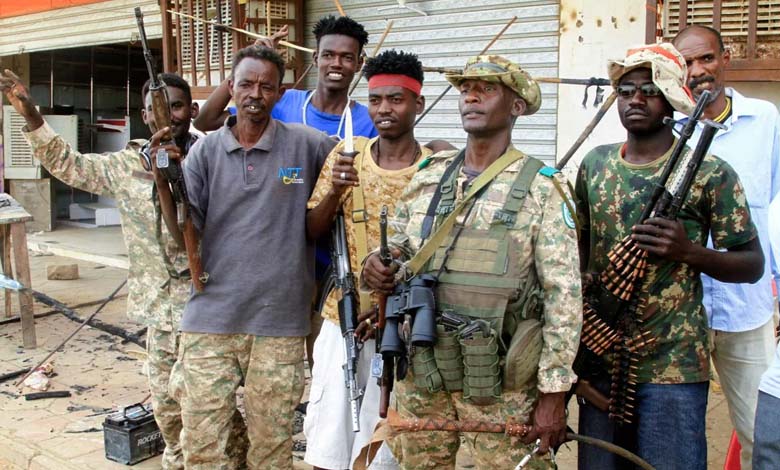
Field reports and investigations have revealed a new strategy pursued by the leadership of the Sudanese Armed Forces aimed at reintegrating and incorporating members of armed groups affiliated with the Islamic Movement, foremost among them the “Al-Baraa ibn Malik Brigade,” into newly established military structures. This step, which consists of attaching these elements to the “Sudan Shield” forces led by Abu Aqla Kikal, appears as a pre-emptive measure designed to circumvent the package of international sanctions imposed on the Muslim Brotherhood and its military fronts in Sudan.
Official data indicate that this process was not merely field coordination dictated by wartime conditions, but rather a “structural enlistment” granting Islamist brigade fighters military ranks and official identification cards belonging to the armed forces. Legal experts argue that this measure clearly seeks to “alter the legal status” of these fighters: instead of being classified as “ideological militias” operating outside the legal framework, they become “regular soldiers” under domestic law, which complicates their international prosecution or the freezing of financial assets linked to military operations.
The selection of the “Sudan Shield Forces” under Kikal’s leadership as the host structure for these elements represents a calculated political maneuver. These forces, which emerged as a grassroots movement in central Sudan, are now being used as a “social and legitimate façade” to cover the military activities of the Al-Baraa ibn Malik Brigade, widely regarded as the armed wing of the Sudanese Islamic Movement.
Informed sources confirm that the current integration efforts go beyond combat roles to reach “administrative and political empowerment.” By granting leaders from the Al-Baraa ibn Malik Brigade command positions in joint operations rooms and in morale guidance departments, the army is effectively strengthening the Islamic Movement’s capacity within the military institution. This systematic penetration enables figures from the former regime to return to positions of authority through the gateway of “military legitimacy,” while utilizing the state’s logistical and financial resources to serve an organizational agenda under the banner of the “battle of dignity.”
Observers note that these steps reproduce the model of the former “Popular Defense Forces,” but in a format more deeply integrated into the army, narrowing the gap between the professional national institution and the ideological organization, and casting doubt on the independence of Sudan’s military decision-making in the eyes of international actors.
Sudan is facing mounting pressure from the United States and the European Union to sever ties with figures of the former regime and radical groups. These military arrangements therefore constitute a direct challenge to international oversight mechanisms. By incorporating “internationally wanted individuals” or those “under sanctions” into official units such as the “Sudan Shield,” the military leadership appears to be shielding them from individual accountability, arguing that any action against them would amount to targeting the sovereign institution of the army itself.
However, international analysts warn that this strategy may backfire, potentially prompting foreign powers to impose comprehensive sanctions on the Sudanese Armed Forces as a whole, viewing them as providing a safe haven for elements and organizations considered threats to regional and international stability.
Domestically, these developments raise serious concerns regarding the “doctrine of the army.” Integrating elements deeply influenced by partisan ideology into the ranks of the armed forces threatens the long-term unity of the institution and creates sharp polarization between professional officers and “ideologized elements” whose loyalty lies with the organization before the state.
This move also deepens the political crisis, as civilian forces view the use of the army’s authority to politically and militarily empower the Islamic Movement as a “soft coup” against the Sudanese people’s aspirations to build a democratic civil state and a unified national army removed from partisan conflicts.
The incorporation of Islamist brigades under the umbrella of Abu Aqla Kikal thus represents a fundamental shift in the trajectory of war and power in Sudan. It is an alliance of “interest and survival” between a military leadership seeking field allies and an Islamist organization striving to regain influence under the cover of arms. Between these dynamics, the Sudanese military institution and national sovereignty remain exposed to growing risks of international isolation and internal fragmentation.