America’s Doomsday Plane Takes Flight: What Is Washington Preparing for Iran?
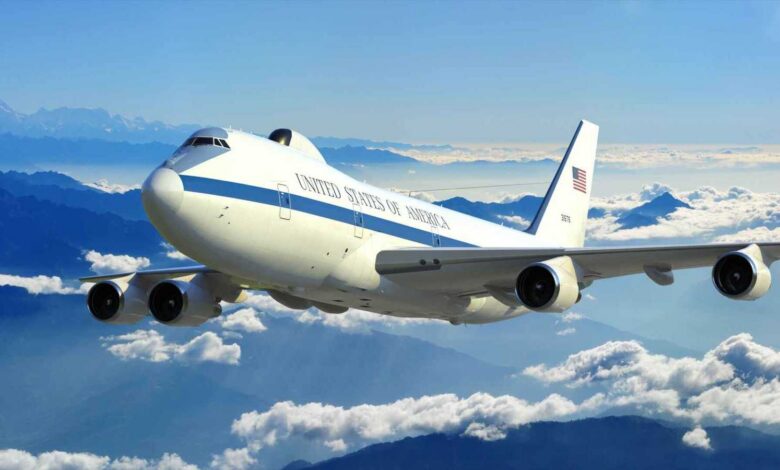
International flight-tracking platforms detected an unusual movement on Friday involving one of the United States’ most secretive and heavily protected military aircraft.
Tracking data confirmed that a Boeing E-4B Nightwatch airborne command aircraft, commonly known as the “Doomsday Plane”, conducted an unannounced flight across several US states before landing in Georgia.
The flight’s timing, amid heightened tensions, prompted questions about its purpose. Some observers described it as a routine readiness check, while others interpreted it as part of preparations preceding a major strike against Iran.
Details of the Route
According to information recorded by public flight-tracking platforms, the aircraft carrying the number 74-0787 began its journey at its main base, Offutt Air Force Base in Nebraska, the operational hub of the National Airborne Operations Center fleet.
It headed east at a speed exceeding 1,000 kilometres per hour, maintaining an altitude of 31,000 feet over Midwestern states including Illinois, Indiana and Ohio.
Rather than continuing east towards bases around Washington, the aircraft made a sharp turn south over northern Virginia. Its flight ended after two hours and fifty-seven minutes with a landing in the Fort Valley area of Georgia.
A Message of Deterrence
Sources close to Pentagon decision-making circles said the E-4B’s flight could not be separated from the tense security environment in the Middle East.
The sources said the United States moves strategic assets associated with nuclear deterrence and command and control during crises to send visible signals to adversaries, particularly Iran. The intended message, they argued, is that senior US command communications are protected and ready to manage any level of conflict.
The sources added that the sortie coincided with “parallel activation of dormant communications networks and very low frequency, or VLF, communications”. These systems are used to communicate with submerged nuclear-powered ballistic missile submarines.
According to the sources, the mission involved more than a training flight for an individual pilot. It reportedly included a live test linking ground-based decision-making centres with airborne command posts, alongside observed movements of RC-135 electronic reconnaissance aircraft and intelligence-gathering missions near strategically important operational theatres.
“Second-Strike” Scenarios
The flight attracted close attention in Washington’s military and strategic research circles.
A report attributed to the Institute for the Study of War, or ISW, described the “Doomsday Plane” flight as a classic demonstration of “second-strike capability”.
The institute argued that Iran is attempting to establish new rules of engagement by developing its missile and long-range drone capabilities while threatening US interests.
Washington, in turn, would be signalling that its command systems can survive a surprise attack, countering any Iranian miscalculation that disabling ground-based command centres in Washington might be possible.
An assessment attributed to the Brookings Institution focused on the crisis’s psychological dimension, describing the flight as “strategic aircraft diplomacy”.
In this interpretation, crisis management with Tehran has reached the point of brinkmanship, where military movements inside the United States become instruments of negotiation and external pressure.
The assessment argued that the Pentagon knows Iranian intelligence agencies and their allies closely monitor these aircraft. Allowing the flight’s data to remain publicly visible, rather than concealing it entirely, would therefore have been a deliberate way to deliver a message without issuing a political statement that might trigger direct diplomatic escalation.
Messages for a Domestic Audience
Political analyst Gibran Salim al-Durra believes the flight’s significance extends beyond a direct military warning to Tehran. It also serves, in his view, to reassure Americans that national command-and-control mechanisms are at the highest level of readiness, amid intelligence reports referring to “unconventional Iranian threats” against vital interests.
He said the E-4B’s movement, alongside an expanded US military presence in the Middle East and the deployment of additional bombers and fighter aircraft, was intended to demonstrate that the United States had not turned inward. Rather, it was prepared to manage a large-scale conflict if Tehran took a major escalatory step, such as accelerating its nuclear programme or launching extensive attacks through its regional proxies.
One Aircraft, Multiple Roles
With its large Boeing 747-derived airframe, electromagnetic pulse-protected systems and protection against nuclear radiation, the Boeing E-4B Nightwatch remains portrayed as the US leadership’s most powerful tool for managing the most extreme scenarios.
Whether its latest flight over the eastern and southern United States was a routine engine and electronics test or an operational movement linked to continuing Washington–Tehran tensions, the political message remains the same in this interpretation: the “Doomsday Plane” reminded international actors, particularly Iran’s leadership, that air superiority and the ability to direct warfare from airborne command posts remain major assets Washington displays whenever the prospect of a wider confrontation draws closer.