The World’s Most Closed-Off Country Knocks on Trump’s Door: The Behind-the-Scenes Story of Turkmenistan’s Leader’s Secret Visit
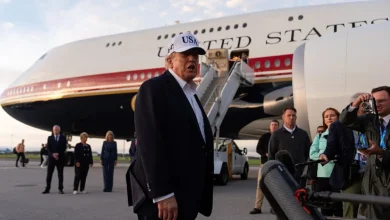
On February 15, surveillance cameras at Fort Lauderdale-Hollywood International Airport captured an unusual sight: a white Boeing 737-700, bearing the emblem of a green falcon on its tail, landed quietly before coming to a stop on the tarmac.
Three days later, a second identical aircraft arrived and parked alongside it. According to Politico, the two government aircraft had come from Turkmenistan, the isolated Central Asian state whose location on the map is unknown to most residents of Florida.
-
Trump Congratulates Him: The Tiger Wins Colombia’s Presidency
-
Trump Announces Death of “Most Wanted Criminal” as Venezuela Confirms Joint Operation
The presence of the two aircraft quickly attracted the attention of a local television station, which dispatched a reporter to investigate the situation. However, the journalist found little more than mystery and speculated that the visit might be linked to prospective agricultural or industrial business deals.
Subsequent leaks, together with brief government statements released with little publicity, later revealed that the passenger who boarded the backup aircraft before its departure was none other than Gurbanguly Berdimuhamedow, the country’s de facto ruler. Although he formally handed the presidency to his son in 2022, he is still widely regarded as the man who exercises real power behind the scenes.
-
House vote canceled to limit Trump’s military powers
-
Trump seeks to end the Iran war soon due to its economic repercussions
The Turkmen Ministry of Foreign Affairs further deepened the mystery by issuing a brief statement announcing that Gurbanguly Berdimuhamedow had begun an official visit to the United States, without specifying the destination, agenda, or duration of the trip. The ministry merely described it as “one of the most important events of the year” and “the beginning of a new phase in bilateral relations.”
The extraordinary secrecy surrounding the visit drew considerable attention, particularly because it coincided with U.S. President Donald Trump‘s stay in South Florida over the weekend. The region had witnessed intense diplomatic activity since the beginning of his second term, yet the Turkmen delegation remained completely out of sight and was not seen at any of the usual venues frequented by visiting foreign dignitaries.
-
Trump faces the challenge of resolving a war that has failed to achieve its objectives
-
The war with Iran and the constraints of Congress… Trump surpasses the 60-day deadline
The visit carries additional significance given the nature of Turkmenistan’s political system, widely regarded as one of the world’s most closed and repressive regimes. Since gaining independence following the collapse of the Soviet Union, the country has maintained an extremely centralized system of government that originated under the late President Saparmurat Niyazov.
That system has continued, in different forms, under Berdimuhamedow, who strengthened the security apparatus and reinforced the image of a tightly controlled state. Ashgabat imposes strict restrictions on travel and the media and issues only a very limited number of entry visas each year, making the appearance of its leader in the United States an exceptionally rare event.
-
We destroyed their forces and nuclear laboratories: Trump outlines the results of the war against Iran
-
We destroyed their forces and nuclear laboratories: Trump outlines the results of the war against Iran
According to several analysts, Berdimuhamedow had hoped to secure a face-to-face meeting with Donald Trump at his political stronghold in Palm Beach. However, the U.S. president’s schedule prevented such a meeting, as Trump quickly returned to Washington to participate in the launch of the “Peace Council,” a new international body he intends to establish as a platform for addressing major international issues, including the reconstruction of Gaza.
According to reports from Turkmen opposition journalists, Ashgabat expressed interest in joining the Council but was reluctant to pay its substantial membership fees. As a result, it reportedly sought an alternative strategy based on strengthening ties with Trump‘s political and business circle.
-
What will Trump do with Iran after the failure of the negotiations?
-
Trump unveils the design of the largest monument of its kind in the world
Despite the absence of a direct meeting, the visit was far from inactive. Berdimuhamedow held meetings with several businessmen and investors known for their close ties to Donald Trump, including Steve Wynn, former Chief Executive Officer of Wynn Resorts; John Reese, President of Nicklaus, the company specializing in golf course design; billionaire Isaac Perlmutter; and William Koch, one of America’s leading industrialists and a longtime supporter of the U.S. president.
Observers believe these meetings demonstrate Ashgabat’s reliance on economic diplomacy by establishing communication channels with influential figures capable of facilitating access to the U.S. administration outside traditional diplomatic channels.
-
200 million dollars in losses within moments that shake Donald Trump’s calculations
-
Trump signals a possible withdrawal from NATO
Nevertheless, the outcomes of the visit remain a matter of debate. Turkmen journalist Ruslan Myatiyev argues that American officials limited themselves to exchanging diplomatic courtesies without reaching any substantive agreements. According to him, the Turkmen delegation’s proposals focused mainly on projects such as building a golf course, purchasing agricultural equipment from John Deere, and possibly negotiating the acquisition of a new Boeing aircraft.
Other analysts, however, argue that the mere effort to strengthen relations with Trump‘s inner circle reflects a broader shift in Turkmenistan’s foreign policy, as the country seeks greater international recognition and new economic partnerships.
-
Supply disruptions push Trump to delay targeting Iranian energy facilities
-
Total destruction of South Pars: Trump threatens Iran over any renewed targeting of gas facilities in Qatar
These diplomatic efforts come as Turkmenistan seeks to capitalize on its enormous natural gas reserves—among the largest in the world—as well as its deposits of rare minerals. The country also aims to reduce its dependence on the Chinese market by opening new export corridors toward Europe, including a proposed pipeline crossing the Caspian Sea to Türkiye.
At the same time, the Trump administration appears increasingly interested in expanding its economic presence in Central Asia through investments in strategic minerals and by encouraging greater capital flows between both sides. This approach has been reinforced by the activities of Trump‘s regional envoy, Sergio Gor, who met Turkmen leaders several weeks before the visit.
-
Oil as the Revolutionary Guard’s strategic lever to pressure Trump
-
After Iran… Trump identifies the next country
Although several months have passed since the two government aircraft departed the United States, Ashgabat has announced neither formal agreements nor tangible outcomes, leaving the true objectives of the visit shrouded in uncertainty.
Whether viewed as an attempt to open a new chapter in relations with Washington or simply as an effort to build business ties with Donald Trump‘s inner circle, the journey remains one of the most intriguing diplomatic initiatives undertaken by Central Asia’s most isolated nation in recent years.
-
War Objectives in Iran Portend Rift Between Trump and Netanyahu
-
Trump presents to the public his justification for a potential attack on Iran