Tempest, the Stealth Fighter: A Three-Nation International Alliance to Build the World’s Most Formidable Combat Aircraft
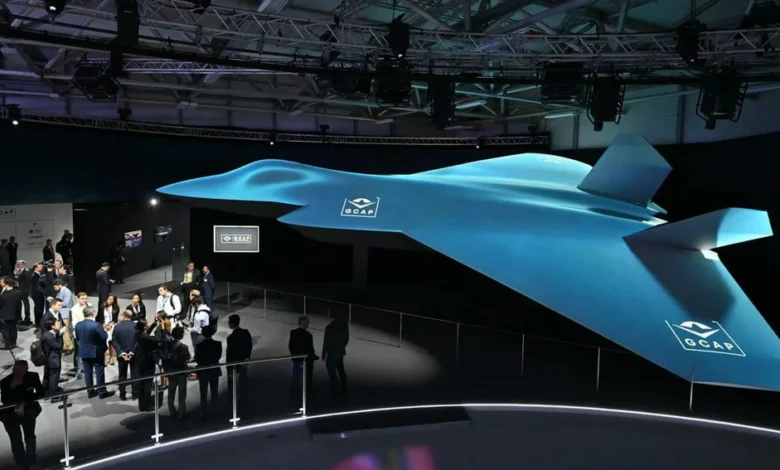
British, Italian, and Japanese defense contractors are working intensively on one of the most secretive military projects in the world.
The Global Combat Air Programme (GCAP), known in the United Kingdom as “Tempest,” aims to develop the future’s manned stealth fighter. The aircraft is designed to have long-range capabilities, a low probability of detection, exceptional lethality, and the ability to control swarms of drones.
In the past, a project of this scale would have taken decades to complete. Today, however, speed is critical. According to the British newspaper The Telegraph, rising tensions in Europe and the Indo-Pacific are pushing the three partner nations in the “Tempest” project to seek deployment of the aircraft by 2035.
Marco Zoff, the programme’s head, explained that this was an ambitious target requiring unprecedented speed, a challenge that, he said, worries him enough to keep him awake at night.
Speaking to The Telegraph, Zoff said: “We have a commitment, we have expectations, we have ambitions, and we have all the capabilities required to achieve this. Therefore, we must remain intensely focused on delivering it.”
For the United Kingdom and Italy, the need to move quickly stems primarily from the Russian threat. In Japan, meanwhile, concerns are focused on China, whose increasingly aggressive posture is emerging on the other side of the Pacific.
Zoff added: “Our countries face unprecedented threats in terms of their sophistication and the speed at which our adversaries are escalating their actions. Therefore, we are fully committed to providing our ministers with what they are asking for: a genuine, effective sixth-generation weapons system within the timeframe they require.”
Zoff, an Italian known for his calm demeanor, became chief executive of Edge Wing, the joint venture responsible for building the “Tempest,” when it was launched just one year ago.
While drawing on thousands of engineers from the project’s parent companies — Britain’s BAE Systems, Italy’s Leonardo, and Japan’s Japan Aircraft Industrial Enhancement — Zoff has also had to steer the programme through intense political debate in the United Kingdom over defense spending.
For months, speculation had suggested that the British Ministry of Defence might be forced to scale back its involvement in the programme or withdraw from it altogether in order to reconcile spending commitments under the country’s defense investment plan. However, when the plan was unveiled last month, the programme secured a £4.6 billion contract to complete the conceptual design phase by December 2027, providing significant relief for Zoff and his team.
In his first extensive interview since taking office, Zoff said: “We never doubted it, and we never lacked political commitment.” He added: “Despite some government changes over the past few years, support for the programme has never diminished.”
He continued: “Obviously, we need funding, but we have complete confidence that whenever funding is required at the end of each phase, the three governments will find a way to provide it.”
Italy has allocated €18.6 billion, or £15.8 billion, to the programme’s development phase. However, the total cost remains unknown. If the Italian figure is replicated in the United Kingdom and Japan, as expected, pre-production costs could reach £50 billion.
Zoff insisted that the project remains on schedule and within its designated budget, emphasizing that the aircraft’s current design reduces the likelihood of cost overruns.
The “Tempest” will employ a “modular” architecture that should, in theory, make it easier to replace outdated technologies with newer ones as they emerge. Zoff said: “We have to be honest and transparent. It will not be an easy task. This is a multibillion-dollar contract, but it is an essential part of our future defense.”
He explained that the aircraft would be “an extremely important tool, capable of penetrating airspace, collecting and sharing intelligence, and striking adversaries,” stressing that all of these capabilities would require advanced new technologies.
He added: “Sixth-generation aircraft rely on many foundational technologies that are essential to the prosperity and security of our nations,” citing examples ranging from stealth characteristics and sensors to high-performance computing, artificial intelligence, advanced materials, and power systems.
Time is the scarcest resource available to Zoff and his team. By defense industry standards, delivering a next-generation fighter aircraft by 2035 would represent an exceptionally rapid achievement.
Under its latest contract, the company has until December 2027 to complete the conceptual design phase. After that, it will have to finalize the detailed designs and begin production.
In the meantime, Zoff will manage a major organization spread across three countries. Thousands of engineers have been recruited from their bases in Preston, Turin, and Nagoya to join the collective effort at Edge Wing’s main headquarters in Reading.
The company has also received authorization from the three partner nations, which will accelerate the awarding of subcontracts without the need for lengthy consultations.
Zoff is also confident that personnel from the three countries can overcome any linguistic or cultural barriers. More importantly, he is relying on the system he has developed to enable teams to collaborate securely and instantly on design work across continents.
Zoff believes this system could serve as a model for other forms of cooperation in the defense industry, including other joint programmes among European allies.
Building this trust is particularly important because officials must protect these sensitive technologies from the eyes of adversaries.
Zoff said: “As you can see from the measures we are taking here, we believe that there are adversaries actively threatening us and trying to obtain information from us. We are doing everything we can to prevent that. But we have to be obsessive about this because we are investing in our most advanced technologies.”
He added: “Our duty is to protect them with the same level of effort and commitment that we devote to delivering them. Otherwise, there is no point in investing this money.”