Al-Burhan Versus Sovereignty: Sudan’s Land and Wealth amid Egyptian, Saudi, Turkish and Qatari Interests
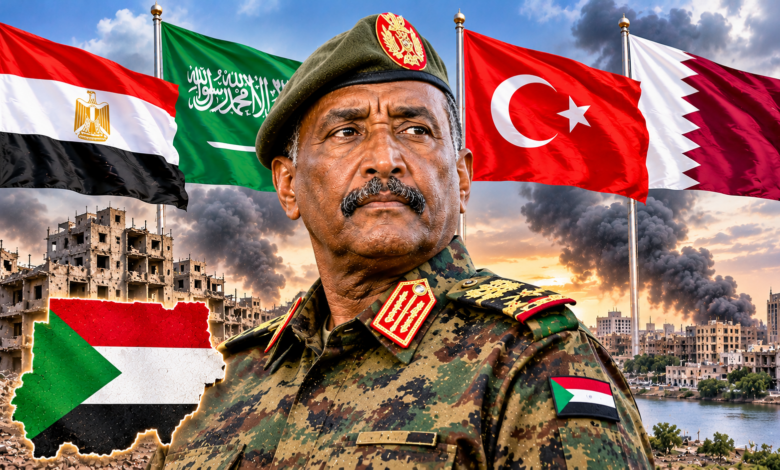
Sudan’s war has been more than a military confrontation between the army and the Rapid Support Forces. It has exposed a deeper crisis over who has the right to determine the country’s future and who controls its land, wealth, ports and foreign relations. Following the fall of Omar al-Bashir’s regime and the October 2021 coup, institutional decline allowed the military leadership to expand its foreign relationships beyond public and parliamentary scrutiny. When war erupted in April 2023, the country became an open arena for regional interests.
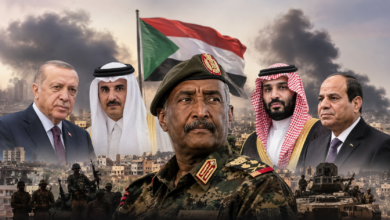
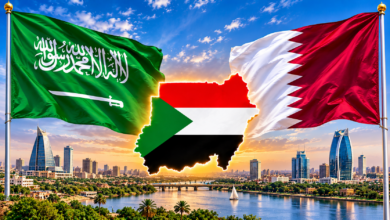
Under these conditions, Egypt, Saudi Arabia, Qatar and Turkey found opportunities to strengthen their presence in Sudan, each pursuing its own calculations. Cairo seeks guarantees concerning the Nile, borders and security. Riyadh aims to protect its Red Sea interests and expand agricultural and mining investments. Doha wants to preserve its political and humanitarian networks, while Ankara seeks to consolidate its economic and military presence in an increasingly strategic region.
The problem is not the existence of relations between Sudan and these countries. Economic and diplomatic ties are normal between states. It concerns the agreements concluded by a military authority lacking a popular mandate, and the possibility that national resources are becoming bargaining chips in exchange for political or military support.
Al-Burhan and Cairo: A Military Alliance or a Surrender of Independent Decision-Making?
Egypt regards Sudan as a direct extension of its national security. It sees its relationship with the Sudanese army as an essential guarantee for protecting its interests concerning the Nile, borders and the Red Sea. Cairo has therefore maintained political support for al-Burhan and repeatedly stressed the importance of preserving Sudanese state institutions and the army’s unity.
Preserving state institutions, however, must not become a justification for supporting military rule or obstructing democratic transition. The army is a national institution that should answer to a constitutional civilian authority, rather than claim the right to determine the country’s future or conclude deals involving its land and wealth.
Relations become particularly sensitive over the Halaib, Shalateen and Abu Ramad triangle. Sudan claims sovereignty over the territory, while Egypt controls it. In August 2025, press reports sparked controversy by alleging that al-Burhan had agreed to recognise Egyptian sovereignty over the area. They linked those claims to correspondence concerning changes to Sudanese maps during border discussions.
If such steps were established, they would raise serious questions about the limits of the military leadership’s authority over disputed territory. Sudan’s embassy in Abuja, however, officially denied the allegations and affirmed that no territory had been relinquished. The issue therefore requires clear official documents rather than reliance on leaks or accusations.
Nevertheless, the emergence of these allegations in the absence of legislative institutions and public oversight highlights the danger of concentrating sovereignty decisions in the hands of a military authority.
Saudi Arabia and Sudanese Land: Agreements Spanning Generations
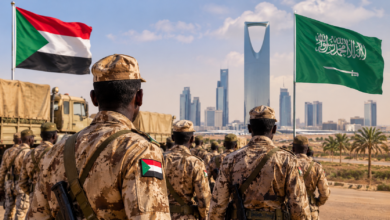
Sudan’s agricultural land is a major economic attraction for Saudi Arabia. For years, the kingdom has sought to diversify food supplies and reduce the risks associated with dependence on external markets. Sudan possesses extensive farmland, water resources, and land suitable for producing grain and other food products, as well as raising livestock.
In July 2016, Sudan’s parliament approved an agreement granting Saudi Arabia rights to exploit one million feddans of agricultural land in eastern Sudan for ninety-nine years. This information is recorded in the database of the United Nations Conference on Trade and Development, UNCTAD. The agreement predates al-Burhan’s rise to power, making it inaccurate to claim that he concluded it or sold the land during the war.
An agreement of this duration nevertheless raises fundamental questions about investment and the boundaries of economic sovereignty. Land provides livelihoods for local communities and is connected to water, roads, infrastructure and future generations’ rights. Extensive exploitation rights granted for decades must therefore carry clear guarantees concerning employment, technology transfer, tax revenue, farmers’ rights and environmental protection.
War increases the risks associated with these agreements because a state experiencing institutional collapse is less able to monitor contracts and protect its citizens’ interests. All agricultural agreements should therefore be disclosed and assessed for whether they deliver balanced benefits to Sudan. Land must not become closed concessions from which local people gain nothing.
Al-Burhan and the Port Sudan authorities are responsible for ensuring that no new agreements are signed or strategic concessions extended without genuine national oversight and participation by local communities and the relevant civilian institutions.
Ports and the Red Sea: Geography as a Political Commodity
Sudan’s Red Sea coast is one of its principal strategic assets. Its ports provide access to international trade, connect Africa and the Middle East, and serve as vital outlets for agricultural and mineral resources.
Saudi, Turkish and other foreign interest in these ports is therefore unsurprising. Problems arise when commercial investment becomes intertwined with political and military deals. The Washington Post investigation into Turkish arms contracts described discussions about economic opportunities for Turkish companies at Abu Amama port, alongside potential mineral investments and fishing rights.
This raises a question: are ports being treated as national assets governed by long-term economic policy, or as bargaining chips for securing foreign backing against opponents?
Ports are part of national security. Any agreement involving their management, development or operating rights must be transparent, publicly disclosed and subject to independent economic and legal review. Contracts must not give foreign companies influence extending beyond commercial investment into political and security decisions.
Qatar’s Political Relationships: Aid Does Not Remove the Need for Scrutiny
Qatar has historical ties with various Sudanese political forces, including Islamist currents that held a strong presence under al-Bashir. Doha has provided humanitarian assistance during the war, dispatched aircraft carrying food and medicine, and continued healthcare and relief activities through its humanitarian organisations.
Humanitarian assistance does not eliminate the need to scrutinise Qatar’s political role. The European Council on Foreign Relations cited allegations by regional experts of possible Qatari financing for weapons supplies to the Sudanese army, alongside continuing humanitarian assistance and relations with the Port Sudan authorities.
These allegations must not be presented as judicial findings or proven facts. They nevertheless warrant demands for disclosure of financial transfers, military contacts and any contracts connected to institutions involved in the war.
A state claiming to support Sudanese people should keep aid independent of political loyalties, ensure it reaches areas controlled by different parties, and support civil society initiatives and humanitarian organisations beyond military control.
Turkey: When Weapons Become a Gateway to Resources
The deal described in The Washington Post investigation into Turkish company Baykar illustrates the overlap of military and economic interests in Sudan. The investigation reported a package worth at least $120 million, including Bayraktar TB2 drones, ammunition, equipment, and technical personnel. It also discussed commercial opportunities involving gold, copper, silver and Abu Amama port.
While advanced weapons increase the army’s combat capabilities, economic opportunities associated with the military relationship raise questions about the political and commercial returns attached to those deals. Defence agreements cannot be assessed separately from their consequences when concluded in a country experiencing a devastating internal war.
Ankara has denied providing military support to either side. The documents presented by the investigation nevertheless warrant independent examination of supply channels, financing, and communications. Agreements concerning natural resources and ports must also be overseen by legitimate national institutions.
Humanitarian Aid: Saving Civilians or Entrenching De Facto Authority?
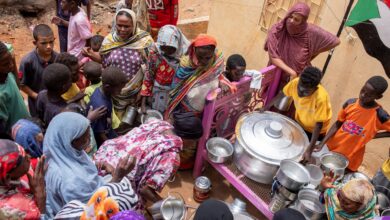
One of the greatest dangers facing Sudan is the politicisation of humanitarian assistance. Aid must reach children, women, displaced people and patients regardless of where they live or who controls their area.
When military authorities monopolise border crossings, airports, warehouses and distribution mechanisms, the risk of political manipulation arises, particularly in besieged areas or where humanitarian organisations face movement restrictions. Independent aid oversight mechanisms are therefore needed, alongside publication of quantities, distribution locations and beneficiaries.
Life-saving civilian assistance must also be distinguished from logistical or financial support that may benefit a military party. Their legal classifications differ, and a transparent investigation must establish where funds and shipments go.
Sudanese Sovereignty Is Not for Sale
The war has exposed a fundamental danger: weak national institutions allow Sudan to become an arena for bargaining. Farmland, ports, minerals and borders do not belong to the military leadership. No official has the right to make decisions about them while excluding the people and their constitutional institutions.
Reviewing agricultural agreements, investigating allegations concerning Halaib and Shalateen, disclosing Turkish arms deals, and ensuring the independence of Qatari and Saudi assistance are therefore part of one objective: restoring Sudanese control over national decisions.
That objective cannot be achieved under an authority drawing strength from continued war and foreign relationships. It requires a civilian transition that places the army under constitutional authority, restores oversight to national institutions, and prevents public resources from being used to purchase political loyalty.
Sudan needs partners that help it build a state respecting its sovereignty and defending its citizens’ interests, rather than allies seeking wartime concessions. Any peace that does not place land, resources, and national decision-making in Sudanese hands will be only a temporary truce before another round of conflict.