Who Has the Authority to Designate a Terrorist Organization in the United States? A Legal Analysis of the Oklahoma Governor’s Order Against the Muslim Brotherhood and CAIR
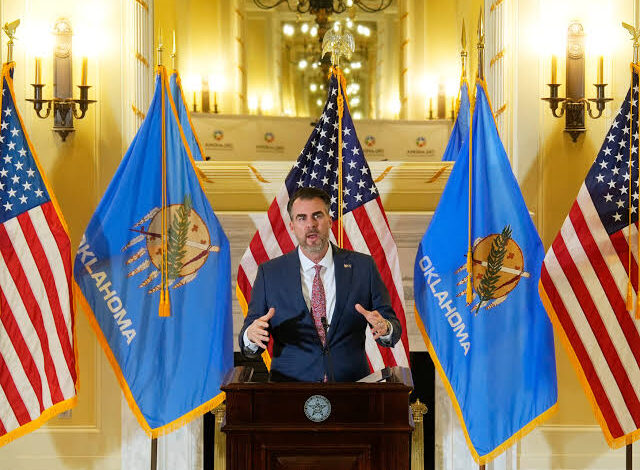
The executive order issued by Oklahoma Governor Kevin Stitt on August 12, 2026, concerning the Muslim Brotherhood and the Council on American-Islamic Relations (CAIR), sparked widespread controversy. The debate was not limited to the organizations targeted by the investigation, but also centered on a fundamental legal question: Can the governor of a U.S. state designate an organization as a “Foreign Terrorist Organization”?
The short answer is: no. However, this does not mean that Stitt’s decision has no effect. The executive order operates within a different scope: it directs the state’s public safety and security agencies to conduct an intelligence-based assessment into whether the Muslim Brotherhood, CAIR, or individuals and entities acting on their behalf pose a terrorist threat or a risk to public safety in Oklahoma. It also directs state officials to advocate for federal action regarding a possible designation.
This distinction between an “investigation” and a “designation” is essential to understanding the development beyond political headlines.
Federal designation is not a state governor’s decision
U.S. law governs the designation of “Foreign Terrorist Organizations” under Section 219 of the Immigration and Nationality Act, codified at 8 U.S.C. §1189.
Under this legal framework, an organization must be foreign, must engage in terrorist activity or retain both the capability and intent to engage in such activity, and its activities must threaten the security of U.S. nationals or the national security of the United States.
More importantly, the law specifies that the relevant “Secretary” is the Secretary of State, acting in consultation with the Secretary of the Treasury and the Attorney General. The authority to make a federal designation therefore lies within the executive branch of the U.S. federal government in Washington, not with the government of any individual state.
The most accurate description of Oklahoma’s decision is therefore: “The governor calls for an investigation and advocates for a federal designation,” rather than: “The governor designated the Muslim Brotherhood or CAIR as Foreign Terrorist Organizations.”
What does the executive order actually do?
According to the governor’s office, the order was issued on August 12 and directs the Oklahoma Department of Public Safety and the Oklahoma Office of Homeland Security to assess whether the Muslim Brotherhood and CAIR, or individuals and entities acting on their behalf, constitute a terrorist threat or a danger to public safety.
It also instructs the Office of Homeland Security to conduct an intelligence-based assessment and take preventive and investigative actions permitted by law on the basis of that assessment.
There are therefore three distinct layers.
The first layer is information gathering and assessment.
The second layer consists of legally available state-level measures if evidence of violations or threats emerges.
The third layer involves political pressure on the federal government to consider designating specific entities.
None of these three layers grants the Governor of Oklahoma the authority to independently issue an FTO designation.
Why did Kevin Stitt use the term “terrorism”?
The governor links his initiative to the broader security context that has existed in the United States for years, while specifically referring to recent presidential action concerning certain branches of the Muslim Brotherhood.
On November 24, 2025, President Donald Trump issued Executive Order 14362, launching a process to consider designating certain branches of the Muslim Brotherhood as Foreign Terrorist Organizations, alongside other possible designations under U.S. sanctions law.
The order focused on branches in Lebanon, Jordan, and Egypt, citing allegations involving violence, support for armed groups, and efforts to destabilize the Middle East.
The significance of this development lies in the fact that it placed certain branches of the Muslim Brotherhood, for the first time in years, at the center of a more assertive official U.S. policy.
However, this does not mean that every Islamic institution operating within the United States automatically falls within the scope of such designations. U.S.-based organizations would require an independent assessment if federal authorities were considering specific action against them.
Moreover, the FTO legal framework requires that the organization be “foreign.” This point alone makes the application of such a designation to a U.S.-based organization such as CAIR legally complex and would require a precise determination of the entity’s nature, structure, relationships with foreign organizations, and the legal basis for federal jurisdiction.
The CAIR case and the line between documents and criminal liability
The controversy surrounding CAIR is partly rooted in a long history of allegations and documents connected to the Holy Land Foundation.
The executive order refers to the terrorism-financing case involving the Holy Land Foundation and notes that CAIR appeared on a list containing more than 200 organizations and individuals described at the time as “unindicted co-conspirators.” However, local media outlets that reviewed the order emphasized that CAIR itself was not charged with a crime in that case.
This highlights one of the most important principles of legal analysis: the appearance of an organization’s name in a document does not, by itself, establish that it committed a crime.
Documents may be of intelligence interest and may have value in an investigation. However, transforming them into a basis for criminalizing an organization or designating it as terrorist requires a different legal process, based on specific evidence and defined legal standards.
The question facing Oklahoma’s agencies will therefore not simply be whether historical or ideological connections exist, but whether there are actual links of a criminal or terrorist nature that can be established through evidence.
The Constitution in the background
Any government investigation involving a civil organization directly touches upon fundamental constitutional rights, particularly freedom of speech, freedom of religion, and freedom of association.
This does not mean that religious or civil organizations are immune from investigation. If there is evidence of money laundering, material support for a terrorist organization, or the commission of criminal offenses, religious or civil activity does not shield an entity from the application of the law.
But the reverse is equally true: religious affiliation, adherence to a particular political position, or engagement in civil-rights advocacy cannot automatically be treated as evidence of terrorism.
This is why the executive order’s reference to taking “lawful” action based on the information produced by the assessment is particularly significant.
The order does not grant state agencies the authority to bypass the law. Rather, it directs them to use the powers they already possess to investigate potential threats.
What does this mean for CAIR?
For CAIR, the greatest immediate risk may not be an actual designation, since no designation issued by Oklahoma could replace the federal system. The greater concern lies in the investigative process itself.
If security agencies conduct a lengthy investigation, it could impose legal, institutional, and political costs on the organization. It could also affect its ability to raise funds, establish partnerships, or gain access to public officials, even without a criminal charge being filed.
Experts cited by Oklahoma Voice have indicated that investigations and attempts to secure a designation could affect CAIR’s ability to operate and raise funding, while civil-rights advocates have described the decision as part of a political climate hostile to Muslims.
Conversely, the Stitt administration maintains that the objective is not to target Muslims or religious activity, but to use public-safety tools to determine whether networks potentially supporting terrorism exist.
The potential legal battle
The legal dimension is likely to be one of the most important factors determining the future of the order.
Any concrete government action resulting from the investigation could become the subject of litigation if it infringes protected rights or exceeds the limits of governmental authority.
The legal battle could become even more complex if the matter moves beyond an “intelligence assessment” and leads to measures involving funding, registration, civil activity, or access to public institutions.
A federal designation, should one occur in the future, would likewise be governed by a specific legal framework and could be subject to judicial review under the conditions established by federal law.
The governor’s order therefore does not represent the end of the process. It may instead represent its beginning.
Why does precision in terminology matter?
In terrorism-related cases, a single word can completely alter a reader’s understanding.
There is a difference between “an organization listed as a terrorist entity,” “an organization under investigation,” “an organization that an official is calling for to be designated,” and “an organization designated by the federal government.”
These are not merely linguistic distinctions; they are fundamental legal distinctions.
Describing Oklahoma’s decision as a “designation” would therefore be inaccurate because the order did not create a new federal terrorist list.
By contrast, stating that it “opens an investigation and calls for a federal designation” is more accurate and consistent with the official text of the executive order.
The broader significance
The Oklahoma case illustrates the expansion of the debate over terrorism from the federal level to the state level.
After Washington launched a process in 2025 to examine certain branches of the Muslim Brotherhood, conservative state governments began adopting local agendas connected to the same issue. This development raises questions about the limits of coordination between federal security authorities and state agencies.
At the same time, civil organizations fear that this expansion could blur the line between legitimate political, religious, and civic activity and terrorist activity.
The equation that the coming days will test is simple in theory but difficult in practice: Is there evidence of terrorist activity, or is the dispute primarily centered on political and ideological identity?
If genuine criminal evidence emerges, law-enforcement authorities have the legal tools to respond.
If such evidence does not emerge, the continuation of an investigation without clear results could itself become a political and constitutional issue.
Ultimately, the strongest outcome of this case would not be a headline claiming that “the Muslim Brotherhood has become terrorist,” nor an opposing headline asserting that “the investigation is purely political.”
What matters is whether a clear report can answer the questions required by law: Who is the entity under investigation? What is the nature of its relationship with any foreign organization? What specific acts are attributed to it? And what evidence establishes that those acts fall within the legal definition of terrorism?
Until documented answers to these questions emerge, Oklahoma’s decision remains an order to open an investigation and to exert political pressure in favor of federal action, rather than a final decision formally designating an organization as terrorist.
That is the distinction that should remain clear in any coverage of the case.