Washington Worries About a Possible Chinese Role in Targeting Its Forces
A U.S. report indicates that Iran obtained high-resolution satellite imagery of Jordan’s Muwaffaq Salti Air Base from Chinese entities before the base was targeted in July.
The Wall Street Journal, citing U.S. officials, reported that Iran obtained high-resolution satellite imagery of Jordan’s Muwaffaq Salti Air Base from Chinese entities before an attack on the base that killed three U.S. soldiers in July. The development has raised concerns about a possible Chinese role in enhancing Iran’s ability to monitor and target U.S. forces and assets in the Middle East.
-
China’s Area 51 Expands: Giant Hangars to Accommodate Fleets of Next-Generation Aircraft
-
Trump Threatens Iran with Broader Strikes as Beijing and Islamabad Open the Door to Negotiations
According to the officials cited by the newspaper, the attack on the base on July 17 came after several months of warnings from senior figures in U.S. President Donald Trump’s administration to Chinese officials regarding Chinese companies allegedly providing Iran with satellite imagery that could be used to locate U.S. personnel, facilities, and military assets.
According to the newspaper, these developments indicate that Washington did not view the imagery as merely isolated intelligence, but instead linked it to the attack on the Jordanian base. This prompted U.S. officials to raise the issue directly with their Chinese counterparts and request evidence that could clarify the extent to which Chinese companies were involved in providing the data to Tehran.
-
China and Russia’s Military Drills: Pressure Messages to Washington’s Allies in Asia
-
The Silent Giant: China’s New Weapon for Expanding Its Influence
The significance of the issue lies in the nature of the imagery that modern commercial satellites can provide. High-resolution images make it possible to monitor military facilities, track equipment movements, and identify patterns of activity inside bases, ports, and strategically important areas. This could give entities that obtain such imagery an enhanced ability to plan strikes and select targets.
Despite the U.S. warnings, the Wall Street Journal reported that Beijing had repeatedly dismissed Washington’s concerns and refused to acknowledge the involvement of Chinese companies in activities that could assist Iran in targeting U.S. forces or assets.
This places the U.S. administration in a delicate position, particularly as President Trump is simultaneously seeking to maintain stable channels of communication with China. The newspaper quoted U.S. officials as saying that the president had told his team that maintaining good relations with China and President Xi Jinping was a top priority for him. This led senior administration officials to avoid turning the issue into a direct public confrontation with Beijing.
-
Joint Sea 2026: Naval Exercises Strengthen Military Cooperation Between China and Russia
-
The Beijing summit brings Iran, Taiwan, and artificial intelligence into focus… What do Trump and Xi want?
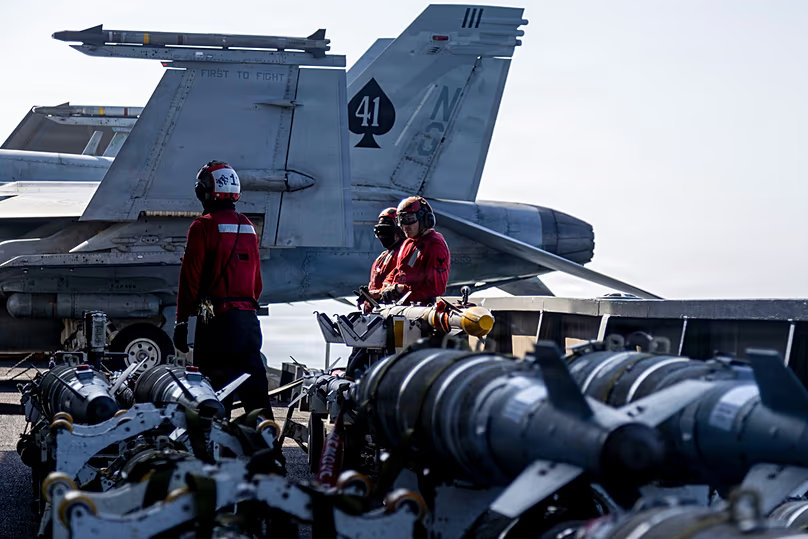
However, recent military developments have made the issue even more sensitive, as the confrontation has entered a more complex phase involving U.S. naval assets in the region. The newspaper reported that Iran had launched ballistic missiles in recent days toward a U.S. aircraft carrier and other warships, noting that some of the attacks came close to producing catastrophic consequences, at a time when Tehran’s ability to target and locate moving vessels had improved during the summer.
This point is particularly important for Washington, since targeting a stationary facility such as a military base differs from tracking warships moving at sea. This means that access to more accurate and timely intelligence could enhance Iran’s ability to engage military targets that are constantly changing position.
From this perspective, Washington believes that Chinese space-based technology and data could provide one of the means of applying pressure on the Islamic Republic, either through sanctions against companies whose involvement is established or by intensifying diplomatic pressure on Beijing to prevent the transfer of this type of data.
-
Israeli report: undeclared Chinese involvement in Iran–U.S. talks
-
Washington Tightens the Maritime Noose Around Iranian Ports
U.S. concerns are growing amid expanding cooperation between Iran, Russia, and China in areas that could strengthen Tehran’s military and intelligence capabilities. Washington’s concern is therefore not limited to Iran’s possession of long-range weapons, but also extends to its ability to integrate those weapons with surveillance, reconnaissance, and target-identification systems, thereby increasing strike accuracy and making it more difficult to protect U.S. forces and facilities deployed across the Middle East.
The Islamic Republic’s acquisition of high-resolution satellite imagery also raises questions about the role played by commercial companies in providing dual-use data, at a time when remote-sensing technologies have become more widely accessible outside traditional military and intelligence institutions.
Against this backdrop, the Trump administration has, in recent weeks, briefed lawmakers on intelligence committees about what it considers Russian and Chinese support for Iran. The move reflects growing concern within U.S. institutions over the sources of power Tehran is benefiting from beyond its domestic military apparatus.
-
Documents: Iran used a Chinese satellite to monitor U.S. bases
-
Russia and China back Iran’s new leader as Washington and Tel Aviv issue threats
The issue does not appear to be limited to the Muwaffaq Salti Air Base incident alone. Rather, it forms part of a broader confrontation in which Iran is seeking to improve its ability to monitor and target U.S. movements, while Washington is attempting to prevent Tehran from obtaining technologies and information that could narrow the U.S. military advantage.
While the Trump administration prefers to avoid an open confrontation with China, continued flows of data and technology to Iran could put Washington before a difficult test: how to pressure Beijing to prevent it from assisting its adversary without turning the issue into another crisis with a major power with which the U.S. administration seeks to maintain stable relations.
Ultimately, the satellite-imagery issue reflects a new dimension of the U.S.-Iranian conflict. The confrontation is no longer limited to missiles, aircraft, and drones; information itself has become a central component of the battlefield, while accurate satellite data can become a decisive factor in identifying targets, directing strikes, and threatening U.S. forces in a region experiencing rapidly escalating tensions.
-
Could the confrontation between Iran and the United States turn into a war of attrition benefiting China and Russia?
-
The fall of Maduro: a step in Rubio’s dream of leading an army of exiles and becoming president of Cuba