Bombing of Ed-Daein Hospital: military escalation raises fears of targeting healthcare facilities in Sudan’s war
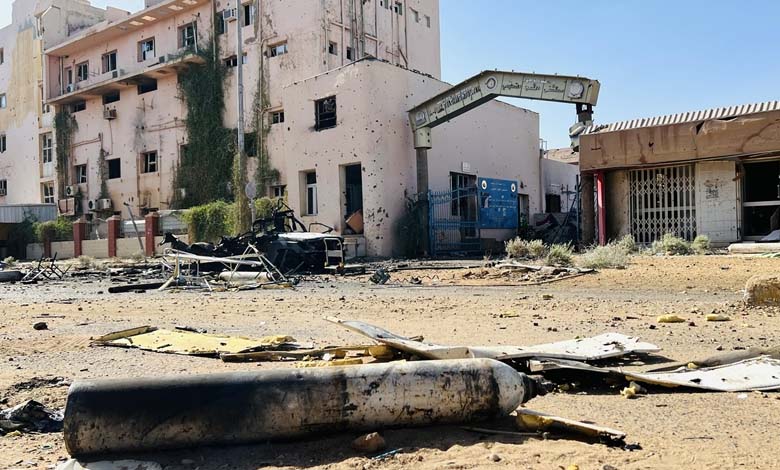
The attack targeting the Ed-Daein Teaching Hospital in East Darfur State has once again highlighted the growing risks faced by civilians and healthcare infrastructure in Sudan, amid the ongoing war and expanding military operations. A medical facility that was supposed to serve as a refuge for patients and the wounded has turned into a scene of humanitarian tragedy after being struck by a drone attributed to Port Sudan forces, resulting in dozens of deaths and injuries.
According to preliminary data issued by the Sudanese Ministry of Health, the attack killed 64 people, including 13 children, 7 women, and 44 men, and injured 81 others with varying degrees of severity. Medical sources indicate that some of the injured are in critical condition, while rescue teams and volunteers continue to transport victims and provide available medical care under extremely difficult conditions.
A hospital out of service
Ed-Daein Teaching Hospital is one of the most important healthcare facilities in East Darfur, providing medical services to thousands of residents in the city and surrounding areas. However, the bombardment caused extensive destruction to large parts of the building, especially the emergency department, which is considered the backbone of any medical facility handling urgent cases.
The attack also damaged a significant number of essential medical devices, including resuscitation equipment and critical diagnostic tools, rendering large sections of the hospital inoperable. According to local medical staff, the scale of destruction makes it difficult to resume normal operations in the near future, placing the local healthcare system under severe strain.
Healthcare workers fear that this situation will worsen the humanitarian crisis in the region, particularly as the hospital was one of the few centers capable of handling critical cases.
Political and human rights condemnations
The attack triggered widespread condemnation in political and human rights circles both within Sudan and internationally. The Rapid Support Forces described the bombing of the hospital as a fully constituted war crime, stating that targeting a medical facility constitutes a clear violation of international humanitarian law.
In a statement, they said the incident reflects the seriousness of the ongoing military escalation in the country and underscores the need to hold those responsible accountable for crimes committed against civilians. They also expressed solidarity with the victims’ families and pledged to pursue those involved through international legal channels.
The Rapid Support Forces called on the United Nations and international human rights organizations to act urgently to open an independent investigation into the incident in order to determine legal responsibility and ensure that perpetrators are not granted impunity.
Calls for an international investigation
For its part, the Sudan Liberation Movement – Democratic condemned the bombing, describing it as a blatant violation of international laws and humanitarian principles. The movement stated that targeting a civilian hospital crowded with patients represents a dangerous escalation in the nature of the conflict in Sudan.
In its statement, it emphasized that the international community must take concrete steps to document this crime and bring those responsible before competent international courts. It also held parties supporting Port Sudan forces morally and legally responsible for attacks targeting civilians and civilian infrastructure.
The movement stressed that protecting civilians must be an absolute priority in any armed conflict, and that targeting children, patients, and healthcare workers constitutes a crossing of all red lines.
Escalation of air operations
In the same context, the Sudanese Observatory for Human Rights warned that the attack on Ed-Daein Hospital is part of an increasing military escalation in Darfur regions in recent times. It noted that intensive air operations carried out by Port Sudan forces pose a direct threat to civilian lives.
The Observatory stated that targeting residential areas and vital infrastructure, especially healthcare facilities, reflects a serious deterioration in compliance with international humanitarian law. It added that international law requires parties to a conflict to respect the principle of distinction between military and civilian targets and prohibits targeting medical facilities that enjoy special protection.
The Observatory emphasized that the continuation of such attacks could lead to the collapse of remaining essential services in affected areas, especially given the limited capacity of the healthcare sector.
Violation of international humanitarian law
Commenting on the attack, Nadine Ali, a member of the Sudanese National Observatory for Human Rights, said that the airstrikes targeting cities in Darfur during the first day of Eid al-Fitr constitute a grave violation of international humanitarian law.
She explained that the targeting of Ed-Daein Teaching Hospital resulted in civilian casualties, including children and medical staff, making it one of the most serious attacks on healthcare facilities during the current conflict.
She added that international law grants special protection to hospitals and medical facilities and obliges parties to a conflict to take all necessary precautions to avoid harming them. She affirmed that any attack on such facilities constitutes a serious crime requiring investigation and accountability.
She also called for an end to the military escalation in Darfur and for the protection of civilians and essential infrastructure upon which the population depends.
A potential humanitarian catastrophe
Experts in humanitarian affairs believe that the attack on Ed-Daein Hospital could have serious consequences for the health situation in East Darfur. With large parts of the hospital destroyed, thousands of patients may be left without adequate medical services, at a time when the region already suffers from a severe shortage of doctors and medicines.
Transporting patients to other cities may also be extremely difficult due to the deteriorating security situation and high transportation costs, increasing the likelihood of higher mortality rates among those in need of urgent care.
Moreover, continued aerial bombardment could force more residents to flee, further straining already limited healthcare facilities in other areas.
War and civilian infrastructure
Since the outbreak of the war in Sudan, many civilian infrastructures have suffered severe damage, including hospitals, schools, and electricity and water facilities. Observers believe that targeting such infrastructure further complicates the humanitarian crisis and makes future reconstruction more difficult.
The destruction of healthcare infrastructure also has long-term effects, leading to a decline in medical services and an increase in disease and mortality rates, especially among vulnerable groups such as children, women, and the elderly.
Calls to stop attacks
In light of these developments, calls are increasing for urgent measures to protect civilians and medical facilities in Sudan. Human rights organizations emphasize that respect for international humanitarian law must be a fundamental condition in any armed conflict.
They also urge the international community to pressure the parties to the conflict to stop attacks targeting civilian areas and to ensure the delivery of humanitarian aid to affected regions.
An ongoing humanitarian tragedy
For the residents of Ed-Daein, what happened is not just an isolated incident, but a humanitarian tragedy that has left deep scars. The hospital, which once represented the last hope for many patients, has now become a symbol of the extent of civilian suffering during the war.
As doctors and volunteers continue their efforts to assist the injured, the hopes of victims’ families remain pinned on achieving justice and holding those responsible accountable, amid growing fears that such attacks may become a recurring reality in the Sudanese conflict.