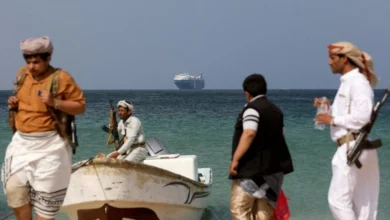
Piracy with Houthi Fingerprints… The Alliance of Terrorist Leaders Threatens Waterways

The specter of piracy has once again struck international shipping routes between the coasts of Somalia and Yemen, bearing Houthi fingerprints and threatening the security of vital waterways.
Over the past two days, a source within the Yemeni Coast Guard confirmed the failure of two piracy attempts targeting commercial vessels 66 miles off Socotra.
-
Yemeni political analyst: Houthis are worsening civilians’ suffering as Eid al-Adha approaches amid deteriorating humanitarian conditions
-
The incident of the woman seeking protection ignites Yemen’s Al-Jawf… The Dahm tribes rise up against the Houthis
This comes weeks after Somali gunmen hijacked the oil tanker “Eureka,” sailing under the Togolese flag, off the Yemeni coast of Shabwa, before taking it to the shores of Somalia’s Puntland region while demanding a ransom of 10 million dollars.
Within less than two weeks, between April and May, pirates seized four vessels in waters near Somalia, according to media sources.
Experts believe that the resurgence of piracy between the Somali and Yemeni coasts comes amid operational coordination and role-sharing between the Houthis and Somali extremist groups, most notably the “Al-Shabaab” movement, the Somali branch of the terrorist organization Al-Qaeda.
-
The Councils of Death… The secret structure of the Houthi militias
-
The Houthis expand the scope of surveillance against Yemenis: monitoring patients
Houthi Encouragement
In this context, the director of the “South 24” Studies Center in Aden, Yaqoub Al-Sufyani, said that “the actions of the Houthi militias against international navigation, particularly during 2024, and the targeting of ships passing through the Bab el-Mandeb Strait, the Red Sea, the Arabian Sea, and the Gulf of Aden, have led to the revival of piracy operations in this region.”
Al-Sufyani added that “the Houthi militias, which escaped punishment and the necessary international response, are now behind encouraging Somali piracy operations, which have a long history of targeting maritime trade routes, ships, and navigation after previously being deterred and reduced through strikes carried out by international forces protecting the waterways.”
He pointed out that “the formation of international forces and naval alliances, including the European Aspides mission and the American coalition, has not been sufficient to demonstrate the appropriate punishment and deterrence against the Houthis in a way that guarantees the non-return of piracy operations to this region.”
-
The assassination by the Houthis of a tribal leader in Al-Jawf ignites a confrontation with the Dahm tribes
-
Hidden collusion with the Houthis: the record of the Muslim Brotherhood’s maneuvers from Taiz to the coast
He stressed that the Houthi militias, through their alliance with the “Al-Shabaab” movement, stand behind the financing and facilitation of piracy activities, noting that the relationship between the Houthis and the Somali “Al-Shabaab” movement “has become a documented relationship and is no longer merely speculation or accusation, but has appeared in the reports of the Panel of Experts on Yemen and in United Nations Security Council reports.”
He explained that “the relationship between the Houthis and Al-Shabaab is one based on mutual interests and benefits, despite the ideological contradictions between the two sides. This alliance is built on the exchange of weapons and advantages, as the Houthi militias have effectively become arms dealers for terrorist and armed groups in the Horn of Africa, including pirates.”
He noted that “the Houthi militias do not hesitate to send weapons to any party in exchange for money, given that the group’s economy is built on war.”
-
The first since the outbreak of the war with Iran: interception of a Houthi missile targeting Israel
-
Chaos, fear and the militarization of public space: pillars of Houthi power in northern Yemen
Al-Sufyani believes that “pirates in Somalia are likely connected to the Al-Shabaab movement and have obtained weapons and technologies that help them track ships from the Houthi militias, which in turn acquired them from Iran.”
Al-Sufyani urged the Yemeni government and the governments of Horn of Africa countries to activate “strong maritime cooperation” to combat piracy operations, calling on the international community to support the Yemeni naval forces and Yemeni Coast Guard, as well as provide Djibouti and Somalia with the necessary capabilities to monitor, track, and pursue pirates on both shores.
He affirmed that “the experiences of local forces have always proven to be more successful and effective than international coalitions, which come at great cost but fail to achieve truly effective results.”
-
After Khamenei’s Death, the Houthis in Yemen Face an “Unknown” Fate
-
Political analyst: The Houthis are dragging Yemen into regional conflicts and pushing the country toward greater isolation
Security Vacuums and Houthi Fingerprints
For his part, the director of the African Center for Studies and Research, Dr. Mohammed Saleh Ouda, attributed the rise in piracy activity in the Horn of Africa and Arabian Sea region to security vacuums.
Saleh said that “there are several reasons behind this, including the instability surrounding the Middle East region as a whole, the militarization of international and regional waters stretching from the southern Red Sea to the Indian Ocean and the Arabian Gulf, in addition to the political deadlock in Somalia and the suspension of U.S. aid to the country.”
He added: “Alongside security challenges, extremely difficult economic and social conditions emerge as a major factor driving young people to seek alternative and rapid ways of obtaining financial resources. In this context, an extremely dangerous factor stands out: the spread of illegal and unregulated fishing.”
-
Domination through intimidation: the Houthis impose their ideology by force of arms
-
A human rights report exposes the secret collusion between Yemen’s Brotherhood and the Houthis against the South
He also pointed to the role of the Houthi militias and regional interests in destabilizing the region in order to facilitate arms smuggling and expand political influence, asserting that the Houthis’ interest lies in destabilizing the area by supporting piracy operations to strengthen their influence and secure smuggling routes.
While emphasizing that the vast length of the Yemeni and Somali coastlines represents a major geographical challenge that is difficult to control without genuine international cooperation, he stressed “the necessity of joint intelligence coordination among coastal states and the assistance of trusted allies to secure these vital waterways.”
-
From Marib to Midi: How Muslim Brotherhood Strongholds Became a Transit Corridor for Houthi Weapons
-
Houthis recalibrate their military compass toward southern Yemen
-
South Yemen Unifies Its Ranks Against the Houthis: Securing the Rear Before Moving Toward Sanaa