Road Blockades and Stone-Throwing at the Army: Hezbollah Responds to the Southern Agreement with a Strategy of Disorder
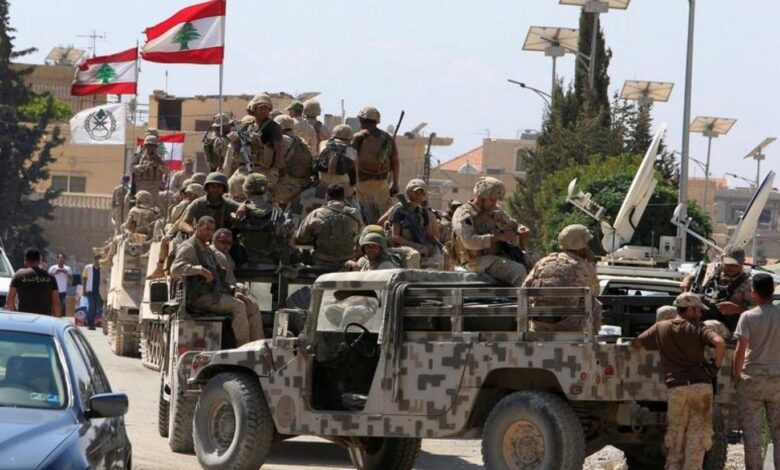
Shortly after Hezbollah warned of the possibility of a “civil war” in response to the agreement reached between Lebanon and Israel, whose ink has barely dried, the group mobilized its supporters onto the streets of Beirut.
Lebanon’s official National News Agency (NNA) reported that Hezbollah members and supporters took to the streets of Beirut on Friday to protest the agreement announced only a few hours earlier between Israel and Lebanon.
According to the National News Agency, Hezbollah supporters rode motorcycles through several streets of Beirut, particularly in central districts near Parliament and along the road leading to the airport, to protest the framework agreement announced between Lebanon and Israel. The agency added that some demonstrators blocked at least one road by setting tires on fire.
The Disorder Card
A correspondent for Agence France-Presse (AFP) observed groups of motorcyclists traveling along one of the city’s main roads, while the Lebanese Army established temporary checkpoints across several streets.
Videos circulating widely on social media show Hezbollah members setting vehicle tires ablaze and demonstrating in the streets against the agreement, which has been described as “historic.”
According to multiple matching posts published by Lebanese social media users claiming to have witnessed the events firsthand, Hezbollah members and supporters blocked roads across Beirut and threw stones at Lebanese Army personnel in protest against the signing of the agreement.
Threat of Civil War
Meanwhile, Hezbollah Member of Parliament Hassan Fadlallah warned that the agreement could only be “imposed” through a “civil war.”
Fadlallah, whose party has repeatedly expressed its opposition to direct negotiations between Lebanon and Israel, stated that Israeli Prime Minister Benjamin Netanyahu “was negotiating with himself.” He added that “this Lebanese authority will not be able to implement the agreement signed in Washington unless, with American support, it moves toward a civil war.”
He further argued that the agreement represents “an attempt to obstruct the Islamabad process,” referring to the reported Iranian-American understanding calling for an end to hostilities across all Middle Eastern fronts, including Lebanon.
Details of the Agreement
Israel’s Public Broadcasting Corporation revealed that the signed framework agreement establishes the fundamental principles for launching a gradual withdrawal of the Israeli military from parts of southern Lebanon under new security arrangements designed to facilitate the redeployment of the Lebanese Armed Forces into the evacuated areas. However, any complete Israeli withdrawal remains conditional upon the dismantling of Hezbollah’s military arsenal.
According to the broadcaster, the agreement includes, in addition to its political framework, a security annex approved by the parties. It stipulates that Israeli forces will remain stationed in certain areas of southern Lebanon until it has been verified that Hezbollah and other armed organizations regarded by Israel as security threats have been disarmed.
Israeli officials further stated that the first phase will involve implementing a pilot project in two mutually agreed areas, one located north of the Litani River and the other to its south. Israeli forces will withdraw from these two zones, after which units of the Lebanese Armed Forces will assume responsibility for security and deployment there.
The agreement also establishes mechanisms for addressing military tunnels, preventing Hezbollah from rearming, and opening negotiations on the demarcation of the land border between the two countries.
The Israeli Public Broadcasting Corporation also quoted a well-informed Israeli source as saying that the Israeli military would reposition itself within the “security belt” but would not completely leave Lebanese territory during this stage.
The same source added that the pilot project would remain limited in scope and that the territory under Israeli military control would gradually shrink as forces were redeployed, thereby allowing the Lebanese Armed Forces to enter and assume control of the agreed areas.
According to the source, residents of Lebanese villages located within the two pilot project areas are expected to be able to return to their homes, a step that had not been possible in recent months because of the Israeli military presence in those locations.