Oklahoma Opens an Investigation into the Muslim Brotherhood and CAIR: A Security Probe Extending Beyond State Borders and Calling for Federal Designation
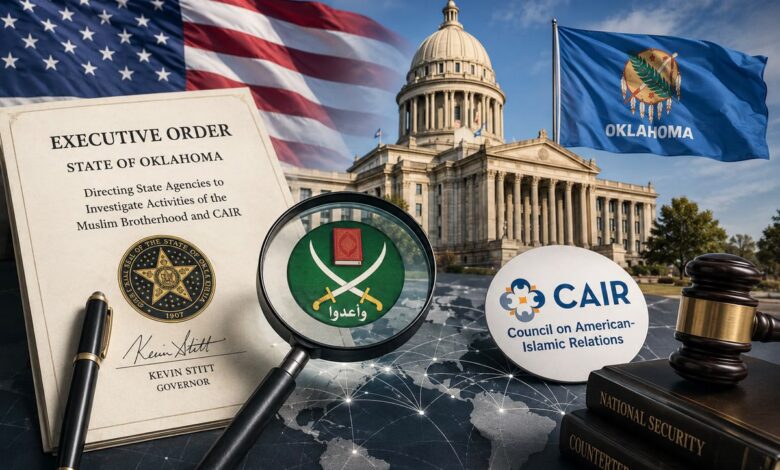
In a significant political and security move, the U.S. state of Oklahoma has entered the growing debate surrounding the Muslim Brotherhood and the network of organizations associated with it in the United States. On August 12, 2026, Governor Kevin Stitt issued an executive order directing the state’s public safety and security agencies to conduct an intelligence-based assessment of the activities of the Muslim Brotherhood and the Council on American-Islamic Relations (CAIR), and to determine whether the movement, the organization, or individuals and entities acting on their behalf pose a terrorist threat or a risk to public safety within Oklahoma.
The significance of the move, however, lies not only in the opening of a state-level investigation. The executive order also links this local inquiry to a broader call for action at the federal level. Stitt directed state public safety officials to advocate for the U.S. government to take steps toward designating the Muslim Brotherhood and CAIR as Foreign Terrorist Organizations. This makes the decision part of a broader American debate over how to deal with the movement, its networks, and its branches, rather than merely a local security measure.
The official wording makes clear, however, that the executive order does not itself designate any entity as a Foreign Terrorist Organization. A state governor does not possess that authority under the federal legal framework governing such designations. Instead, the order does what is within the powers of state authorities: it instructs state agencies to conduct an intelligence-based assessment, take preventive and investigative measures permitted by law based on the findings, and simultaneously call on the federal government to consider a designation.
This distinction is essential to understanding the scope of the decision, particularly because the term “Foreign Terrorist Organization” carries a specific meaning and significant legal consequences within the U.S. legal system. Under Section 219 of the Immigration and Nationality Act, an organization must be foreign, engaged in terrorist activity or retain the capability and intent to engage in such activity, and its activities must threaten the security of U.S. nationals or the national security of the United States. The authority to make such a designation rests with the U.S. Secretary of State, in consultation with other government agencies, rather than with state governors.
From a Local Investigation to a Federal Issue
Stitt’s decision therefore seeks to build a bridge between two different levels of American security policy. The first is the state level, where Oklahoma agencies are responsible for gathering information and assessing potential risks within the state’s borders. The second is the federal level, where the authority to designate foreign organizations falls within the legal jurisdiction of the U.S. government.
According to the governor’s office, the executive order is based on responsibilities already assigned to the state under Oklahoma’s homeland security and counterterrorism laws, which give local authorities a role in preventing terrorist acts, identifying threats, and preparing to respond to potential risks. The order took effect immediately upon its issuance.
Legally, therefore, the move does not amount to Oklahoma declaring that CAIR or the Muslim Brotherhood is a terrorist organization. Rather, it launches an investigative process that could, depending on its findings, lead to recommendations and actions at the state level, while also generating political pressure for action by the federal government.
This distinction is important because political rhetoric surrounding terrorism often conflates “investigation” with “designation.” An investigation involves examining facts, evidence, and potential connections. Designating an organization as a Foreign Terrorist Organization, by contrast, is a federal legal procedure governed by specific criteria and processes.
Why Now?
Stitt’s decision comes within a broader American context shaped over the previous year by presidential action targeting certain branches of the Muslim Brotherhood.
In November 2025, President Donald Trump issued Executive Order No. 14362, launching a process to examine the possible designation of certain branches of the Muslim Brotherhood as Foreign Terrorist Organizations, as well as Specially Designated Global Terrorists. The order mentioned branches in Lebanon, Jordan, and Egypt and linked the initiative to what it described as violent activities, support for violence, and destabilizing actions in the Middle East.
Under that order, the Secretaries of State and the Treasury, in consultation with the Attorney General and the Director of National Intelligence, were instructed to prepare a report on branches that could potentially be subject to designation and subsequently take appropriate action in accordance with relevant federal laws.
This forms part of the background to Stitt’s position: there is an existing policy direction in Washington toward reassessing certain branches of the Muslim Brotherhood, while the debate is gradually extending to individual U.S. states.
However, the existence of a federal decision concerning foreign branches of the Muslim Brotherhood does not automatically mean that every American organization with a similar name, or one alleged to have historical or ideological connections to the movement, becomes a terrorist organization. Any federal designation requires a specific legal determination, evidence, and criteria applicable to the entity concerned.
CAIR at the Center of the Debate
The most sensitive aspect of Oklahoma’s decision is the inclusion of the Council on American-Islamic Relations (CAIR) in the assessment. CAIR describes itself as an organization dedicated to defending the civil rights and liberties of American Muslims. Its critics have, for years, raised allegations concerning historical or organizational links to the Muslim Brotherhood and other entities, allegations that the organization rejects.
The executive order refers to the terrorism-financing case involving the Holy Land Foundation. In that case, CAIR appeared on a lengthy list of entities described at the time as “unindicted co-conspirators,” without this meaning that CAIR itself was charged with committing a crime in the case. This distinction was also highlighted by local media in their coverage of the decision.
The issue is particularly significant because the mere appearance of an organization’s name in a court document or in the context of a security-related case does not, as a matter of law, establish its involvement in terrorist activity. The question Oklahoma agencies will therefore have to address is not simply whether names or historical connections appeared in previous documents, but whether there is specific and assessable evidence of activity that constitutes a terrorist or security threat within the state.
A Battle Between Security and Civil Rights
The decision has also sparked an internal debate in Oklahoma over the boundaries between counterterrorism and the protection of civil liberties. Critics of the order argue that using security agencies to investigate a Muslim civil organization could create a climate of suspicion surrounding the civic and political activities of American Muslims, particularly in the absence of a specific security incident or publicly announced criminal charge justifying the investigation.
KOSU reported that CAIR Oklahoma rejected the decision, arguing that the organization works in the field of civil rights and constitutional liberties and pointing to its involvement in cases concerning religious freedom and equality before the law. The organization has argued that its civil rights work in the state is the reason it has been targeted, an interpretation rejected by the Stitt administration.
Supporters of the decision, on the other hand, argue that preventive security does not require authorities to wait for an attack or crime to occur. From their perspective, if intelligence indicators suggest the existence of a network that could pose a threat, security agencies have a responsibility to investigate before any harm occurs.
This is where the central dilemma lies: how can the state investigate a potential threat without turning suspicion into a presumption of guilt?
A Potential Legal Battle
The legal dimension is likely to become one of the most important factors determining the future of the decision. The executive order itself calls for “lawful” action based on the information obtained, meaning that state agencies have not been granted unrestricted authority to bypass the Constitution or existing laws.
In the United States, freedom of speech, religion, and association are constitutionally protected. Any measure targeting an organization because of its ideas or the religion of its members could therefore face significant legal challenges. However, if an investigation is based on evidence of specific crimes, unlawful financing, or material support for designated terrorist organizations, the legal situation would be fundamentally different.
The issue is further complicated by CAIR’s previous involvement in legal disputes within Oklahoma, including cases related to freedom of worship and the construction of mosques. In July 2026, the U.S. Department of Justice opened an investigation into zoning and land-use practices in the city of Broken Arrow following the rejection of an application involving a proposed mosque, according to CAIR.
The situation in Oklahoma therefore appears to be developing along two parallel tracks: a security track focused on CAIR and the Muslim Brotherhood, and a civil rights track concerning the protection of Muslim religious and civic institutions.
What Comes Next?
The next step is not an automatic federal designation, but rather the completion of the assessment ordered by the governor. So far, the state has not announced a specific incident within Oklahoma that directly prompted the issuance of the order, nor does the executive order establish a final deadline for completing the assessment or publicly releasing its findings.
This leaves several possible scenarios open. The first is that state agencies conclude there is insufficient evidence of a direct terrorist threat, in which case the decision may come to be seen more as a political move than as a security measure producing tangible results.
The second scenario is that the investigation uncovers violations, connections, or financial activities that justify referring cases to law enforcement authorities, potentially leading to separate legal proceedings.
The third, and most sensitive, scenario is that the state provides information or recommendations to the federal government in support of a move to designate specific entities.
In every scenario, one central question will remain: can the authorities move from political rhetoric to evidence capable of being tested and evaluated under the law?
States can investigate threats that fall within their jurisdiction, and state governments can exert political pressure on Washington. They cannot, however, independently redefine the federal system governing terrorist designations.
In this sense, Kevin Stitt’s decision represents more than a local security order. It is another chapter in the growing American debate surrounding the Muslim Brotherhood and the boundaries between political, religious, and civic activity on the one hand, and counterterrorism on the other.
The final outcome will not be determined by the political language accompanying the decision, but by whether the investigations produce specific evidence capable of withstanding legal and constitutional scrutiny. Mere ideological, political, or historical disagreement cannot, by itself, serve as a substitute for proof.
Oklahoma has not “designated” the Muslim Brotherhood or CAIR as Foreign Terrorist Organizations. Rather, it has opened a state-level investigation and called on the federal government to consider such a designation. The difference between those two actions is not merely procedural; it lies at the very heart of the case, both legally and politically.