Washington and Moscow Side with Killer Robots at Geneva Conference
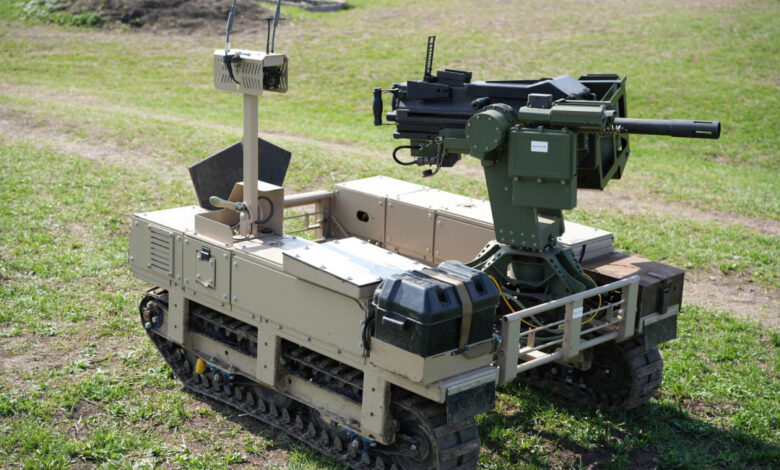
An international confrontation is unfolding over a binding treaty on autonomous weapons, dividing the United States, Russia and Israel from countries seeking to prevent machines from making decisions to kill without human intervention.
States attending an international conference in Geneva face growing disagreement over the future of autonomous weapons. The United States, Russia and Israel oppose legally binding restrictions on their development, while other countries seek negotiations on an international treaty governing their use.
The dispute centres on weapons increasingly capable of identifying, tracking and attacking targets through artificial intelligence, with diminishing need for direct human intervention. This development raises fears that algorithms could determine who is killed in future wars, alongside questions about legal and moral responsibility for the consequences of military operations.
States are considering the issue at the seventh Review Conference of the Convention on Certain Conventional Weapons, held at Geneva’s Palais des Nations from November 16 to 20. Calls include banning some lethal autonomous weapon systems and restricting others while ensuring that humans retain control over decisions concerning the use of force.
The conference encountered difficulties from the outset. Russia’s delegation objected to adopting the agenda because of the participation of observers, including representatives of the European Union and civil society organisations. The disagreement led to proceedings being suspended and consultations lasting several hours.
The United States proposed extending the work of the Group of Governmental Experts for another five years, with the aim of producing non-binding guidelines rather than moving towards negotiations on a new international treaty.
Russia, meanwhile, considers restrictions or prohibitions premature and advocates further study of autonomous systems’ technical and legal aspects. Moscow’s and Washington’s positions align with Israel’s opposition to a binding treaty.
Austria, Belgium, Brazil, Ireland, Mexico, New Zealand and Panama, by contrast, are leading an effort to launch negotiations on a binding international instrument. It would prohibit certain categories of weapons, restrict others and define the level of human intervention required before an attack.
The initiative draws on broad support within the United Nations. In October, 163 countries voted for a resolution calling for action on autonomous weapons. The United States, Russia, Belarus, Israel and North Korea opposed it. Nine countries abstained, including China, Iran and Saudi Arabia.
The vote does not mean supporting states have agreed on a specific treaty model. It nevertheless revealed growing demand for international rules while major military powers remain committed to preserving their freedom to develop the technology.
Britain, France and Germany support starting negotiations but leave the final agreement’s form open, whether legally binding or based on voluntary commitments, in an effort to bridge differences.
One of the principal challenges concerns these systems’ ability to distinguish between different battlefield situations. Identifying someone as a combatant is not enough to establish whether that person is still fighting, has been wounded or has surrendered. These circumstances involve different protections under international humanitarian law.
Humanitarian organisations warn that algorithms may fail to interpret such nuances, particularly in complex environments where civilian and combatant movements overlap. The possibility of programming systems to target people based on shared characteristics, such as clothing or movement patterns, also raises fears of fatal mistakes that may be difficult to prevent or correct.
These concerns are no longer confined to future scenarios. Artificial intelligence is already used in military operations in Ukraine, the Middle East and Sudan through systems that help analyse information, identify targets and accelerate targeting processes. Using these technologies does not necessarily mean a weapon independently decides to open fire; however, many systems remain under human supervision.
The distinction between using AI to assist armed forces and allowing it to select targets and execute attacks independently lies at the heart of the Geneva debate. The issue is not simply technological accuracy, but responsibility when systems fail: who is held accountable when an algorithmic decision kills civilians?
Pope Leo XIV has also warned against entrusting life-and-death decisions to artificial intelligence. His position echoes calls from the United Nations and the Red Cross to keep responsibility for the use of force in human hands.
Reaching an agreement nevertheless faces a fundamental obstacle within the Convention on Certain Conventional Weapons: decisions require consensus among states parties, allowing any opposing state to block them. Continued disagreement could prompt countries seeking binding restrictions to pursue negotiations outside this framework, following the example of earlier international treaties concluded beyond traditional consensus mechanisms.
That option would also carry consequences. It could produce an agreement that major military powers decline to join, limiting its reach. Countries most advanced in developing these weapons would be essential participants in any effective international regulatory framework.