Egypt and Sudan’s war: From political support for the army to growing military involvement
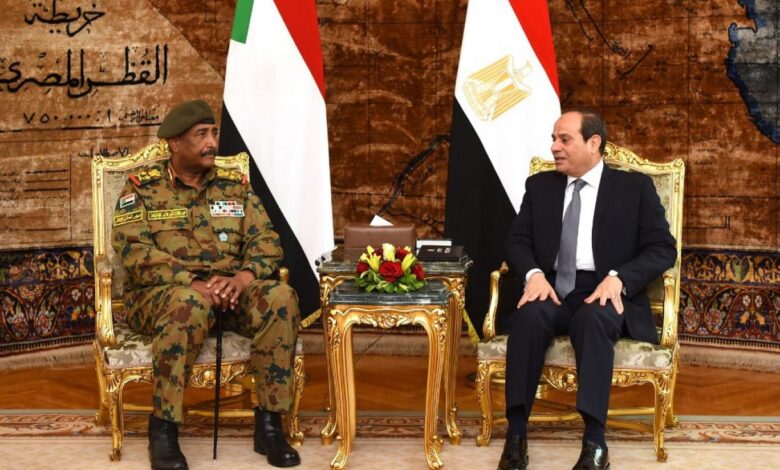
Cairo is expanding its role in the conflict. National security, Nile waters, and Sudan’s unity are cited as justifications for its involvement, while continued military assistance raises questions about the prospects for ending the war.
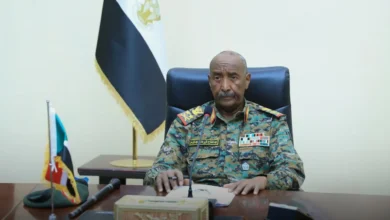
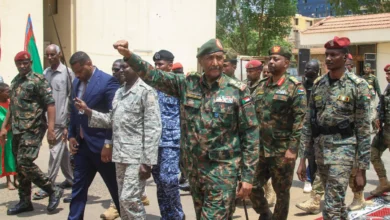
Egypt’s role in Sudan’s war has increasingly extended beyond diplomatic statements and repeated calls to preserve the country’s unity and stability. Cairo has gradually become more visibly involved in the military and political dimensions of the conflict that erupted in April 2023 between the Sudanese Armed Forces (SAF), led by Abdel Fattah al-Burhan, and the Rapid Support Forces (RSF), commanded by Mohamed Hamdan Dagalo.
More than three years after the outbreak of hostilities, Cairo appears increasingly committed to preserving the Sudanese army as the country’s official military institution. This position extends beyond the historical relationship between the two countries and reflects strategic considerations involving the security of Egypt’s southern border, Nile waters, regional power dynamics, and the future of political authority in Khartoum.
Recent developments have revived debate over the nature and limits of Egypt’s role, particularly after Cairo announced on November 25, 2026, that it was prepared to take all measures permitted under international law and its joint defense agreement with Sudan to support Khartoum and protect what it described as its “red lines.” The announcement reflects a shift toward more explicit expressions of willingness to provide assistance beyond conventional political support.
Supporting the army: Cairo’s strategic choice
Since the beginning of the war, Egypt has maintained that Sudanese state institutions must be preserved, giving priority to the Sudanese Armed Forces as the country’s official military institution. Cairo argues that the collapse of the army or the disintegration of state institutions could create a widespread security vacuum and turn Sudan into an arena for armed groups and foreign intervention.
This position nevertheless raises a fundamental political dilemma. Declared support for state institutions does not necessarily imply an impartial stance toward both warring parties, particularly when the institution receiving that support is directly involved in military operations.
This approach has been evident in successive Egyptian statements rejecting the establishment of parallel entities in Sudan and emphasizing the importance of preserving the country’s unity and territorial integrity. Cairo has also directly linked its national security to Sudan’s stability, giving its political involvement a security dimension that extends beyond bilateral solidarity.
Egypt’s position is closely connected to the historical relationship between the two countries’ military establishments. Cairo and Khartoum have longstanding military and security cooperation, alongside shared strategic interests that make any major shift in Sudan’s balance of power directly relevant to Egyptian security calculations.
From logistical support to allegations of involvement in air operations
One of the most sensitive aspects of Egypt’s role concerns the nature of the military assistance Cairo may have provided to the Sudanese army.
In an investigation published on February 2, 2026, Reuters quoted Egyptian security officials acknowledging that Egypt had provided logistical and technical support to the Sudanese Armed Forces. The investigation also examined the strengthening of military infrastructure in southern Egypt over the preceding months as part of efforts to protect the border and address security threats.
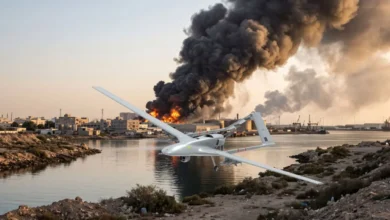
The investigation reported the presence of Turkish-made Bayraktar Akıncı drones in Egypt, drawing on satellite imagery analyzed by military experts. It also referred to cargo flights arriving from Turkey, while noting that their exact contents could not be independently established.
These findings are significant because they raise questions about whether Egypt’s border regions could serve a broader role in providing military and technical assistance related to operations inside Sudan.
The commander of the Rapid Support Forces has previously accused Egypt of participating in airstrikes against his forces, allegations that Cairo has denied. Reuters also cited media and diplomatic sources concerning an alleged airstrike against an RSF convoy in a border region, while emphasizing that it had been unable to independently verify the details.
It is therefore essential to distinguish documented evidence concerning military equipment and drones from allegations or information attributed to unnamed sources regarding direct involvement in airstrikes. These different categories of evidence require separate assessment.
Nevertheless, the evolution of Egypt’s military presence near Sudan, alongside Cairo’s stated willingness to act under the joint defense agreement, indicates that Egyptian security considerations have become increasingly intertwined with the course and outcome of the war.
The joint defense agreement: A legal framework or a pathway toward expanded intervention?
Cairo’s announcement that it is prepared to act under its joint defense agreement with Sudan marks a significant development in Egyptian political rhetoric. The agreement provides a strategic framework for bilateral relations while raising questions about the circumstances under which political support could develop into a direct military commitment.
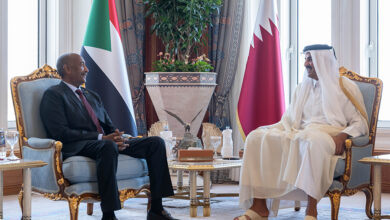
On November 24, 2026, a joint Egyptian-Sudanese statement emphasized the importance of protecting Sudanese state institutions, particularly the armed forces, rejecting threats to the country’s unity and opposing recognition of parallel entities. The following day, Cairo reaffirmed its readiness to take measures authorized under international law and the joint defense agreement.
These statements indicate that Egypt has moved from expressing concern about developments in Sudan’s war toward defining political and security red lines whose violation it would regard as a direct threat to national security.
A fundamental question consequently arises: could an expanded interpretation of Egypt’s national security interests lead to deeper military involvement in Sudan?
Politically, Cairo can present this approach as a preventive measure aimed at avoiding the disintegration of the Sudanese state. The extensive shared border means that any deterioration in Sudan’s security environment could contribute to smuggling, armed group activity, and further population displacement.
In practical terms, however, direct military intervention or extensive operational assistance to one of the warring parties could intensify the confrontation and make Egypt a more directly involved actor, potentially reducing its capacity to engage with Sudan’s various political forces.
Drones and military reinforcement in southern Egypt signal changing strategic calculations
Reports of strengthened military infrastructure in southern Egypt have gained significance in assessments of Cairo’s role because of the region’s proximity to Sudan and the military equipment identified through satellite imagery.
According to Reuters, imagery collected between September 2025 and January 2026 revealed the presence of Turkish-made military aircraft.
The investigation also indicated that Cairo had become increasingly concerned over RSF advances in Darfur, particularly following the fall of El Fasher in October 2025, which had been the Sudanese army’s last major stronghold in the region at the time.
These developments suggest that changes in the balance of power on the ground played an important role in Egypt’s reassessment of the risks associated with the war.
The strengthening of military capabilities in southern Egypt can therefore be understood as part of border protection preparations. It also raises questions about their potential use in supporting the Sudanese army.
No published evidence conclusively establishes that all the equipment concerned was used in combat operations inside Sudan. The presence of drones alone is likewise insufficient to establish Egypt’s direct involvement in airstrikes.
However, the coincidence of these developments with reports of logistical and technical assistance and recent Egyptian official statements makes the military dimension one of the most prominent aspects of Cairo’s involvement in the war.
Sudan and Nile waters: Strategic considerations beyond the battlefield
Egyptian policy toward Sudan cannot be understood without considering the issue of Nile waters, one of the principal determinants of Egypt’s national security.
Sudan represents a vital geographical and political partner for Egypt in the management of Nile water resources. Any significant transformation in Sudan’s political leadership could also affect Khartoum’s positions on regional water-related issues.
On November 2, 2026, the two countries held the third round of their joint consultation mechanism in Cairo, bringing together their foreign affairs and irrigation ministers. Both sides reaffirmed that their water security was interconnected and indivisible, while emphasizing their water rights and existing uses under the 1959 Nile Waters Agreement.
The discussions also addressed coordination on water-related matters and the two countries’ positions in regional and international forums.
These developments demonstrate that Cairo regards Sudanese stability as an integral component of an interconnected regional security and water management framework.
From this perspective, Egypt’s support for the Sudanese army reflects historical and military considerations alongside a determination to preserve a partner with whom it shares strategic interests, most notably those concerning Nile waters.
Reducing Sudan’s political future to the preservation of Egypt’s water-related interests, however, risks overlooking Sudan’s independent national priorities. Sustainable stability requires broad domestic consensus extending beyond the preservation of existing institutions.
The civilian forces conference and the limits of Egypt’s political role
Egypt’s involvement also extends to Sudan’s political process through its organization of meetings involving civilian and political forces.
In July 2024, Cairo hosted a conference of Sudanese political and civilian groups in an effort to create space for dialogue on ending the war and developing a political framework capable of overcoming national divisions.
Egypt referred to this initiative as part of its political commitments during the September 2025 meeting of the foreign ministers of the Quad mechanism. The meeting emphasized the need for a humanitarian truce, followed by a permanent ceasefire and an inclusive civilian-led political transition.
The joint statement also stressed that external military assistance to the warring parties contributes to escalating and prolonging the war, and that ending such assistance is essential to resolving the conflict.
This reveals a contradiction that warrants examination. Cairo supports ceasefire initiatives and political settlement efforts while simultaneously reaffirming its military and political support for the institution engaged in the war.
The consequences of Egyptian assistance must be evaluated according to its nature and effects. Continued military support for either party can influence its willingness to negotiate, particularly when it believes external assistance may strengthen its position.
Has Egyptian support contributed to prolonging the war?
This is the central question in assessing Egypt’s role. In theory, logistical, technical, and intelligence assistance can strengthen the army’s ability to sustain military operations and reduce the pressure that might otherwise encourage negotiating concessions.
The provision of military equipment and technology, if proven to be connected to combat operations, could also contribute to the intensification of hostilities and make a prompt settlement more difficult to achieve.
Establishing that Egyptian assistance alone has prolonged the war would nevertheless require evidence concerning the scale and timing of the support, as well as its direct impact on the military decisions of the recipient.
Sudan’s war stems from a combination of domestic factors involving struggles over political power, resources, and military institutions, alongside foreign assistance and competing centers of influence.
Cairo’s responsibility should therefore be examined in light of the nature of its support and its compatibility with commitments to a ceasefire and civilian protection, while accounting for the complex internal dynamics of Sudan’s conflict.
Civilians pay the price of the prolonged war
While Cairo emphasizes its national security, Sudan’s unity, and the preservation of state institutions, Sudanese civilians remain the principal victims of continuing hostilities.
The war has generated widespread displacement, destroyed infrastructure, weakened healthcare and education services, and aggravated food insecurity across several regions.
The situation is becoming increasingly serious as drone attacks also affect civilian infrastructure, including electricity and water facilities.
On November 1, 2026, Egypt’s Ministry of Foreign Affairs condemned the escalation of drone attacks against civilian and critical infrastructure in Sudan. It called for civilian protection, an end to the flow of weapons, and stronger efforts to secure a ceasefire and facilitate humanitarian assistance.
These statements raise further questions about Egypt’s ability to reconcile its support for the Sudanese army with meaningful pressure to bring military operations to an end.
Protecting the Sudanese state requires a political resolution to the war. Preserving the military establishment must also be accompanied by the development of a political consensus that guarantees the participation of Sudanese society’s various constituencies.
Egypt faces the challenge of balancing security and peace
Recent developments indicate that Egypt’s role in Sudan has become increasingly connected to direct military and security considerations. Cairo has moved from conventional political support toward declaring its willingness to act under the joint defense agreement, alongside indications of strengthened military capabilities near the border.
The information disclosed by Reuters concerning logistical and technical assistance and the presence of drones warrants continued independent scrutiny, particularly regarding its potential connection to military operations inside Sudan.
Determining whether Egyptian assistance has contributed to prolonging the war requires a rigorous assessment of its impact on the decisions of both parties, the prospects for negotiations, and the scale of civilian casualties.
If Egypt’s stated objective is to protect Sudan from disintegration, its central challenge lies in achieving that objective without allowing military assistance to become an additional factor in prolonging the conflict. Sudan’s lasting stability depends on a political settlement capable of ending the war and rebuilding state institutions on inclusive national foundations.