Corruption, companies, gold, and public funds: Why are calls to hold al-Burhan and his inner circle accountable growing in Sudan?
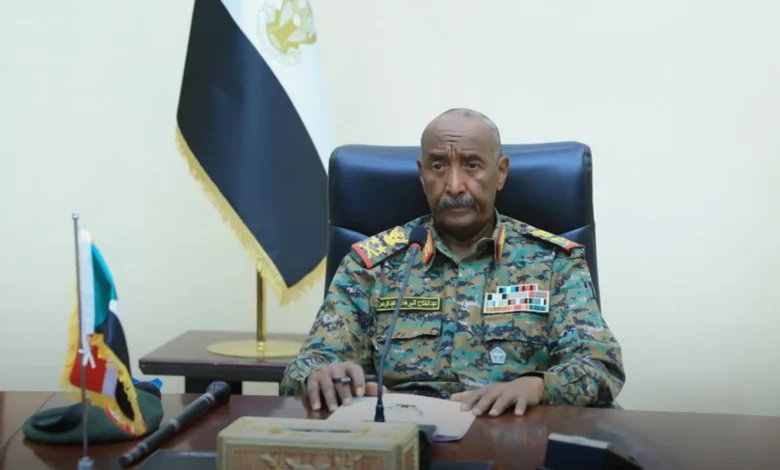
Calls for Abdel Fattah al-Burhan to step down have increasingly extended beyond opposition to the ongoing war and deteriorating living conditions. They now intersect with more complex questions concerning the management of public funds, oversight of economic entities linked to the military establishment, sources of wartime financing, and the ability of state institutions to combat corruption in the absence of independent scrutiny.
As participants in the “Ikhtana ya Burhan” (“Leave us alone, al-Burhan”) campaign raise slogans demanding the army chief’s departure, issues involving the economy, gold, and companies affiliated with military institutions have emerged among the principal matters requiring transparent investigations and legal accountability.
These concerns encompass economic affairs documented in international reports, alongside cases that remain subject to ongoing investigations and political or journalistic allegations whose definitive legal outcomes have yet to be established.
The war economy brings public finances under scrutiny
Sudan has historically suffered from profound difficulties in managing public resources, particularly during the decades in which the former regime dominated the country’s economic and political institutions.
In a report published in May 2025, the U4 Anti-Corruption Resource Centre highlighted the relationship between corruption, institutional weakness, and opaque transactions, as well as the influence exerted by military and political institutions over major economic sectors, including agriculture, energy, and mining.
The report noted that companies affiliated with military and paramilitary institutions wield considerable influence across profitable sectors of the economy, amid significant challenges involving transparency, oversight, and financial accountability.
These concerns become increasingly serious during wartime, when economic resources are transformed into instruments for financing military operations and defense expenditure takes precedence over healthcare, education, and infrastructure.
One of the central questions raised by demands for accountability among Sudan’s leadership therefore concerns the extent to which economic entities affiliated with the military are subject to independent financial oversight and whether their revenues are transparently transferred to the public treasury.
Military-affiliated companies under scrutiny
Zadna stands out as one of the companies warranting particular attention in the debate surrounding the relationship between Sudan’s military establishment and the national economy.
European sanctions documents describe the company as being 99 percent owned by a private fund controlled by the Sudanese Armed Forces (SAF).
The documents also indicate that al-Burhan appointed Lieutenant General Mirghani Idris Suleiman as chairman of the company’s board in October 2021 and that Zadna forms part of a network of companies associated with the military establishment.
The documents link revenues generated by this network to the military establishment’s economic capacity and examine the role of its affiliated companies in financing the army’s activities.
These findings raise questions about the relationship between political authority and economic resources, as well as the separation between public funds and the institutional and commercial interests associated with the Sudanese Armed Forces.
The available information remains insufficient, however, to establish that al-Burhan personally embezzled funds or bears direct criminal responsibility for every commercial activity associated with the military.
The situation calls for an independent investigation into contracts, revenues, expenditure, and the companies’ beneficial ownership, alongside the public disclosure of financial audit findings.
Gold: A national resource that has become fuel for war
Gold occupies a central position in Sudan’s economy and has become one of the principal sources of financing associated with the conflict.
In July 2026, the British government announced sanctions against 11 individuals and entities suspected of involvement in financial and commercial supply networks supporting both sides of Sudan’s war.
The announcement covered Sudanese mining companies and networks associated with financing military operations and procuring equipment and supplies, including entities linked to the Sudanese Armed Forces and the Rapid Support Forces (RSF).
The British authorities also indicated that official gold exports were valued at approximately $1.5 billion in 2024 and 2025, while the sector’s actual value is believed to be considerably higher because of smuggling and informal trade.
These findings illustrate the magnitude of Sudan’s predicament. Despite possessing substantial natural resources, the country is experiencing a devastating war and economic collapse, while illicit commercial networks and conflict-related financing continue to pose major challenges.
Several questions consequently confront the authorities led by al-Burhan. How much revenue is reaching official state institutions? Which authorities oversee gold transactions? How can Sudan ensure that its national resources are protected from diversion toward armed networks operating outside legal oversight?
Bank account freezes open the way for further investigations
One of the significant developments preceding the end of November was the announcement by the Central Bank of Sudan that it had frozen the bank accounts of dozens of companies, institutions, and individuals over suspected money laundering and terrorist financing.
According to a report published by Sudan Tribune on November 17, 2026, the measures affected entities operating in the gold, oil, telecommunications, import, and export sectors, alongside state-owned companies.
The directives were issued in response to requests from the public prosecution authorities and the prosecution office responsible for combating money laundering and terrorist financing, with the aim of preventing the disposal of suspected funds until investigations are completed.
The newspaper explained that the inquiries involved suspected illicit enrichment and unusual financial transfers.
The development is particularly significant amid growing debate over the management of Sudan’s economic resources during wartime. However, the asset freezes are precautionary measures and do not constitute convictions of the individuals or companies concerned.
Nor do they, by themselves, establish al-Burhan’s personal involvement in money laundering.
What does accountability really mean?
Calls for al-Burhan’s resignation and accountability must be grounded in verifiable evidence.
Genuine accountability requires the publication of financial reports, independent audits of companies associated with public institutions, disclosure of the beneficial owners and recipients of contracts and transactions, and investigations into the origins and movement of funds.
It also requires an independent judiciary, prosecution service, and regulatory authorities, alongside safeguards against the misuse of government institutions to protect private interests or settle political scores.
As the war continues, the need for these measures becomes increasingly urgent. A lack of transparency makes it difficult for citizens to determine where national resources are going, who benefits from them, and how much public funding is being allocated to military expenditure.
The “Ikhtana” campaign demonstrates that accountability has become an integral part of Sudan’s political debate. Its demands encompass both a change in leadership and a broader transformation of the way the state is governed.
After years of military coups, warfare, and economic crises, Sudan needs institutions capable of holding officials accountable, regardless of their military rank or political position.
Persistent suspicions surrounding the management of public funds, in the absence of independent investigations and publicly disclosed findings, will perpetuate the crisis of confidence and further undermine the prospects of a political settlement capable of securing the support of the Sudanese people.