From GB News to i24: Khaled Hassan Reopens the Muslim Brotherhood Debate and Puts British Policy under Scrutiny
Two television interviews with British-Egyptian researcher Khaled Hassan, a specialist in national security, foreign policy and counter-extremism, have reopened debate over Western governments’ approach to the Muslim Brotherhood. They have also examined the limits of policies adopted in London, Paris and Cairo towards organisations that some states classify as security and political threats. His appearances on Britain’s GB News and Israeli broadcaster i24 offered two complementary perspectives: one addressing British responsibility for the organisation’s continued activities on European soil, and the other assessing the effectiveness of legal and political measures targeting it and their ability to address the roots of extremism.
In his GB News interview, Hassan did not confine his remarks to Britain’s delay in deciding whether to ban Iran’s Islamic Revolutionary Guard Corps. He broadened the discussion to what he regarded as the absence of a coherent British national security strategy. In his view, the problem is not an isolated decision or a particular organisation, but a political pattern in which security decisions are postponed until events place the government under public pressure and force it to act belatedly.
The researcher argued that this approach affects allies’ confidence in Britain’s ability to take clear and decisive positions on security threats. According to his reasoning, a country seeking to present itself as an influential international partner cannot remain hesitant on matters affecting national security or the activities of transnational organisations. Delaying decisions on banning certain groups may also send contradictory signals to partners expecting a clearer British position.
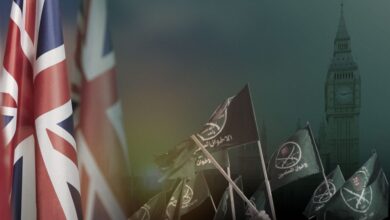
One of the main issues Hassan raised was the Muslim Brotherhood’s continued activity from London. He criticised what he described as the failure to take decisive action against the organisation, arguing that its presence and activities in the British capital raise questions about the consistency of British policy with its stated commitment to countering extremism and protecting national security.
This issue carries particular significance given London’s position as an international political, media and financial centre. Debate over political and religious organisations operating in Britain extends beyond domestic affairs. It also concerns their impact on international networks and the possibility of using an open legal and media environment to conduct activities beyond the host country’s borders.
In this context, Hassan criticised the Conservative Party on GB News for not committing to banning the Muslim Brotherhood, arguing that political promises are insufficient unless translated into practical decisions. He also expressed doubts about British governments’ willingness to take serious action, suggesting that political responses often follow embarrassing events rather than emerge from a pre-existing strategic vision.
His reference to Nigel Farage fit within the same argument: he suggested that the British politician might be more willing to act on the issue. More broadly, however, the remark reflects the extent of political disagreement in Britain over how to address organisations whose activities and objectives are controversial. It also demonstrates that the Muslim Brotherhood issue has moved beyond security policy to become part of wider party-political debates about immigration, identity, security and foreign affairs.
In his i24 interview, Hassan turned to a different question: the effectiveness of permanently placing the Muslim Brotherhood on Egypt’s list of terrorist organisations. He offered a critical assessment, arguing that its practical impact could remain limited without a broader approach addressing the ideas and ideological foundations underpinning the organisation.
The researcher linked Egypt’s decision to preparations for a transfer of power and efforts to prevent figures associated with the organisation from attaining office or participating in political competition. This interpretation treats the measure as having political and legal dimensions, rather than necessarily representing a comprehensive shift in counter-extremism strategy.
The significance of this argument lies in distinguishing legal measures targeting an organisation and its structures from intellectual and social policies addressing the conditions that allow extremism to spread. Listing a group as a terrorist organisation may trigger various legal measures, but it does not, by itself, explain how to confront extremist ideas or prevent their reproduction within society.
To clarify his position, Hassan cited a statement he attributed to His Highness Sheikh Abdullah bin Zayed Al Nahyan, emphasising that confronting extremist organisations should extend beyond their structures to addressing their ideology. This approach raises an important distinction between countering an organisation as a political or security entity and countering extremism as a body of ideas and practices that may persist after the organisation has been weakened or some of its institutions dismantled.
The interview also examined the nature of the conflict between the Egyptian authorities and the Muslim Brotherhood, particularly whether extremist voices could be prevented from reaching power. Responding to the presenter, Hassan argued that the conflict was more closely connected to competition for power than to countering extremism. This political reading invites scrutiny of motives and outcomes and calls for a distinction between stated security objectives and the political calculations that may accompany decisions concerning the organisation.
The i24 discussion expanded to consider whether other countries might follow Egypt’s example. Hassan suggested that some governments could be motivated by a desire to protect their positions against potential competitors. This brings renewed attention to the use of terrorism designations in domestic political contexts. Even when grounded in security considerations, designation requires clear legal criteria and transparent procedures to ensure that combating violence is not confused with restricting legitimate political competition.
Another prominent point was Hassan’s assessment of the Egyptian decision’s external consequences. He suggested that one potentially positive outcome would be increased political embarrassment for Britain and France over their failure to designate the organisation as terrorist. This indicates that the issue is no longer confined to relations between Cairo and the Brotherhood, but forms part of a broader debate over differing Western approaches to political movements with religious foundations.
The i24 presenter observed that the decision’s message appeared to be directed more towards the West than the Middle East. This helps illuminate its diplomatic and political dimensions. Under this interpretation, Cairo is not addressing a domestic audience alone: it is also confronting Western states with questions about their positions towards the organisation and their willingness to review their policies in light of regional and international developments.
Across the two interviews, Khaled Hassan sought to connect three central dimensions: national security, counter-extremism and governments’ political calculations. On GB News, he focused on what he regarded as a contradiction between Britain’s security rhetoric and its continued reluctance to take decisive action. On i24, he offered a critical reading of Egypt’s measures, warning against reducing the fight against extremism to legal action alone.
Comparing the interviews shows that the Muslim Brotherhood issue has become a test of governments’ ability to formulate balanced policies that go beyond slogans and reactive responses without turning security designations into instruments of political competition. It also highlights the need for clear standards based on evidence, legal procedures and respect for rights, alongside efforts to confront incitement and extremist discourse regardless of their source.
Hassan’s appearances on GB News and i24 were therefore more than two separate media engagements. They provided a forum for overlapping questions about the future of British policy towards the Muslim Brotherhood, the limits of Egyptian measures and Western states’ responsibility to develop a more consistent approach to security and counter-extremism. Between criticism of British hesitation and reservations about relying solely on legal decisions, the central issue remains how to build a comprehensive strategy that distinguishes legitimate political activity from extremism and violence, addressing each case according to clear legal and security criteria.