On i24, Khaled Hassan Questions the Effectiveness of Egypt’s Brotherhood Designation and Warns against Reducing Counter-Extremism to Legal Measures
British-Egyptian researcher Khaled Hassan’s appearance on Israeli broadcaster i24 has renewed debate over the decision to place the Muslim Brotherhood permanently on Egypt’s list of terrorist organisations. Hassan, who specialises in national security, foreign policy and counter-extremism, also addressed the decision’s potential political and legal consequences, both domestically and in Cairo’s relations with Western capitals. During the interview, he offered a critical assessment, arguing that its practical impact could remain limited unless accompanied by a broader strategy addressing the organisation’s ideological foundations.
The significance of his remarks lies in the scope of the discussion prompted by the interview. It extended beyond legal designation to consider the Egyptian authorities’ objectives, the decision’s possible relationship to domestic political balances, and preparations for a transfer of power. The discussion also examined whether other countries might take similar steps and the resulting pressure on Western governments that do not share Egypt’s approach.
Assessing the decision, Hassan argued that permanently listing the organisation in Egypt did not necessarily represent a fundamental shift in the fight against extremism. However important legal measures may be, they cannot alone eliminate the influence of ideas or prevent their spread, particularly when those ideas are embedded in social, political or media networks extending across borders.
This argument places the debate within a broader framework that distinguishes an organisation as an administrative and political structure from the ideology that enables it to survive and adapt. Weakening an organisational structure does not necessarily eliminate the ideas held by associated individuals or groups. Similarly, banning an entity or placing it on a terrorism list does not, by itself, provide a comprehensive strategy for preventing extremist discourse from reproducing itself.
Hassan’s emphasis on addressing ideology was therefore among the most significant points in his i24 interview. To illustrate his position, he cited a statement he attributed to His Highness Sheikh Abdullah bin Zayed Al Nahyan. His argument was that confronting extremist organisations should extend beyond security and legal measures to examining their underlying ideas, challenging their narratives and assessing the environment that enables them to spread.
This approach presents a challenge for governments that rely on legal measures as their principal tool against controversial organisations. Designation may restrict targeted entities’ ability to conduct certain activities, but it does not automatically address the causes behind the spread of radical ideas. Nor does it prevent new front organisations or networks from emerging unless accompanied by intellectual, educational and institutional programmes.
At the same time, acknowledging the limits of designation does not diminish the importance of legal tools when grounded in evidence and clear judicial procedures. States have the right to protect their security and confront organisations proven to be involved in violence or unlawful activities. The effectiveness of such policies, however, depends on the clarity of their criteria and their ability to distinguish individual responsibility, political affiliation and illegal conduct.
Elsewhere in the interview, Hassan linked Egypt’s decision to preparations for a transfer of power and efforts to prevent figures associated with the Muslim Brotherhood from standing for election or attaining positions of authority. This interpretation offers a political reading of the decision, focusing on calculations surrounding the next phase and the balance of power within Egypt’s political system.
Asked about preventing extremist voices from reaching power, the researcher argued that the conflict between the Egyptian authorities and the Brotherhood was more closely connected to competition for power than to countering extremism. This perspective frames their relationship politically and opens a debate about how to distinguish national security considerations from calculations related to competition for office.
The sensitivity of this issue in Egypt cannot be overlooked, given the history of relations between the state and the Muslim Brotherhood and the political transformations of recent years. The organisation remains central to debates over the future of political life, the boundaries of participation and the relationship between religion and politics. It also features prominently in disputes over its designation and its members’ responsibility for activities attributed to them.
Hassan’s analysis therefore goes beyond assessing the Egyptian measure. It asks whether states can achieve lasting political and security stability through regulatory decisions alone. Alongside security tools, countering extremism requires an intellectual discourse capable of offering alternatives, educational and media institutions able to scrutinise radical ideas, and policies that prevent social and political crises from being exploited to expand influence.
The interview also addressed the possibility of other countries following Egypt’s example. Hassan suggested that some governments might be motivated by a desire to protect their positions against potential competitors. This assessment brings renewed attention to the use of terrorism designations in political contexts, particularly when legal criteria differ between countries.
Designation is not simply a political announcement. It carries legal, financial and organisational consequences and can affect the rights of individuals and institutions. Replicating one country’s approach elsewhere should therefore not be automatic, but should require an independent assessment based on the laws, evidence and facts specific to each case.
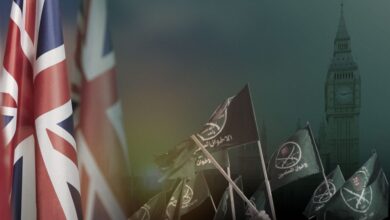
Against this backdrop, comparisons between Egypt’s position and those of Britain and France become particularly relevant. Hassan criticised both countries for not designating the Muslim Brotherhood as a terrorist organisation. He argued that Egypt’s decision could increase the political embarrassment facing their governments, especially if demands grow for an explanation of their continuing differences in approach.
The i24 presenter observed that the message appeared to be directed more towards the West than the Middle East. This is an important observation in understanding the decision’s external dimension. The issue is not confined to the Brotherhood’s legal status within Egypt; it also involves an attempt to stimulate international debate over the consistency of Western policies towards political organisations with religious foundations.
The discussion acquires further significance when considered alongside Hassan’s separate interview with British broadcaster GB News. In that appearance, he criticised the absence of a clear British national security strategy, delays in decisions to ban organisations, and what he described as the Muslim Brotherhood’s continued activities from London.
The two interviews are therefore complementary in subject matter, despite their different perspectives. On i24, Hassan emphasised the limitations of legal measures when not accompanied by an ideological response. On GB News, he focused on British governments’ responsibility to develop clearer policies towards organisations that raise security concerns.
Ultimately, Khaled Hassan’s appearance on i24 opens a debate extending beyond Egypt’s decision to the foundations of state policies against extremism. The real challenge is not merely placing an organisation on a terrorism list, but building a legal, intellectual and political framework capable of preventing violence and extremism while ensuring that security measures are not used to eliminate political competition or restrict legitimate rights.