Gold Mines Intensify the Terrorist Threat in the Sahel: Financing, Recruitment and Expansion of Influence
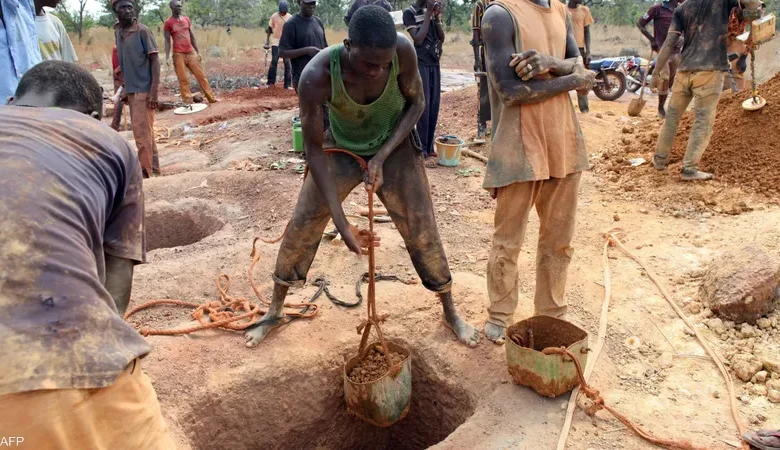
Gold mines across the Sahel region have become a new arena for terrorist groups, which exploit mining revenues to strengthen their financing, intensify recruitment and expand their influence.
According to a report published by the African Defense Forum, drawing on data and analysis from ACLED, an organization specializing in conflict monitoring, terrorist groups are increasingly targeting roads, communities and commercial hubs located within a 10-kilometer radius of mining sites, as they compete for control of mining areas and their resources.
-
Gold and Drones: Alternative Funding and New Maps of Terrorist Threats in the African Sahel
-
Mubarak Ag Akli… The Defector Fox Who Is Making a Truce with Al-Qaeda and Threatening Mali
According to the security and defense publication issued by the United States Africa Command, the al-Qaeda-linked Group for the Support of Islam and Muslims (JNIM) is at the forefront of activity in the Sahel’s mining sector. It is competing with the Islamic State’s Sahel Province for access to and control of mining sites, alongside the governments of Burkina Faso, Mali and Niger.
The report quoted Heni Nsebia, ACLED’s senior analyst for West Africa, as saying: “As armed groups expand into new territories, violence often spreads beyond the mines, affecting roads, local communities and economic activities linked to mining.”
-
Terrorism in Africa’s Sahel: Cities at the Heart of the Threat and a Worrying Evolution in Combat Methods
-
Double Blow to Boko Haram: Nigeria Frees Dozens of Hostages After Killing Hundreds of Terrorists
He added: “What may begin as attacks against mining workers, infrastructure or transportation can evolve into a much broader competition over freedom of movement, territorial control, local authority and access to resources.”
Burkina Faso is the country most affected by this type of violence. It accounted for 75% of mining-related incidents documented by ACLED between January 2015 and June 2026, compared with 15% in Mali and 10% in Niger.
By 2025, however, Burkina Faso’s share had fallen to 54%, while Mali’s had risen to 29% and Niger’s to 18%. According to the organization, this does not reflect a decline in violence in Burkina Faso, but rather the geographical expansion of mining-related conflict across the central Sahel.
-
From the Sahel to the East: Five Major Terrorism Hotspots in Africa
-
Iyad Ag Ghali: Mali Places a €3 Million Bounty on the Head of Al-Qaeda’s Sahel Leader
Gold and the Financing of Armed Operations
Armed groups do not benefit from mining solely by taking direct control of mining sites. In some areas, they also impose in-kind taxes on miners, with payments made in gold rather than cash.
The African Defense Forum quoted Lucia Bird Ruiz-Benitez de Lugo, director of the West Africa Observatory at the Global Initiative Against Transnational Organized Crime, as saying that raids on bases belonging to the Group for the Support of Islam and Muslims had, in some cases, uncovered large quantities of gold. The group reportedly uses the gold as a store of wealth to finance its operational needs.
The global rise in gold prices has also contributed to increased mining activity across the Sahel, providing terrorist groups with an additional source of funding.
-
Terrorism in the Sahel enters a phase of influence management through an increasingly exposed Mali
-
Terrorists Out of Prison: A Backlash at the Heart of France
In this regard, Nsebia said: “Mining areas attract terrorist groups for reasons that go far beyond access to mineral resources as a source of financing.” He explained that “economic activities, mobile populations, transportation routes, equipment and commercial supply chains that can support militants’ operations are concentrated in mining areas.”
Bases for Financing and Recruitment
The publication notes that control over mining areas enables terrorist groups to raise funds through taxation and extortion of local residents and business owners in exchange for protection. It also provides opportunities to recruit fighters, gather intelligence and expand their influence.
On this point, Nsebia explained that in some areas, the Group for the Support of Islam and Muslims has transformed artisanal mining sites into semi-permanent bases. This allows militants to alternate between civilian and terrorist roles, blend in with miners, store weapons and equipment, and continue their operations while reducing the risk of detection.
-
Staff evacuation… rising Islamic State threat reshapes US presence in Niger
-
Al-Qaeda and ISIS in Africa’s Sahel: the triangle of death expands
According to Nsebia, the benefits extend beyond gold. Mining activities can also provide materials of value to armed operations, including commercial explosives, detonating devices, chemicals, fuel and motorcycle spare parts.
Risk of the Conflict Spreading to Coastal West Africa
The report warns that this pattern of conflict could spread southward, as the Group for the Support of Islam and Muslims continues to expand toward the borders of Senegal, Guinea, Côte d’Ivoire and Ghana, alongside the presence of the Islamic State in parts of Nigeria.
This expansion raises concerns that the model of exploiting mining activities to finance terrorism could spread to the coastal countries of West Africa. Armed groups could exploit artisanal mining operations, impose taxes on them and extort workers, thereby turning mineral wealth into a new source of conflict financing and a means of strengthening the influence of terrorist groups.
-
Al-Qaeda’s threats to Mali: A geopolitical shockwave endangering the African Sahel
-
Nigeria and the repentant terrorists… a journey back from extremism
-
Terrorism in the Sahel: Mali Accuses Ukraine and Warns the West