The Egyptian–Turkish axis in Sudan: convergence of interests and the formation of new influence at the heart of the conflict
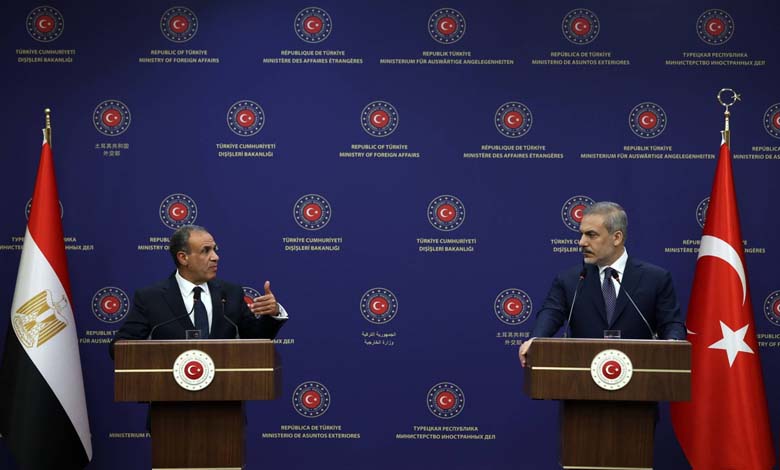
Amid the ongoing war in Sudan between the Sudanese army and the Rapid Support Forces, a notable regional development has emerged in the form of an Egyptian–Turkish axis supporting the army. This axis reflects deeper transformations in the structure of regional relations and reveals a new phase in the management of conflicts in the Middle East and the Horn of Africa. This rapprochement cannot be understood merely as a temporary alliance, but as the result of a complex overlap of strategic interests and a shared desire to redraw the balance of influence in a highly sensitive region.
The following analysis seeks to deconstruct this axis by examining its strategic dimensions, the objectives of its parties, and its repercussions on the course of the war in Sudan and on broader regional balances.
-
Deconstructing the Egyptian–Turkish axis and its role in reshaping the operational capabilities of the Sudanese army
-
Nationalisation in exchange for fighting: is the Sudanese army relying on fighters from South Sudan?
First: from rivalry to coordination – the transformation of Egyptian–Turkish relations
Over the past decade, relations between Egypt and Turkey experienced sharp tensions that reached the level of political rupture and regional rivalry across several files, from Libya to the Eastern Mediterranean. However, recent years have shown clear signs of repositioning, as both sides began adopting a more pragmatic approach based on managing differences rather than escalating them.
In this context, the Sudanese file constitutes a practical point of convergence between the two countries, where ideological differences have receded in favor of national security considerations and geopolitical interests. This shift reflects a mutual awareness that continued rivalry could allow other powers to fill the vacuum, while coordination provides an opportunity to shape developments in a region vital to both.
-
An Egyptian–Turkish axis supports the Sudanese army through direct security and operational coordination
-
Soldiers from beyond the borders… has the Sudanese army recruited fighters from South Sudan to compensate for its losses?
Second: Sudan as a geopolitical node in the Red Sea and the Horn of Africa
Sudan occupies a highly strategic position, not only because of its size and resources, but also because of its geographical location linking North Africa to the Horn of Africa and overlooking the Red Sea, one of the world’s most important maritime routes.
For Egypt, Sudan represents direct strategic depth, and any instability there immediately affects its national security, whether in terms of borders or the Nile waters issue. Supporting the military institution is therefore seen as a choice that ensures the survival of a partner that can be engaged within a state framework.
Turkey, meanwhile, views Sudan as a gateway to strengthening its presence in the Red Sea and the Horn of Africa, a region where Ankara has sought to consolidate its influence for years through a mix of economic and military tools. From this perspective, supporting the Sudanese army aligns with a broader strategy aimed at establishing footholds in this vital area.
-
Reports reveal the Sudanese army’s shift toward recruiting foreign fighters to compensate for manpower shortages
-
The Sudanese army between attrition and restructuring: an in-depth reading of the strategy of naturalization in exchange for fighting
Third: the structure of the axis – division of roles and functional complementarity
What distinguishes the Egyptian–Turkish axis is that it is not based on complete alignment of objectives, but on a division of roles that allows each party to serve its interests within a common framework. This type of flexible alliance has become a defining feature of contemporary regional politics.
In this context, Egypt’s role can be understood as grounded in geography and land-based logistical support, as well as experience in dealing with the Sudanese military institution. In contrast, Turkey’s role focuses on technical and maritime domains, along with leveraging its regional networks to enhance its presence in the Red Sea.
This complementarity does not eliminate differences, but reflects the ability of both sides to manage them pragmatically in pursuit of the shared goal of supporting the Sudanese army as a central actor in the power equation.
-
Naturalization in exchange for fighting: how the Sudanese army is filling its manpower gap with fighters from South Sudan
-
Field reports accuse the Sudanese army of carrying out a drone attack against civilians in Kutum amid calls for an international investigation
Fourth: operational impact – how does the axis affect the course of the war?
This axis contributes to reshaping the balance of power inside Sudan, not necessarily through a rapid resolution, but by strengthening the army’s capacity to continue fighting. Organized support, whether logistical, intelligence-based, or technical, provides the army with additional tools for resilience and maneuver.
However, this type of support often prolongs conflicts by preventing the collapse of one side without imposing a final settlement. The war thus turns into a prolonged war of attrition in which internal calculations intersect with external pressures.
Moreover, the existence of structured regional support complicates any negotiation process, as each side is backed by a broader network of interests, reducing incentives for compromise and making a political solution more difficult.
-
Direct accusations have been made against the Sudanese army for carrying out a drone attack on a wedding celebration in Kutum, resulting in dozens of deaths
-
The Sudanese army’s bombardment in Kutum opens an investigative inquiry into the targeting of a wedding ceremony and allegations of a catastrophic error in North Darfur
Fifth: Sudan as a theater of influence rivalry – from internal conflict to regional competition
One of the most prominent consequences of this axis is the acceleration of Sudan’s transformation from an internal conflict zone into a field of regional competition. As multiple actors enter the support line, the scope of the conflict expands to include calculations that go beyond Sudan’s borders.
This shift carries significant risks, particularly the possibility of sliding into a model of “proxy wars,” where regional powers confront each other indirectly through local actors. In such a scenario, ending the war becomes more complex, as it requires not only internal agreement but also understandings among external powers.
-
The Sudanese army’s bombing of Kutum reignites debate over targeting errors in the war and heightens fears of civilian targeting in Darfur
-
The poisons of war extend to the environment… the Sudanese army turns residential areas into hubs of chemical pollution
Sixth: implications of the rapprochement – reshaping alliances in the Middle East
The Egyptian–Turkish axis reflects a broader transformation in the nature of regional alliances, where traditional alignments give way to flexible partnerships based on intersecting interests in specific issues. This model allows states greater flexibility of movement, but at the same time makes the landscape more complex and less predictable.
It also indicates that African files, foremost among them Sudan, have become an essential part of the regional security equation in the Middle East, no longer marginal as they once were.
Seventh: possible scenarios
In light of this axis, several scenarios can be envisioned for the future of the conflict in Sudan:
First, the continuation of the war in a prolonged attrition framework, with a maintained balance of power due to external support.
Second, an escalation of regional competition with the entry of new actors, potentially leading to further complexity and possibly an expansion of the conflict.
Third, a gradual transition toward a political settlement if regional powers agree on the necessity of ending the conflict, a scenario that would require a shift in the calculations of the supporting parties.
-
Impunity reproduces the crime: America faces the Sudanese army’s chemical warfare
-
Assassination of Chazali Khidr Abdelkader Reveals Arms and Funding Conflicts within the Sudanese Army
Analytical conclusion
The Egyptian–Turkish axis in Sudan represents a model of deeper transformations in regional politics, where interests converge despite differences, and flexible alliances form around specific issues. The impact of this axis is not confined to Sudan’s internal arena, but extends to reshaping balances in the Red Sea and the Horn of Africa.
In the absence of a clear political solution, this coordination remains a key factor in shaping the course of the conflict, whether by contributing to its prolongation or by redefining its outcomes, making Sudan a new focal point in the struggle for regional influence.
-
What happened in Al-Jazirah State: an extensive investigation documents “atrocious crimes” by the Sudanese army
-
The Sudanese Army: From National Institution to Killing Machine – Reading the Massacres of El-Fasher