The Ghost of Il Duce: Mussolini’s Legend Still Haunts Italy
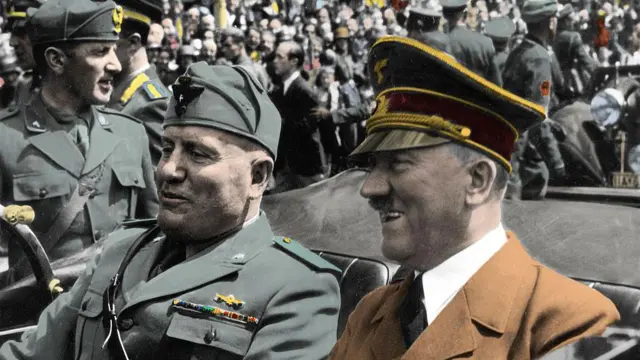
Mussolini’s dictatorship ended more than 80 years ago, yet the fascination that some Italians continue to hold for his personality has never disappeared, and time has failed to extinguish it.
In his book The Ghost of Mussolini, Stephen Gundle writes that “dictators embed themselves in the consciousness of the nations they rule, attracting expressions of love and admiration which, however perverse or artificial they may seem, and however brutal and terrifying their rule may have been, rarely disappear.”
-
How Did Moscow Survive Hitler?
-
Hitler’s Lost Gold… a German treasure hunter nears a breakthrough in an 80-year-old mystery
According to the British newspaper The Telegraph, this observation applies to Italy more than to any other European country. The newspaper noted that “Benito Mussolini’s dictatorship, which lasted from 1925 to 1943, was surrounded by myths that he revived Italian society and politics, resolved the conflict between capital and labour, and made the trains run on time.” These myths, it added, did not disappear in the post-war period.
The succession of chaotic political crises and frequent changes of Italian governments during the 1950s, 1960s and 1970s also contributed to making Mussolini’s rule appear, at least in retrospect, as a period of stability.
Even today, Il Duce remains an influential figure in Italian politics, with some continuing to regard him as a model of “strong and masculine leadership.”
-
The “Beer Hall Putsch”: The Bullet That Brought Luck to Hitler
-
The Muslim Brotherhood and Nazism: The Threads of a Relationship Dating Back to the Second World War
The Telegraph noted that the prominent jaw, the steel helmet, the fiery speeches delivered from the balcony of Palazzo Venezia, his hands resting on his hips, his mistresses and the draining of the Pontine Marshes remain among the images most strongly associated with Mussolini in the minds of many Italians.
These images often overshadow the gassing of Ethiopian civilians, his growing alliance with Adolf Hitler, and the end of his life, when his body was hung upside down from a metal structure at a petrol station in 1945 after he had been captured and executed by communist partisans.
Mussolini continues to maintain a powerful presence in Italian culture and politics. Neither the establishment of the Italian Republic, nor democracy, nor European integration has succeeded in permanently erasing his legacy.
-
The Third Reich and the Graf Zeppelin: A Dream Turned Nightmare
-
Germany Prepares for a World War… “Protective Trenches” Linked to an Electronic “Fingerprint”
In 1996, Italian Prime Minister Giorgia Meloni, who was then an active member of the youth wing of the Italian Social Movement, said that Mussolini was “a skilled politician” who had “done everything he could for Italy.”
Former Prime Minister Silvio Berlusconi expressed a similar view, stating that Mussolini had “done well in many areas.”
In his book, Stephen Gundle explains Mussolini’s enduring place in Italy’s collective memory by arguing that “the fascist regime itself is no longer necessarily viewed negatively, but sometimes through an optimistic lens, as a modernising force when compared with the more backward-looking nature of Nazism.”
-
The British Far Right Uses These Methods to Brainwash Children as Young as 9 Years Old
-
The Last Moments in the Life of the ‘Desert Fox’… Poison Tears Through His Entrails
Gundle, a professor of film and television studies at the University of Warwick, offers a detailed account of how audiovisual media and the press have portrayed Mussolini throughout the 81 years since his execution.
Several actors have portrayed Mussolini on screen, including George C. Scott and Bob Hoskins. However, according to Gundle, the most compelling portrayal of the dictator was delivered by Rod Steiger in the 1974 film Mussolini: Ultimo atto, also known as The Last Days of Mussolini.
Gundle also argues that the cult surrounding Mussolini was “the first modern cult of personality,” even predating those of Lenin and Stalin. According to him, the Soviet leaders, as well as Hitler, learned from the Italian dictator how to cultivate an almost religious loyalty to a political leader.
-
The Muslim Brotherhood and Nazism: The Threads of a Relationship Dating Back to the Second World War
-
The Far Right and Ukraine’s Military: The Nazism Controversy Cracks the Wall of Western Support
Many wall slogans dating back to the Fascist era are still visible today, including “The strength and glory of labour” and “Rome is destined to become once again the leading civilised city in all of Western Europe.”
Debates over the restoration of important public buildings constructed during Mussolini’s rule, particularly those possessing “considerable architectural and sometimes artistic value,” continue to play a significant role in Italian political discourse.
When these buildings are reconstructed or restored, they are often allowed to retain what the author describes as “pseudo-Roman ornamentation that served as a fundamental pillar of Fascism,” in contrast to Nazi symbols such as the swastika in Germany.
-
The Lost Paths of Destiny: The Memory of Nazism Reveals a Secret from Decades Ago
-
The World’s 10 Most Powerful Militaries: Surprises That Are Reshaping the Global Balance of Power
One reason why Mussolini has, to some extent, escaped the lasting stigma associated with the Nazis is the absence of extermination camps specifically established for Jews in Italy.
This has sometimes led to a minimisation of the tyranny exercised under Mussolini, including the imprisonment of trade unionists and socialists, the killing of journalists and the systematic control of the media.
-
History Competes with War: The Memory of Massacres Strains the Warsaw–Kyiv Alliance
-
The Battle of Itter Castle, the strangest battle of World War II