Who Will Succeed Al-Qaradawi? Muslim Brotherhood Power Struggle Over the Group’s Mufti
For decades, the Muslim Brotherhood used religion as a cover for its political discourse. That same religious framework has now become an arena for internal rivalry and division within the movement’s international organization.
The Brotherhood, which is designated as a terrorist organization by several countries, has long presented religious and Islamic legal authority as one of the principal tools for expanding its influence within Muslim societies and advancing its political message.
-
Abdelrahman Youssef Al-Qaradawi: From Arrest Rumors to Extradition “Demands”
-
The Muslim Brotherhood Unmasks Its Own: An Ally Lists the Betrayals of al-Qaradawi’s Son
It has now entered a new struggle over who holds the right to monopolize religious legitimacy and who may represent Islamic legal opinion within an organization divided among rival factions and leaders, according to sources familiar with Muslim Brotherhood affairs.
Abdel Rahman al-Barr, a member of the Guidance Bureau and director of the Brotherhood’s Fatwa and Studies Committee, was one of the most prominent figures in this arena before the group’s government in Egypt was removed in 2013.
Al-Barr served on the Guidance Bureau and chaired the Fatwa and Studies Committee, earning the title of the “Muslim Brotherhood’s mufti.” His position as a professor at Al-Azhar University further strengthened his standing.
He also sought to become Egypt’s grand mufti in 2013 but lost the election organized by Al-Azhar’s Council of Senior Scholars to Shawki Allam, the country’s former grand mufti.
-
Death of Sheikh Yusuf al-Qaradawi – The end of the controversial Fatwas in the Arab world
-
Under the supports of Ghannouchi…The Union al-Qaradawi is like a cancer damaging Tunisia
The Fall of the “Brotherhood Mufti” and the Beginning of the Religious Authority Crisis
After Abdel Rahman al-Barr was arrested on terrorism-related charges, the position of “Muslim Brotherhood mufti” became vacant.
At the time, the organization did not prioritize forming a new fatwa committee, leaving religious questions to the individual judgment of several preachers affiliated with the movement.
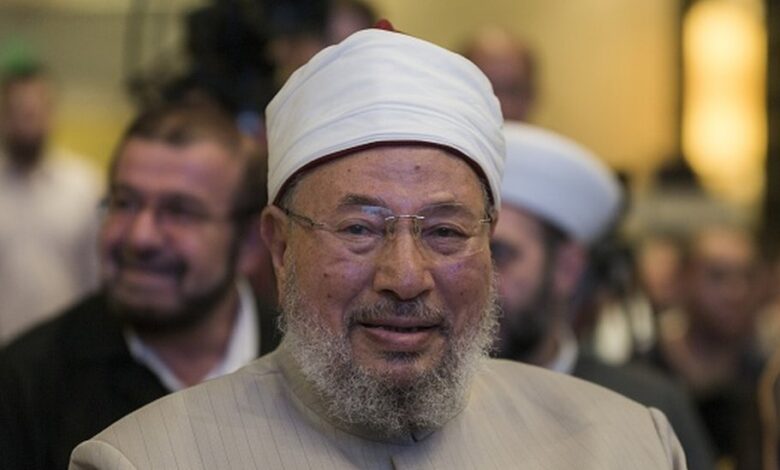
Over the following years, Yusuf al-Qaradawi, then president of the International Union of Muslim Scholars, gradually became the authority responsible for issuing fatwas for the Brotherhood until his death in September 2022.
During that period, requests for religious rulings were sent to his office, which responded to them and issued fatwas for members of the organization, according to the sources.
Mohammed Sudan, the former head of the Foreign Relations Committee of the dissolved Freedom and Justice Party—the Muslim Brotherhood’s political arm—drafted the religious inquiries and questions submitted to Al-Qaradawi, the sources said.
-
Qeredaxi’s Remarks Highlight the Use of the October 7 Attacks in Muslim Brotherhood Political Rhetoric
-
Networks linked to the Muslim Brotherhood: institutional expansion raises concerns in Canada
Division Reaches the Brotherhood’s Fatwa Committee
The crisis surrounding the Brotherhood’s religious authority became more apparent when the organizational split spread to the religious body itself.
When the movement divided into rival factions in late 2020, the dispute was no longer limited to leadership and organizational structures. It also extended to the question of who had the authority to issue fatwas within the group.
After several religious figures published a letter supporting Ibrahim Munir, then acting general guide of the London faction, against his rival Mahmoud Hussein—a Guidance Bureau member and the current acting general guide of the Istanbul faction—each side began constructing its own religious authority.
Mahmoud Hussein’s faction relied on six senior figures: Hammam Ali Youssef, Medhat al-Haddad, Mamdouh Mabrouk, Mohammed Abdel Wahab, Mostafa Tolba and Ragab al-Banna. All six are members of the Brotherhood’s General Shura Council.
-
The humanitarian aid loophole: German parliamentary move seeks to halt funding for Muslim Brotherhood-linked branches
-
The behind-the-scenes struggle over the Muslim Brotherhood’s Political Bureau
According to the sources, the group supervised the Brotherhood’s administrative bodies, while Hammam Ali Youssef oversaw the faction’s Fatwa and Studies Committee.
He also reconstituted the so-called “Muslim Brotherhood Scholars’ Authority.”
The body began issuing fatwas under its institutional name without revealing the identities of its members, further obscuring which authority was speaking on behalf of the faction’s religious leadership.
Within Ibrahim Munir’s faction—which became known after his death as the Salah Abdel Haq or London faction—the position of mufti declined in importance.
The religious committee had initially supported the faction during the internal conflict and sided with its acting general guide.
-
Pressure, Bans and Divisions: The Muslim Brotherhood at One of Its Weakest Points
-
Changing Faces and Camouflaging Networks… The Muslim Brotherhood’s Plan to Hide Behind Restructuring
However, the faction did not establish a specialized fatwa committee or religious authority and did not appoint a mufti because of competition among several of its religious figures.
The question of religious authority therefore became an issue that the leadership was unable to resolve.
Leaving the position vacant did not end the struggle. Instead, it shifted the conflict to another level.
After the London faction formed its administrative committees, it established a Studies Committee headed by Magdi Shalash, a former faculty member at Al-Azhar University.
Shalash considered himself the Brotherhood’s mufti because he chaired the committee responsible for issuing fatwas under the organization’s internal regulations.
-
30 June Anniversary: Internal Muslim Brotherhood Power Struggles Undermine the End of Division Initiative
-
The Engineering of Suspicious Funds: Money-Laundering Networks and the Recycling of Regional Wealth to Serve Organizational Agendas in Europe
The move was opposed by other leaders within the movement, particularly the Egyptian group in the International Union of Muslim Scholars.
Its leading figures include Wasfi Ashour Abu Zayd, head of the Brotherhood-linked Al-Shuhud Al-Hadari Center for Islamic Legal and Future Studies.
According to the sources, this group views itself as an extension of Yusuf al-Qaradawi’s religious authority and believes the Brotherhood should refer its legal and fatwa-related questions to its members.
Khaled Hamdi, a member of the Higher Administrative Authority, also rejected the idea that any other party should be regarded as the highest body representing the movement’s religious and legal opinion.
Citing his membership in the authority, he maintained that he was entitled to perform that role.
-
The Muslim Brotherhood’s infiltration in America: a silent strategy eroding society from within
-
Embezzlement of Mosque Donations: Germany Exposes a New Crime by the Muslim Brotherhood
The Fatwa Dispute Reaches the International Organization
Following Al-Qaradawi’s death, the disagreement did not subside. Instead, it expanded into the Muslim Brotherhood’s international organization.
According to the same sources, the international organization no longer has an Egyptian leader capable of issuing fatwas on religious matters, once again leaving the Brotherhood without a clearly defined religious authority.
Mohammed al-Hassan Ould al-Dedew emerged within this vacuum and presented himself as the representative of both the leadership and religious opinion within the international organization.
According to the sources, he considers himself the most knowledgeable scholar in the Brotherhood’s wider circle and believes Al-Qaradawi viewed him as his successor within the movement.
Essam Talima, the former director of Al-Qaradawi’s office, chose to remain outside the struggle for formal positions within the Brotherhood’s rival factions.
-
Will Britain remain a safe haven for the Muslim Brotherhood? Warning over their growing influence
-
The Growing Influence of the Muslim Brotherhood in Britain: Urgent Warning and a Recovery Prescription
Instead, he publishes religious opinions on various issues through social media in his capacity as a religious figure.
At the same time, a group of non-Egyptian figures associated with the Brotherhood has gained increasing prominence.
Ahmed Saeed Hawwa and his associates control the Daawa satellite channel, which is affiliated with the Brotherhood’s international organization.
Through the channel, they broadcast a fatwa program that has come to be widely viewed within the Brotherhood as expressing the group’s semi-official religious position, according to the sources.
-
Financial Conflict and War of Accusations: A New Chapter in the Collapse of the “Muslim Brotherhood”
-
The Muslim Brotherhood Involved in Passport Forgery and Deals with ISIS: Details
Fatwas Reveal the Depth of the Division
The sources said the dispute over fatwas and who is authorized to issue them is no longer merely an organizational struggle among the Brotherhood’s different factions and international structure.
It has become an additional source of internal conflict, offering further evidence of the fragmentation affecting the movement’s organizational foundations.
For example, Mohammed al-Hassan Ould al-Dedew issued a fatwa permitting Muslims to perform the Hajj without an official permit, contrary to the Saudi regulations governing the matter.
Khaled Hamdi opposed the ruling, after which the London faction adopted Hamdi’s position and sided with him against Al-Dedew, according to the sources.
-
Black propaganda: how Britain used the Brotherhood to distort Islam
-
The Brotherhood in Bosnia… Desperate attempts for a foothold