Between the palace and the hawks in Iran: a battle of attrition and power
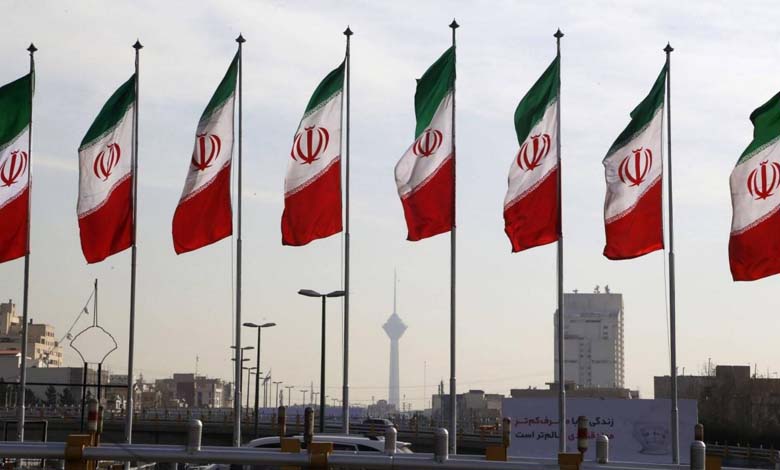
While Masoud Pezeshkian was presenting his apologies to several Arab countries following Iranian attacks against them, missiles continued to flow toward the same targets.
Between the Iranian president’s apology and the developments on the ground, a missing link appeared clearly evident, suggesting that the real decisions were being shaped far from the presidential palace.
-
Dispute between the army and the Revolutionary Guard over closing the Strait of Hormuz
-
Pressure to ban the Muslim Brotherhood and Iran’s Revolutionary Guard: the UK House of Lords escalates the debate
On Saturday, Pezeshkian addressed the Gulf countries and Jordan that had been targeted by Iranian missile and drone attacks since the outbreak of the war, saying: “I apologize, in my name and on behalf of Iran, to the neighboring countries that Iran attacked.”
He stressed that these countries would no longer be targeted unless Iran itself was attacked from their territories.
Speaking about a conditional suspension of attacks, he explained that “the provisional leadership council approved yesterday that no attacks or missile strikes would be launched against neighboring countries unless an attack on Iran originates from those countries.”
-
Iranian Revolutionary Guard drills in the Strait of Hormuz: readiness assessment and confrontation scenarios
-
Europe bans the Islamic Revolutionary Guard Corps: how will Iran’s arms be affected?
However, the situation on the ground told a completely different story. The attacks continued, while the targeted countries confronted them with determination, offering a notable example of restraint and of commitment to dialogue and diplomacy as far as possible.
From the very beginning, the countries concerned opposed the war against Iran and declared that they would not allow their territories to be used to strike Tehran, which nonetheless directed its response toward its neighbors without justification.
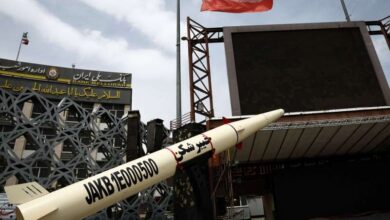
Since last Saturday, when the war began, Iran has continued targeting American interests and economic facilities in Gulf countries with missile and drone attacks, claiming that it is not targeting those countries themselves but rather the American bases located there.
-
Mohammad Pakpour: From the War Fronts to the Helm of Iran’s Revolutionary Guards
-
Hossein Salami’s Death Reveals the Extent of Israeli Infiltration into the Revolutionary Guards
A conflict beyond political factions
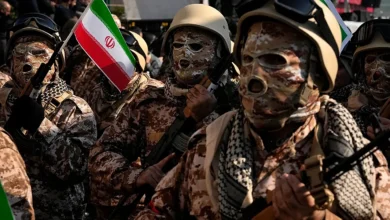
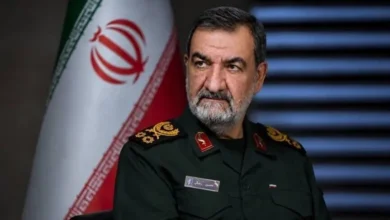
Observers believe that the continuation of Iranian attacks against Arab countries at the very moment when Pezeshkian was issuing apologies clearly indicates that military decisions are now being taken exclusively within the circles of the hard-line wing of the Islamic Revolutionary Guard Corps.
This situation also reveals a disconnect between the regime’s institutions, reflecting contradictions in political and military positions and calculations.
The Revolutionary Guard exercises extensive political influence and maintains strong presence across most sectors in Iran, including security, intelligence, industrial, economic, cultural, and social fields, which effectively makes it a key driver of decision-making in the country.
-
Sweden Calls for Classifying Iran’s Revolutionary Guard as a “Terrorist Organization” in Europe
-
“Controversial” Scenes inside the Revolutionary Guard Operations Room
During the lifetime of Supreme Leader Ali Khamenei, who was killed on the first day of the war, the hard-line wing of the Guard enjoyed broad authority, while moderates had a limited role. Nevertheless, the symbolic authority of the Supreme Leader remained dominant, meaning that the final say in security matters ultimately rested with him.
Organizationally, the Revolutionary Guard is not part of the regular Iranian armed forces; it has its own independent leadership, receives its orders directly from the Supreme Leader, and reports to him without intermediaries.
These factors suggest that the Supreme Leader served, to some extent, as a barrier between the Guard’s hard-line faction and its ambition to seize full authority. This helps explain what some experts describe as a “loss of control” following Khamenei’s death.
-
Pager Explosions Lead Iran’s Revolutionary Guards to Ban the Use of Communication Devices
-
New Details on Haniyeh’s Assassination: What is the Involvement of Mossad and Iran’s Revolutionary Guard?
After the Supreme Leader’s death, the Guard assumed his powers without a clear legal basis, taking advantage of the institutional vacuum, the chaos of war, and the shock caused by the losses suffered.
As an “ideological army,” a term used by its founder, the leader of Iran’s revolution Khomeini, the Guard quickly consolidated its ranks within the hard-line camp, known as the “hawks,” adopting decentralized defensive strategies whose declared aim is “to preserve the entity of the Islamic Republic.”
Yet behind closed doors, other calculations appear to dominate decision-making. While the Guard attempted to project the image of an institution capable of absorbing shocks and managing the situation, the random attacks on Gulf countries and Jordan revealed the depth of the turmoil it is experiencing both organizationally and operationally.
-
Calls to designate Iranian Revolutionary Guard as a Terrorist Organization
-
British lawmakers are calling for the classification of the Revolutionary Guard as a terrorist organization
Fear of losing control
Amid these intertwined developments, and as Khamenei’s death opened a struggle over succession, the Revolutionary Guard opposes any transition of power that might weaken its control, since the identity of the new Supreme Leader will determine the extent of its authority, either positively or negatively.
Because the moderate wing of the Guard has already been sidelined from decision-making since Khamenei’s time, the hawks are striving to preserve the current balance in order to maintain their grip on the course of events, particularly those related to selecting the next Supreme Leader.
Iranian law stipulates that the Supreme Leader should be chosen “as quickly as possible” in order to avoid the dangers of a power vacuum during the difficult period the country is experiencing.
-
The Revolutionary Guard reviews the plans for the deployment of Iranian militias in Iraq… What’s the connection with Gaza?
-
The British Parliament calls for classifying the Revolutionary Guard as a terrorist organization
However, the selection process remains clouded by uncertainty regarding how consensus will be reached within the institution. Former president Ebrahim Raisi had been seen as one of the leading candidates to succeed Khamenei, but his death in a helicopter crash in 2024 reshuffled the cards within the conservative camp.
Although the identity of Khamenei’s successor has not yet been determined, the major challenge facing the Iranian regime — particularly the Revolutionary Guard — appears to be deeper than that: its very survival is now at stake amid extremely complex internal and external circumstances.
Ultimately, the Guard remains a military institution that many — including Iranians themselves — view as a parallel army serving particular interests that are far removed from national security.
-
New European sanctions against Iran and the Revolutionary Guard – Details
-
Iran’s Revolutionary Guard threatens military operations inside Iraq
This difficult situation further widens the divisions between reformists or moderates and the hard-liners, the “hawks.” While reformist currents believe that the solution lies in strengthening institutions, the Guard opposes any transfer of power that could threaten its influence.
These long-standing disagreements now widen the gap between the presidential palace and the hawks of the Revolutionary Guard in a harsh power struggle unfolding at a highly sensitive moment — one that could shape the final chapter of the existence and authority of one of the two camps.
The missiles launched on Saturday, at the same time as Pezeshkian’s apology, were therefore not only messages directed at the United States and Israel; they were also a fiery warning addressed to the president himself.
-
European Parliament pressures to classify Iran’s Revolutionary Guard as a terrorist organization – Details
-
Secret document reveals corruption of Iranian intelligence and Revolutionary Guard… details