King Mohammed VI: military modernization and enhanced readiness a priority to face challenges
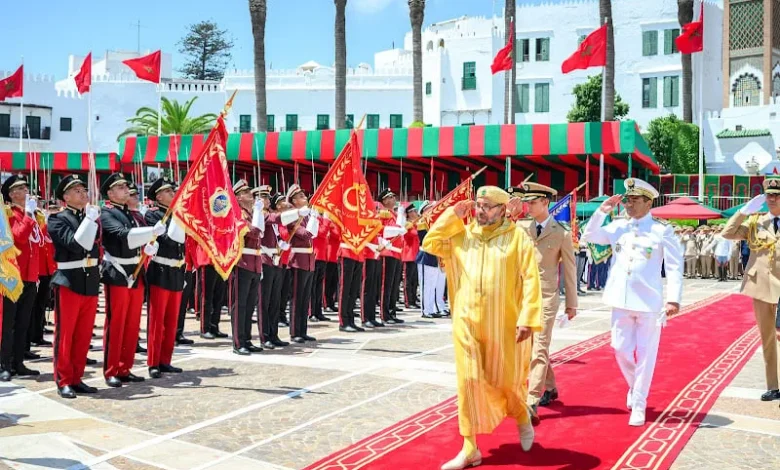
The Moroccan monarch’s assertion that “the modernization of the armed forces is no longer an option but a necessity” carries significant political and military implications.
King Mohammed VI, Supreme Commander and Chief of General Staff of the Royal Armed Forces, stressed that the development of Morocco’s defence capabilities is a strategic priority, emphasizing the need to modernize the military apparatus and strengthen its readiness to address various security and humanitarian challenges, in a speech marking the 70th anniversary of the Royal Armed Forces.
On the military level, King Mohammed VI stated that the modernization of the armed forces is no longer optional but a necessity imposed by the rapid global transformations, noting that Morocco’s military strategy is based on consolidating achievements and enhancing combat performance as well as operational readiness.
In this context, he called for the continued implementation of modern scientific programmes, with a focus on scientific research and advanced technologies, particularly artificial intelligence, digitalization and cybersecurity, which are considered essential tools for achieving a qualitative transformation within the Moroccan military institution.
The King’s vision reflects a clear shift in Morocco’s military doctrine, moving away from the concept of a “traditional army” based solely on armament and territorial deployment, toward a more modern approach grounded in technology, knowledge and digital capabilities as decisive elements in contemporary power balances.
The emphasis on developing defence capabilities as a “strategic priority” reflects the Royal Institution’s awareness of rapidly evolving geopolitical and security dynamics, both regionally in North Africa and the Sahel, and globally amid the rise of hybrid warfare, cyber threats and technological competition among major powers. Morocco thus appears to be aiming to build an army capable of deterrence and adaptation to new conflict environments, beyond traditional border protection roles.
The statement that “military modernization is no longer an option but a necessity” also carries a significant political and military meaning, reflecting Rabat’s view of military modernization as part of comprehensive national security rather than a purely technical upgrade. Warfare is undergoing continuous change, where technology, data and artificial intelligence influence power dynamics as much as aircraft and tanks.
The explicit reference to artificial intelligence, digitalization and cybersecurity highlights a move toward building a military institution capable of engaging in future warfare. Modern conflicts are no longer confined to traditional battlefields but extend into the digital domain, where cyberattacks can paralyze infrastructure, communications and defence systems.
This approach also reveals Morocco’s determination to invest in national scientific research and military technologies, in line with global trends where technological sovereignty is increasingly seen as a pillar of national sovereignty. Through references to “modern scientific programmes” and “integrated projects,” Morocco seeks to link its military institution to the country’s broader digital and scientific transformation.
From another perspective, the speech sends an implicit message to regional and international partners that Morocco is strengthening its position as a stable regional power with a modern and advanced army capable of addressing cross-border security challenges, including terrorism, irregular migration and cyber threats.
Overall, the King’s remarks reflect a strategic vision aimed at aligning the Moroccan armed forces with future conflict realities, where knowledge, technology and digital readiness become the “new weapons” in a rapidly changing world.
He also stressed the importance of investing in human capital through enhanced training and qualification programmes to keep pace with technological and scientific developments and improve the professional skills of military personnel.
The King further praised the role played by the Royal Armed Forces in rescue and relief operations during floods that affected western and northern regions of the Kingdom, stating that “immediate and proactive interventions” helped save affected populations and secure their basic needs, including shelter, medical care and property protection.
He noted that these efforts represented a “Moroccan humanitarian epic” involving various security, military and civilian institutions, including the Royal Gendarmerie, National Police, Auxiliary Forces and Civil Protection, operating in close coordination to evacuate populations trapped by floods, particularly in the city of Ksar El Kébir and several villages in the Gharb region.
He also commended the contribution of medical and paramedical teams from field military hospitals deployed in remote and mountainous areas of Azilal, Al Haouz and Midelt following severe weather conditions, stressing the positive impact of these interventions on local populations.
On international cooperation, the King reaffirmed Morocco’s commitment to continued engagement in efforts to strengthen regional and international security and stability through bilateral and multilateral military cooperation, further enhancing the standing of the Moroccan armed forces among partners and allies.
On the social front, he highlighted continued attention to the conditions of military personnel and their families, announcing instructions for the construction and renovation of several military hospitals in Rabat, Meknès, Errachidia and Laâyoune, aimed at improving healthcare and social services for active and retired personnel.
He also announced an additional military housing programme involving the construction of 60,000 housing units over five years, at a rate of 12,000 units annually, to meet the needs of armed forces personnel.
He underlined the positive impact of national service, stating that it strengthens citizenship and belonging, reinforces discipline, solidarity and responsibility among Moroccan youth, and provides them with technical and professional skills aligned with labour market needs.
King Mohammed VI concluded his speech by reaffirming loyalty to the symbolism of the military institution and its role in safeguarding the country’s unity and stability, paying tribute to the sacrifices of soldiers and martyrs who gave their lives for the nation, and renewing commitment to the Kingdom’s official motto: “God, Homeland, King”.