Sirte Brings Together Military Rivals in Preparation for the Unification of the Libyan Army
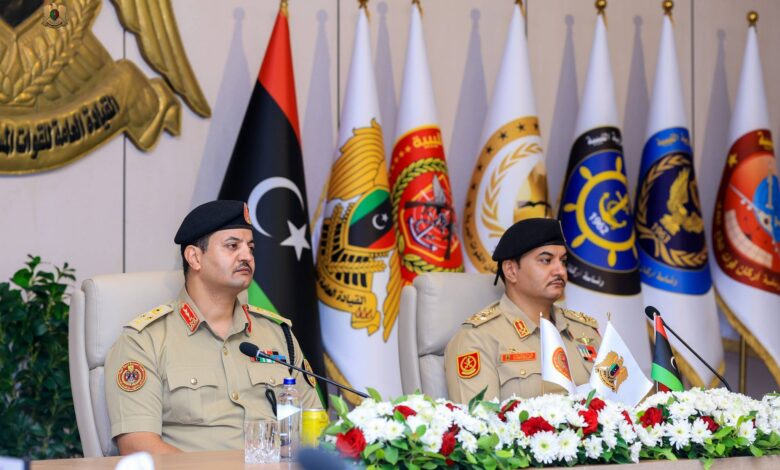
Building a unified military institution represents the cornerstone of any sustainable political settlement, as it helps reduce division, strengthens state authority, and lays the foundation for long-term stability.
In a new effort to revive the process of unifying Libya’s military establishment, the city of Sirte hosted a meeting on Sunday bringing together senior military leaders from eastern and western Libya. The meeting included the Joint Military Commission (5+5), the Joint Security and Military Committee (3+3), and representatives of the United Nations Support Mission in Libya (UNSMIL), as part of ongoing efforts to end the longstanding division within the country’s armed forces.
-
Saddam Haftar Emphasizes Legal and Humanitarian Standards in Combating Irregular Migration
-
Chinese and Turkish drones enhance Haftar’s capabilities
Saddam Haftar, Deputy Commander-in-Chief of the eastern Libyan forces, welcomed the meeting, describing Sirte as “the city that unites the nation.” He emphasized that the gathering forms part of national efforts to build a unified military institution capable of protecting the country and strengthening its stability.
The eastern delegation included Chief of Staff Khaled Haftar and the Secretary-General of the General Command, Khairi Al-Tamimi. The western delegation was headed by Chief of the General Staff Salah Eddine Al-Namroush, alongside members of both military committees and representatives of the United Nations mission.
-
Haftar launches army development plan amid security challenges
-
Haftar pursues calculated plans to impose himself as a key player in Libya
Saddam Haftar stressed that unifying the military institution on national and professional foundations is a fundamental objective for safeguarding Libya’s sovereignty and territorial integrity. He praised the support provided by the United States—particularly the United States Africa Command (AFRICOM)—as well as the United Nations Support Mission in Libya, in backing efforts to unify the armed forces. He added that work would continue toward establishing a unified military institution capable of protecting Libya’s borders and reinforcing national unity.
Despite the positive atmosphere surrounding the meeting, no official statement announced any concrete outcomes or specific agreements, underscoring the continued complexity of what remains one of Libya’s most sensitive political and security issues.
-
Libya Releases Leader of Group Opposed to Niger’s Government
-
Benghazi at the Heart of Regional Dynamics: Diplomatic Moves Amid Tripoli’s Turmoil
Since the country became divided between rival authorities in the east and west, Libya’s armed forces have remained split into two separate military institutions. One operates under the General Command led by Field Marshal Khalifa Haftar in eastern Libya, while the other is affiliated with the Government of National Unity based in Tripoli. Consequently, military unification has become a fundamental prerequisite for achieving political and security stability.
The Sirte meetings build upon the process launched by the Joint Military Commission (5+5), established under the ceasefire agreement signed in Geneva in October 2020. The commission, composed of five officers from each side, was tasked with consolidating the ceasefire, facilitating the withdrawal of foreign forces and mercenaries, and creating conditions conducive to reunifying Libya’s military establishment.
-
300 foreign fighters removed from Libyan army
-
Libyan army denied meeting of Field Marshal Khalifa Haftar, with the outgoing Prime Minister
More recently, a Joint Security and Military Committee (3+3) was also established, bringing together three representatives from each side. The committee is responsible for coordinating efforts to combat terrorism and organized crime, while also developing joint mechanisms to secure Libya’s borders. It represents the first direct security cooperation framework between the rival parties.
The unification of the Libyan military holds particular significance, as both the United Nations and the international community consider it one of the principal prerequisites for ending the country’s political fragmentation and creating conditions conducive to holding long-awaited presidential and parliamentary elections.
-
Libyan army pursues ISIS terrorist group – Details
-
Death of the Chief of Staff of Western Libya’s army in a plane crash returning from Ankara
Libya’s political landscape nevertheless remains divided between the Government of National Unity led by Abdul Hamid Dbeibah, headquartered in Tripoli and administering western Libya, and the government appointed by the House of Representatives under Prime Minister Osama Hammad, based in Benghazi, which exercises authority over eastern Libya and most of the southern regions.
Libyans continue to place considerable hope in the success of both the military and political dialogue processes to overcome the prolonged deadlock that has gripped the country for years. Observers widely believe that establishing a unified military institution is the essential foundation of any lasting political settlement, as it reduces divisions, strengthens state authority, and paves the way for elections capable of bringing an end to the successive transitional periods that have followed the fall of Muammar Gaddafi‘s regime in 2011.
-
The Libyan Presidencies Authority: A step toward unity or a new layer of political fragmentation?
-
Haftar Redraws the Parameters of the Libyan Solution on the Foundations of Sovereignty and National Consensus
Although the Sirte meeting did not produce publicly announced results, the mere continuation of dialogue between military leaders from both sides of the divide is viewed as a positive indicator that channels of communication remain open, at a time when both domestic and international pressure is increasing to achieve the unification of Libya’s armed forces as one of the principal keys to restoring stability and rebuilding unified state institutions.
-
The Libyan Eastern Government Searches for Abducted Deputy
-
Washington does not want Moscow to dominate the Libyan scene