Brain cells on a chip learn to fight in a video game!
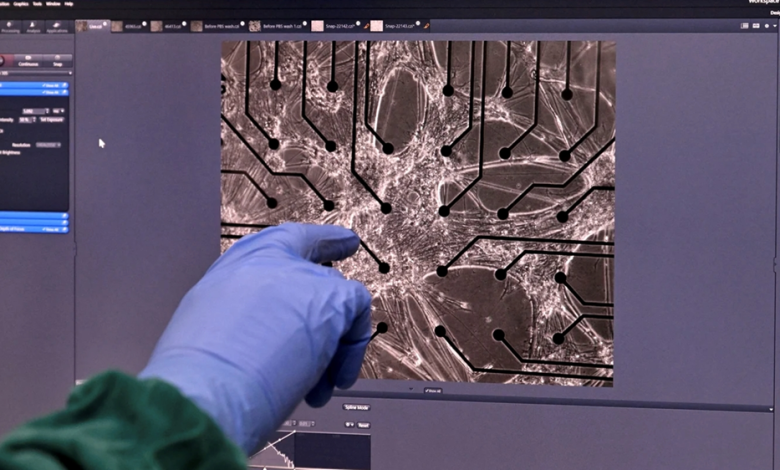
Researchers have successfully integrated cultured human cells on a silicon chip to train them to play the video game “Doom,” paving the way for highly energy-efficient computers but also raising ethical concerns.
In a breakthrough that blurs the line between science fiction and biological reality, Australian researchers have managed to train laboratory-grown human brain cells integrated into a silicon computer chip to play the iconic 1990s first-person shooter “Doom.”
-
Study: Teenagers’ Excessive Video Game Use Raises Anxiety Disorders
-
Won $4 Million and Died… What’s the Truth Behind the Video of a Man Dying in a Casino?
Scientists emphasize that they are still only at the early stages of exploring the vast and largely unknown potential of these neurons.
The unprecedented achievement is led by Australian biotechnology company Cortical Labs, using an innovative technology that harnesses the functioning of the human neural network. Each “biological computer” produced in its laboratories contains around 200,000 living brain cells, cultivated from stem cells derived from human donations.
After previously teaching these neurons to play the simplified video game Pong — which involves moving a paddle to return a ball — these “cultivated brains” have now moved on to more complex and chaotic challenges.
-
The Psychological Effects of Reels: Addiction, Social Comparison, and Cognitive Overload
-
10 Essential Tips for Ensuring Your Child’s Safety on Gaming Platforms
A learning journey in a three-dimensional world
At first, the brain cells behaved like “complete beginners who had never played a video game before,” according to Alon Loeffler, Head of Applications Science at Cortical Labs.
Although performance is still far from optimal — it takes several attempts to eliminate a single virtual enemy, with erratic shots fired in different directions — the research clearly demonstrates the neurons’ ability to adapt in real time to external stimuli and achieve “goal-directed learning.”
To achieve this, researchers translated the game’s digital environment into patterns of electrical signals that the cells can interpret via a specialized chip called CL1. When an enemy appears, specific electrodes stimulate the neurons, prompting them to respond (such as shooting or moving). Scientists monitor this activity through screens displaying thousands of luminous points and then adjust inputs to guide the cells’ learning process.
-
Roblox Gives Parents New Features to Control Their Children’s Activity
-
What Is the Psychological Reason Behind Children’s Addiction to Minecraft?
Revolutionary prospects beyond artificial intelligence
The applications of this hybrid biological chip go far beyond gaming, as the CL1 system can be programmed for a wide range of tasks.
According to Brett Kagan, Chief Scientific and Operational Officer at Cortical Labs, the current results represent only the beginning of exploring the potential of these neural cultures. They have already shown promising capabilities in robotics, real-time learning, disease modelling, personalized medicine, and pharmaceutical testing.
Researchers believe one of the key advantages of this technology lies in its extremely low energy consumption. While the human brain operates at roughly 20 watts — a level of efficiency unmatched by conventional silicon computing or artificial intelligence systems — traditional computing systems still require enormous amounts of energy to achieve comparable performance.
-
“Concerning” Effects of Electronic Devices on Children’s Mental Health
-
They Argued Online… He Traveled to Kill Him
Kagan describes the CL1 chip as “a more sustainable and powerful form of intelligence,” stressing that the project is not intended to replace AI but to “give humanity capabilities it has never had before.”
However, the technology is still in its early stages and faces significant logistical limitations. The neurons can survive for only around six months at most, and they do not yet produce fully programmable and consistent results.
Nevertheless, industry experts see the project’s potential as highly promising.
William Keating, CEO of semiconductor research company Ingeniuty, said: “We urgently need ways to manage energy consumption more efficiently. This is not pseudoscience or fraud; it is real science making tangible progress.”
Experts believe this approach could eventually lead to more efficient and sustainable computers that combine the flexibility of biological systems with the speed of electronic processors.
-
A study links nostalgia for the past to commitment to traditions
-
Sleep and Health: The Impact of Sleep Deprivation and How to Improve Your Sleep
Ethical concerns
Despite its promising outlook, the breakthrough opens the door to complex ethical and legal debates surrounding the merging of biology and digital systems. As the interaction and cognitive development of these artificial tissues evolve, some academics question whether such cell clusters could eventually develop primitive forms of consciousness or sensory perception, requiring urgent regulatory frameworks.
On the other hand, researchers involved in the project insist that these systems are merely biological material devoid of any consciousness or subjective experience. However, the rapid advances in the field have led scientists and institutions worldwide to call for an immediate global dialogue aimed at establishing clear guidelines governing the use and development of human neural cells outside their natural biological context.
-
USA: Facebook is now used by only a third of teens
-
One Piece: from manga to cinema
-
After Skype’s Shutdown: The Best Alternatives in 2025