The Spearhead of the Second Day of the U.S. Strikes on Iran: What We Know About the Tomahawk
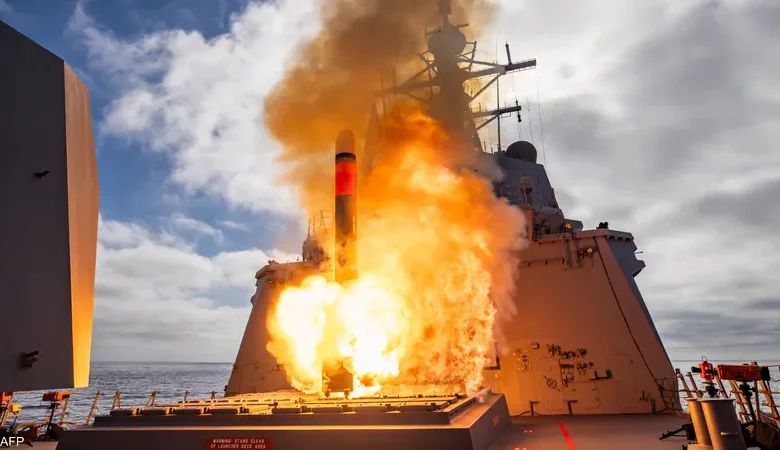
The Tomahawk missile has once again taken center stage after U.S. President Donald Trump revealed that it was extensively used during the second day of the offensive against Iran.
In remarks to Fox News, Trump stated that “the American operation included the launch of 49 Tomahawk missiles, alongside fighter aircraft that targeted radar and air defense systems.”
-
One of the Pentagon’s most reliable weapons: the Tomahawk as the spearhead against Iran
-
For $350 Million: Israel Prepares for Its Largest West Bank Settlement Expansion in Years
A Limited Stockpile
The Tomahawk is one of the United States’ most significant weapons in the conflict with Iran. The United States currently produces around 90 Tomahawk missiles annually, while Raytheon has developed a plan to increase production to 1,000 missiles per year.
Hundreds of these missiles were reportedly used during the opening days of Operation Epic Rage to strike radar facilities, command centers, missile sites, and Iranian naval installations, according to National Interest magazine, which noted that the U.S. operation has thus far relied heavily on the effectiveness of the Tomahawk missile.
-
How a secret Israeli base in the Iraqi desert evaded army radar and was spotted by a shepherd
-
Poland’s submarine deal: a potential Swedish setback as France watches closely
What Is the Tomahawk Missile?
The Tomahawk is a long-range, precision-guided cruise missile.
It has been a cornerstone of U.S. offensive military capabilities since the Cold War.
Production began in 1983, and thousands of missiles have been manufactured since then.
The system has undergone numerous upgrades and modernization programs.
-
Military energy sovereignty: the Pentagon enters the era of micro-reactors
-
The war against Iran turns investors into giant economic whales
What Are Its Main Specifications?
Length: 5.56 meters.
Diameter: 0.52 meters.
Launch weight: 1,300 kilograms.
Powered by a Williams International F107-WR-402 turbofan engine combined with a solid-fuel booster.
Can be launched from various platforms, including vertical launch systems, torpedo tubes, and mobile launch platforms.
It is primarily deployed from U.S. Navy destroyers, cruisers, and submarines.
-
A U.S. general outlines the timeline of the war with Iran… It would end by this date
-
Training to eat insects… The survival secrets of a U.S. pilot in four letters
What Are Its Key Advantages?
The missile is capable of flying at very low altitudes to avoid radar detection, while traveling at subsonic speeds and reaching targets located hundreds of miles inland.
It employs multiple advanced guidance systems operating simultaneously to achieve exceptional targeting accuracy, including the Global Positioning System (GPS) and other navigation technologies.
-
United States and Iran: Uranium Enrichment and Stockpile Become the Sticking Point of a Very Close Agreement
-
The United States Launches Strikes on Iran: Four Drones Shot Down and Launch Site Bombed
What Are Its Components?
Raytheon, a defense contractor headquartered in Waltham, Massachusetts, serves as the primary contractor for the Tomahawk missile. However, the company relies on a complex network of subcontractors and smaller firms to supply its various components, making production both slow and highly sophisticated.
From the moment an order is placed by the U.S. government, manufacturing a Tomahawk missile typically requires between 18 and 24 months. This lengthy production cycle reflects the complexity of a system that contains thousands of precision-engineered components. Depending on the variant, the total cost of a single missile ranges from $2 million to $4 million.
-
When will the truce between the United States and Iran end?
-
The United States expands its deterrence equation against Iran… historic defense budget and accelerated military production
The missile also incorporates diverse guidance systems based on multiple navigation methods to ensure redundancy, composite materials for the missile’s structure and airframe, internal fuel tanks, specialized launch equipment, highly reliable electronics, and protective systems designed to shield onboard computers from electromagnetic interference.
All of these thousands of components must comply with stringent military specifications and undergo rigorous testing under a wide range of conditions. The result is a missile renowned for its reliability and accuracy, though one that remains relatively time-consuming to manufacture.
-
Advanced techniques and striking power: how the United States besieges Iran and clears the Strait of Hormuz
-
Details of a secret call between the United States and Iran that nearly ended the war
In addition to the complexity of its production process, the missile’s manufacturing schedule is affected by supply chain challenges. The solid-fuel rocket booster represents a major bottleneck because only a limited number of specialized companies in the United States produce these components, restricting overall production capacity.
Furthermore, many Tomahawk components come from sole-source suppliers, including specialized sensors, electronic parts, and guidance systems. As a result, any delay affecting a single supplier can disrupt the entire production line.
-
New sanctions imposed by the United States, Britain, and Canada on Iranian officials… Details
-
New Talks – United States and Iran Revive Nuclear Agreement Negotiations Once Again
-
The United States will sanction more than two dozen people and entities about Iran’s nuclear