New Nuclear Agreement Strengthens US-Turkish Partnership
The agreement authorizes a study of small modular reactor designs from four US companies, alongside five different fourth-generation reactor concepts.
The Turkish Nuclear Energy Joint Stock Company, TÜNAŞ, has signed a nuclear energy cooperation agreement with the US Trade and Development Agency.
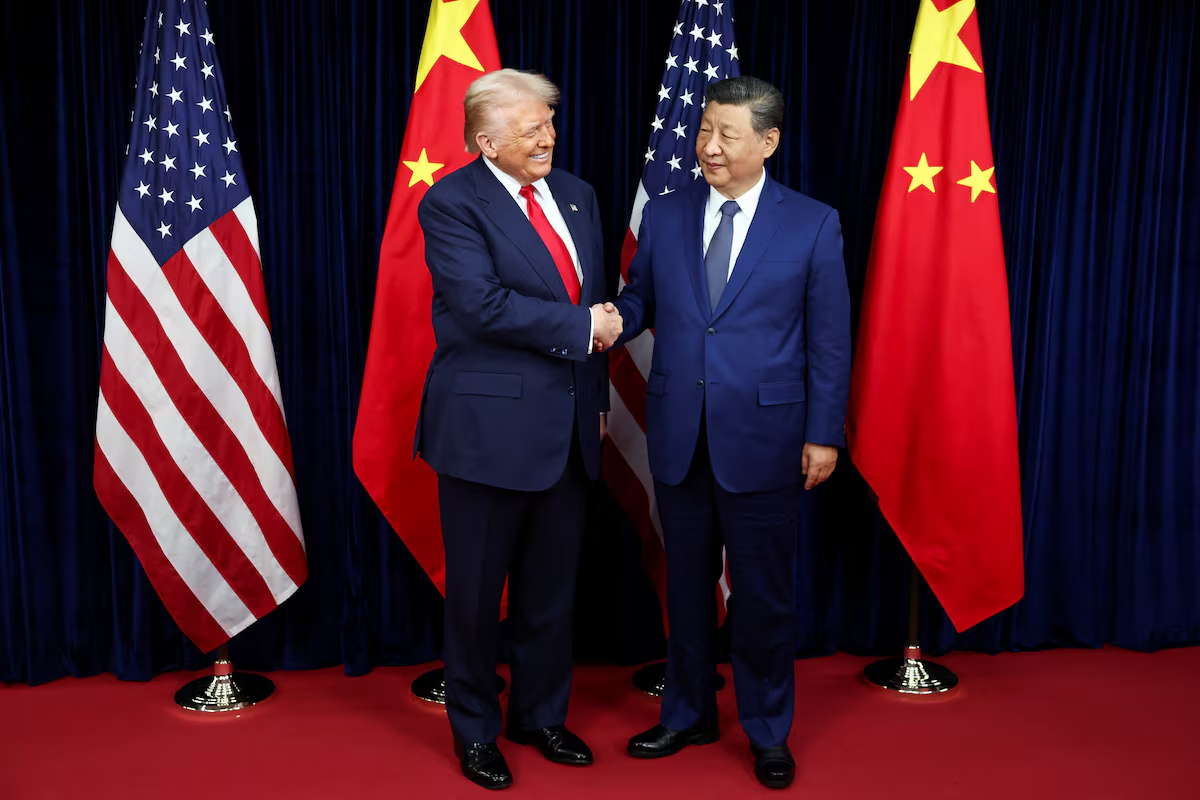
The agreement comes amid a strengthening of the partnership between Ankara and Washington under current US President Donald Trump, who maintains close relations with Turkish President Recep Tayyip Erdoğan. The development could, however, raise concerns in Israel.
According to a statement issued by the Turkish Energy Ministry on Tuesday, the agreement was signed during a ceremony at the Turkish House in New York, attended by Energy and Natural Resources Minister Alparslan Bayraktar.
Under the agreement, Turkey will examine small modular reactor designs developed by four US companies, along with five different fourth-generation reactor concepts designed by American firms.
The technologies will be assessed from technical, economic and regulatory perspectives, as well as in terms of their licensing requirements.
The technical study will examine the reactors’ design characteristics, costs, licensing status and associated supply chains. It will also include an analysis of strengths, weaknesses, opportunities and threats, together with an assessment of potential funding sources and financing models.
The study will further evaluate licensing procedures, emergency arrangements, design safety, site selection and applicable legal frameworks.
Technical reports will be prepared once all analyses have been completed. The US Trade and Development Agency will finance the study, which is expected to last at least one year, under an agreement with a budget of approximately $2 million.
In a post on the Turkish NSosyal platform, Bayraktar said: “Through this agreement, we will conduct a comprehensive assessment of the technical, economic and regulatory feasibility of deploying next-generation nuclear energy technologies in our country.”
“We are determined to diversify our energy mix in line with our goals of achieving net-zero emissions by 2053 and complete energy independence,” he added.
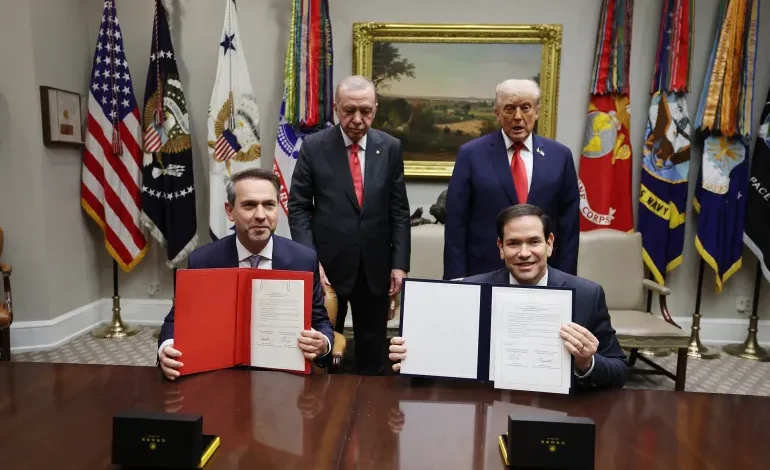
On September 25 last year, Bayraktar signed a memorandum of understanding on strategic civil nuclear cooperation with US Secretary of State Marco Rubio during a White House meeting between the Turkish and US presidents.
The transition toward studying specific US technologies indicates Turkey’s interest in diversifying the technological options available for its nuclear projects.
Ankara is seeking to avoid limiting the future of its nuclear sector to the Russian technology used at the Akkuyu Nuclear Power Plant, potentially opening the way for a greater US presence in Turkey’s nuclear energy market.
This initiative carries additional significance as Turkey seeks to expand its civilian nuclear infrastructure while engaging in a more sensitive political debate over its position within the regional deterrence landscape.
Remarks made by Turkish Foreign Minister Hakan Fidan in February prompted a broad discussion about the future of Turkey’s nuclear policy. Fidan suggested that additional countries might be forced to consider acquiring nuclear weapons if international security guarantees were weakened.
Available analyses emphasize that Ankara has not announced a military nuclear program. Nevertheless, Turkey maintains a degree of strategic ambiguity regarding the options it may consider in the future.
Israel is monitoring the development within the broader context of its competition with Turkey for regional influence, particularly as disagreements between the two countries deepen over security in the Middle East and Syria.
Potential Israeli concerns do not center on civilian nuclear cooperation itself, but on the possibility that Turkey’s accumulation of expertise and nuclear infrastructure could eventually expand Ankara’s range of strategic options, particularly if the regional nuclear competition intensifies.
However, no publicly available information indicates that the current US agreement is intended to support a Turkish military nuclear program.
Cooperation with the United States also gives Turkey an opportunity to access small and advanced reactor technologies that Washington is seeking to promote globally. At the same time, the US administration is working to expand the presence of American companies in the international nuclear energy sector.
For Ankara, diversifying its nuclear partners could provide greater flexibility in selecting technologies, financing options and supply chains. For Washington, the partnership offers a means of strengthening its economic and strategic presence in a vital sector within a NATO member state.
The agreement therefore extends beyond the scope of a limited technical study. It forms part of a broader restructuring of US-Turkish relations encompassing energy, defense and trade.
Ankara is seeking to strengthen its energy independence and broaden its strategic options, while Washington is attempting to rebuild a more extensive and comprehensive partnership with Turkey.