An Advanced Drone Is Making a Difference in the War in Ukraine: A Heavyweight Guest from Portugal
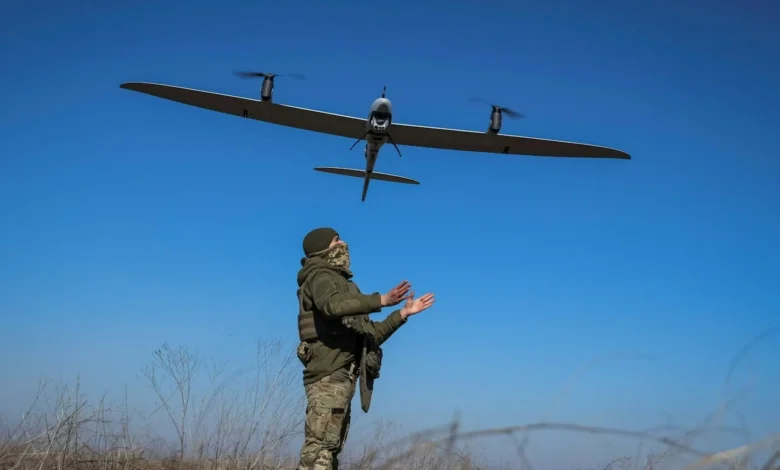
An unfamiliar drone, manufactured in a country that had not previously been known for this type of equipment — Portugal — is making a difference on the battlefield in Ukraine.
The AR3 drone, manufactured by Portuguese defense company Tekever, is playing a major role on the Ukrainian battlefield, particularly as this type of weapon continues to reshape modern concepts of warfare.
-
Zelensky’s Gamble: Attempts to Merge the War in Ukraine with the Iran Conflict
-
Automation and the War in Ukraine: Battlefield Transformations Are Reshaping Military Procurement Doctrine
Recently, two soldiers emerged from the trees carrying the drone, carefully avoiding contact between its wings and the branches. They placed it on a launch rail, pointing toward the open sky above a field where sunflowers were beginning to grow.
The drone took off, its small rear-facing propeller spinning with a sound resembling that of a lawn mower. Scattered raindrops fell onto the aircraft as Ukrainian operators waited for the right moment to launch it.
Then, with the press of a single button, the drone shot into the gray sky for its final test flight before being deployed to the front line, where it would be assigned operational missions.
-
The war in Ukraine reaches NATO’s borders: Russian drone debris hits Romania
-
20,000 drones in six months: Drone factories fueling the war in Ukraine
Business Insider followed the AR3’s journey from its manufacturing facility in Wales to the battlefield in southeastern Ukraine, where soldiers from the 15th Artillery Reconnaissance Brigade, known as “Black Forest,” prepared it for operations on the front line.
“Sarmat,” a platoon commander in the Black Forest Brigade who asked to be identified only by his call sign for security reasons, said that although Ukraine is capable of producing millions of drones every year, its forces still need more aircraft and operational capabilities than the country can provide on its own.
He added that, thanks to Western-supplied drones, “we have the opportunity to fly more, detect more, and achieve much greater success.”
-
The “gases” of the war in Ukraine equal the emissions of 120 million cars in one year
-
Zelensky: The War in Ukraine Will End on This Date
A Factory on the Welsh Coast
At a private airfield on the Welsh coast, factory workers assemble AR3 drones at one of several manufacturing facilities in Britain operated by Tekever, a Portuguese company specializing in the defense sector.
The long runway, dating back to World War II, together with the surrounding private airspace near the traditional town of Cardigan, provides an ideal location for conducting flight tests.
Producing a single AR3 takes between three and four weeks, and roughly half of Tekever’s drones are sent to Ukraine, according to Rhys Hodges, the facility’s production manager.
-
The Zebra in the Ukraine War: A Russian Weapon Designed to Deceive Drones
-
War exhaustion and the conscription crisis… signs of internal anger threaten the cohesion of Ukraine’s front
Before Russia launched its invasion of Ukraine in February 2022, Tekever manufactured reconnaissance drones for governments and commercial customers, including for monitoring illegal fishing and maritime migration.
The company is now increasing its drone production for Ukraine.
At the beginning of the war, Ukraine relied heavily on Western military assistance to repel Russian forces. Kyiv also invested heavily in its domestic drone industry in an effort to gain a technological advantage over a much larger military.
-
War attrition and the conscription crisis: signs of internal anger threaten the cohesion of Ukraine’s front
-
Zelensky sends his envoy to Washington… Ukraine seeks a breakthrough in the wall of war
Hundreds of Ukrainian companies now produce millions of drones each year, including attack and reconnaissance drones.
This growth has reduced Ukraine’s reliance on foreign suppliers for certain types of drones, but it has not eliminated that dependence entirely. Long-range reconnaissance drones such as the AR3 can travel farther and remain airborne longer than many of the smaller and cheaper drones that Ukraine produces in enormous quantities.
These systems provide a vital means of identifying important Russian targets beyond the immediate front line.
-
Lessons from the Ukraine war: drones and robots alone are not enough
-
Ukraine War… 21,000 Missions for Robots in Three Months
To the Front
After a drive from the factory in Wales to London, followed by a flight to Warsaw, two train journeys to Kyiv, and finally a drive to a remote forest at the end of a dirt road near Dnipro — more than 24 hours of travel eastward — Business Insider was able to follow one of Tekever’s drones.
The Black Forest Brigade uses the forest as cover while preparing AR3 drones for operational missions.
Operators relay the coordinates gathered by the new drone to artillery crews, which can then decide whether to launch an attack.
The drone can later return to assess the damage caused by the fighting if the attacking units decide to open fire.
This capability fills a crucial gap between small drones that monitor the immediate front line and other surveillance systems that observe areas much farther inside territory controlled by Russia.
-
1000 for 35: first prisoner-of-war body exchange in the fifth year of the Russia-Ukraine war
-
Russian security services thwart a terrorist attack and arrest two agents working for Ukraine
-
Fourth anniversary of the war: three military lessons from the battles in Ukraine