Israel Moves to Capture a Share of Suez Canal Trade with an Alternative Route
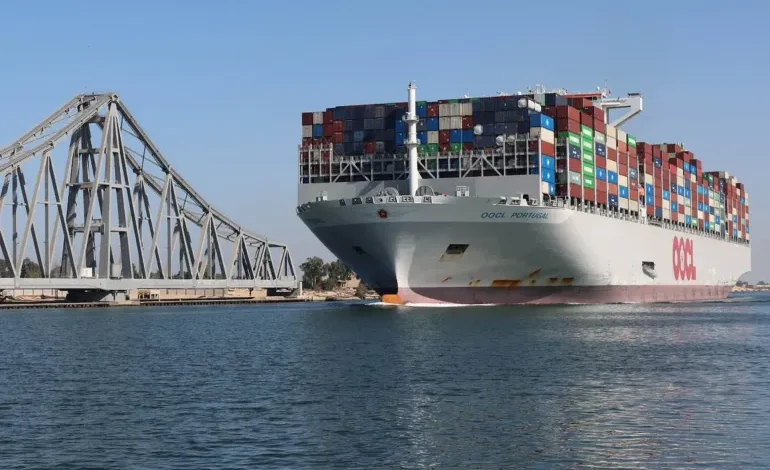
Tel Aviv is accelerating plans to turn its ports and rail network into a logistics hub within the economic corridor linking India, the Middle East and Europe.
Israel is stepping up efforts to strengthen its position in the India–Middle East–Europe Economic Corridor by developing its ports and road and rail networks, seeking to draw some Asia–Europe trade away from the Suez Canal.
Israel’s Channel 12 reported on Thursday that the Israel Ports Company intends to submit a strategic plan to the government for approval in the coming weeks. The plan aims to turn Israel into a major logistics hub within the corridor, known as IMEC, amid concerns over the progress of competing regional projects.
The plan’s outline was presented at the “Mari Med” conference in Tel Aviv, attended by representatives from Israel, the United States, Greece, the European Union and Jordan, alongside shipping companies and stakeholders associated with the ports of Haifa and Ashdod.
According to the channel, participants agreed to establish a permanent international professional forum and working groups meeting every two months. These bodies would coordinate efforts and address regulatory and operational obstacles to move the project from planning to implementation.
The corridor’s basic concept involves transporting goods by sea from India to ports in the Persian Gulf, then overland through Saudi Arabia and Jordan to Israel, before shipping them across the Mediterranean to Greece and other European markets.
The plan includes logistics centres and dry ports connected to rail networks and seaports, allowing containers to move between the Gulf and the Mediterranean by train and truck.
Some shipments could thereby bypass the traditional maritime route through the Red Sea and the Suez Canal.
However, the project is not an alternative waterway. It relies on multimodal transport, requiring containers to be unloaded and reloaded when transferred between ships, trains and trucks.
Shorter Transit Times and Reduced Exposure to Shipping Risks
Israel hopes to attract shipping companies by reducing transit times and offering an alternative route when maritime navigation is disrupted, particularly in the Red Sea and the Bab el-Mandeb Strait.
Houthi attacks on merchant vessels in recent years have prompted shipping companies to reroute vessels around the Cape of Good Hope, increasing journey times and costs. Regional tensions have also raised concerns about shipping security in the Strait of Hormuz.
The proposed corridor could provide an additional option for transporting some cargo to Europe, reducing reliance on maritime routes vulnerable to disruption. Companies could also benefit from diversifying supply routes to lower the risk of interrupted deliveries.
On October 14, Israeli business media quoted the chairman of Haifa Port as estimating that the corridor could handle approximately 1.5 million twenty-foot equivalent units (TEUs) annually during its initial phase, potentially rising to three million TEUs later.
However, these figures remain projections and have yet to be demonstrated through fully integrated commercial operations.
The corridor’s ability to compete with the canal will depend on its overall cost, the speed of border procedures and the efficiency of rail connections between the countries involved.
Overland transport involves transit, handling and storage charges, as well as container transfers between different modes of transport. Direct maritime shipping, by contrast, allows large volumes of goods to be moved without intermediate unloading.
Regional Competition over Trade Routes
Israel faces the possibility of being bypassed by alternative regional projects, amid concerns that delays in infrastructure development and international cooperation arrangements could weaken its prospects of playing a central role in the corridor.
Saudi Arabia is studying a route through Syria rather than Israel, highlighting how political disagreements could shape the project’s future.
Plans for rail connections between Saudi Arabia and Turkey through Jordan and Syria could also open other trade routes between the Gulf and the Mediterranean.
International analyses have also proposed a multi-route network encompassing Egypt, Saudi Arabia, Syria and Oman, allowing trade routes to diversify and reducing reliance on maritime chokepoints.
Channel 12 quoted Israel Ports Company chief executive Pinhas Tsaruya as describing the project as an opportunity to turn Israel into a major trade hub, while warning of intensifying competition over global trade routes.
The company’s chairman, Hezi Haleviya, said the corridor’s significance extended beyond economic returns to strengthening Israel’s strategic position and national security over the long term.
Potential Implications for the Suez Canal
The project could affect Suez Canal revenues if it encourages shipping companies to divert some traffic to the overland route through the Gulf and Israel. In that case, the canal could lose transit fees from vessels choosing the alternative route, along with some associated logistics business.
However, moving containers through Haifa Port does not automatically mean the canal will lose vessels that would otherwise have passed through it. The actual impact will depend on the volume of cargo diverted and the new corridor’s ability to offer a reliable service at competitive prices.
Egypt could also participate in regional trade networks, drawing on its Red Sea and Mediterranean ports and the Suez Canal’s location. Competition could therefore become a contest among regional ports and routes to attract cargo, rather than a wholesale shift of trade to a single corridor.
The Israeli plan still awaits government approval. Implementation of the wider corridor depends on investment, the completion of infrastructure and political and commercial coordination among the countries along its route. Channel 12 provided no specific estimates for the plan’s costs or the volume of trade expected to be diverted from the Suez Canal.
The central competitive challenge is whether Israel can attract a share of container trade between Asia and Europe and turn its ports into major links in supply chains. That goal remains dependent on the corridor’s economic viability and its ability to compete with direct maritime shipping.