Minutes That Shook Iran: Live Broadcast Suddenly Cut Off After Secret Messages Attributed to Khamenei
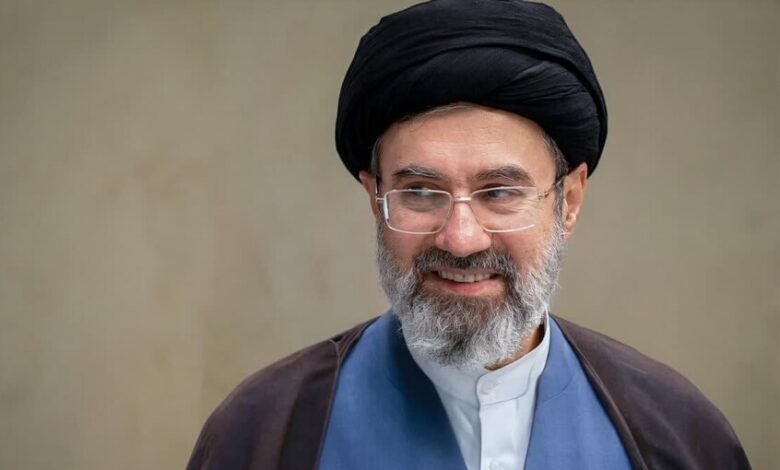
A major controversy erupted over what were described as “top-secret” messages attributed to Iran’s Supreme Leader, Mojtaba Khamenei, after excerpts were aired on state television before the broadcast was abruptly interrupted.
The messages were presented by Mahmoud Nabavian, a member of the Iranian Parliament’s National Security and Foreign Policy Committee, who read them during a state television program, according to Iran International.
-
Mojtaba Khamenei Stalls Negotiations… Missing Approval and a Suspended Agreement
-
Mojtaba Khamenei Calls for Unity Amid Domestic Anger and External Pressure
What Did the Messages Contain?
During his remarks, Nabavian stated that Khamenei opposed negotiations with the United States and that the conditions he had set for the talks were not reflected in the memorandum of understanding signed by the two sides.
During the broadcast, Nabavian said that Khamenei had repeatedly expressed dissatisfaction with the course of the negotiations, adding that the Supreme Leader had questioned why his stipulated conditions had not been respected.
According to Nabavian, Khamenei wrote that Iran was “neither in a hurry nor under any pressure to negotiate or reach an agreement,” and that the talks should focus on “ending the war and obtaining compensation,” rather than discussing the nuclear issue.
He also stated that Khamenei instructed negotiators not to discuss what he described as the “main issue,” referring to Iran’s nuclear program.
-
Mojtaba Khamenei: Uncertainty surrounds the fate of the absent Supreme Leader
-
Mojtaba Khamenei’s silence unsettles Tehran: the Leader’s absence weighs on negotiations
Messages Attributed to Khamenei
During the program, Nabavian began reading what he described as correspondence from Khamenei, arguing that the outcome of the negotiations differed from what should have occurred and from the conditions that were supposed to legitimize the talks.
He further claimed that the Supreme Leader had called for the negotiations to be halted.
According to Nabavian’s account, Khamenei reiterated his position on the nuclear issue on April 4, April 18, and April 24, demanding that Iran achieve a “victory” through full recognition of its right to enrich uranium, or alternatively that the nuclear issue be removed entirely from the negotiating agenda.
The Iranian lawmaker also referred to the Strait of Hormuz, stating that Khamenei viewed it as a key pressure tool against the United States.
He added that these instructions were contained in a letter dated March 12.
-
Mojtaba Khamenei’s Survival of Assassination Attempt Redraws Iran’s Leadership Map
-
Who is Mojtaba Khamenei, before whom Iranian leaders bow?
Broadcast Interrupted and Official Measures Taken
As Nabavian continued speaking, the program’s production team interrupted him, and the live broadcast ended abruptly.
Later, Iran’s state broadcasting authority announced that the parliamentarian’s statements could constitute “a legal violation that may justify judicial action,” as he had referred to classified documents and correspondence involving senior state officials.
The authority also announced the resignation of one of its executives following the incident and confirmed that disciplinary measures would be taken.
-
Khamenei’s Authority After the War: Unprecedented Challenges and Two Possible Scenarios
-
The Qom shrine and Mojtaba’s fate… a diplomatic memo reveals surprises
The case triggered reactions within conservative circles. Hossein Soleimani, editor-in-chief of the Mashregh news website, accused Nabavian of presenting only selected excerpts from a much broader series of communications.
In a post on the X platform, he stated that the matter involved approximately twenty different pieces of correspondence, adding that if secret or highly classified documents had indeed been disclosed, they should be presented accurately and in their entirety.
In recent days, Nabavian and other figures associated with the Paydari Front, regarded as one of Iran’s most hardline political movements and strongly opposed to dialogue with the United States and the West, have criticized the memorandum of understanding between Iran and the United States.
-
Washington offers a large reward for information about Khamenei
-
The will buried with Khamenei: how the Revolutionary Guard overturned the father’s wish
Swiss Talks
Meanwhile, the Iranian negotiating delegation, headed by Mohammad Bagher Ghalibaf and including Foreign Minister Abbas Araghchi, Central Bank Governor Abdolnasser Hemmati, and other officials, arrived in Switzerland to participate in a round of technical discussions with the United States as negotiations begin.
These talks are taking place amid a renewed closure of the Strait of Hormuz by the naval branch of the Revolutionary Guards, following what Tehran describes as violations of the memorandum of understanding in Lebanon.
For its part, the United States military stated that maritime traffic through the strait remains operational despite Iran’s announcement of its closure.
-
Iran after Khamenei: a disoriented regime and a silent struggle over the Supreme Leader
-
Geopolitical risks unsettle global markets after Khamenei’s death