The Expansion of the Yellow Line Is Strangling What Remains of Life in Gaza
Residents and displaced people believe that any further expansion would further reduce the space available to hundreds of thousands of civilians who are already living in overcrowded areas after repeated waves of displacement.
A number of residents of the Gaza Strip have expressed concern over Israeli plans to expand the so-called “Yellow Line” as house demolitions continue in areas under Israeli military control.
-
Hamas Struggles to Fill Leadership Vacancies as the Gap with Gazans Widens
-
Bloodshed on the eve of Eid in Gaza: seven killed in Khan Younis and Al-Maghazi
Every morning, Palestinian resident Abdullah Al-Astal stands outside his home near the “Yellow Line” east of Khan Younis in the southern Gaza Strip, watching Israeli tanks move nearby.
For many months, the sight of military bulldozers demolishing homes, along with repeated gunfire from military vehicles and drones, has become part of his daily life. Al-Astal does not hide his fears regarding increasing reports of Israeli plans to expand what is known as the “Yellow Line” within the Gaza Strip.
Last Thursday, Israeli Prime Minister Benjamin Netanyahu acknowledged that his army currently controls 60 percent of the Gaza Strip and revealed his government’s intention to expand that control to 70 percent of the territory.
-
Hamas weapons: the main obstacle to peace in Gaza
-
The Peace Council considers Hamas’s weapons an obstacle to Gaza’s reconstruction
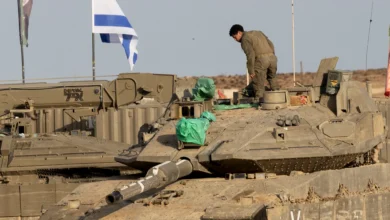
Since October 20 of last year, Israel has been placing yellow concrete blocks along the so-called “Yellow Line,” which represents its initial withdrawal line from areas inside Gaza following the ceasefire agreement between Israel and Hamas that entered into force on the 10th of the same month.
The line separates areas where Israeli forces are deployed in the east from areas where Palestinians are permitted to move in the west. Through this arrangement, Israel currently exercises control over approximately 60 percent of the Gaza Strip.
Al-Astal said, “I live very close to the Yellow Line. When I sit in my house, I hear bullets striking the walls and the metal structures around us. At any moment, I could be wounded or killed.”
-
Israel assassinates the son of a Hamas leader in Gaza
-
Amputees in Gaza: a symbol of unfulfilled promises
He added, “I see the tanks every day. They come to protect the bulldozers that demolish houses and then withdraw. During their movements, the shooting never stops.” He also pointed to neighboring homes whose residents had been hit by Israeli military fire.
As the war continues, Palestinians’ fears are growing over the possibility that the line could be expanded to encompass nearly 70 percent of the Gaza Strip, compared with approximately 60 percent at present according to local estimates.
Residents and displaced persons believe that any additional expansion would further narrow the space available to hundreds of thousands of civilians already living in densely populated areas after repeated displacement.
-
71.4 billion dollars required for recovery and reconstruction in Gaza
-
Closed since the start of the war with Iran, Israel reopens the Zikim crossing to allow aid into Gaza
Al-Astal asked, “If the Yellow Line expands, where will we go? What alternative place is there for us? The entire population is already confined to a very small area, and increasing the pressure will only lead to an explosion.”
He added, “If there were a safe place we could go to, we would have done so already. But there is no safe place left.”
In the Zeitoun neighborhood southeast of Gaza City, Palestinian Hamdi Malaka shares the same concerns.
He said, “If they want to occupy all of Gaza, they should say so openly instead of talking about yellow and red lines. We no longer have a home, land, or anywhere else to go.”
-
Palestinian Analyst: Gaza Welcomes Eid Amid an Unprecedented Humanitarian Disaster
-
Israel announces the killing of 20 militants in Gaza and the destruction of a rocket manufacturing site and a tunnel
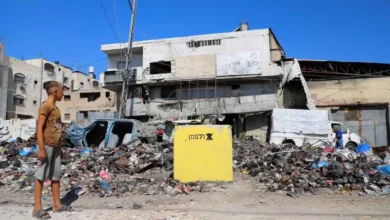
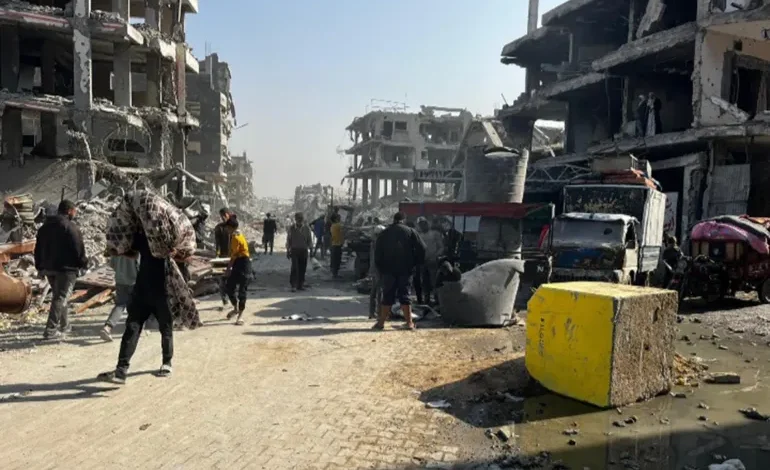
Hamdi lives in an area that has suffered extensive destruction during the war, surrounded by collapsed buildings and piles of rubble.
“We are already close to the Yellow Line. If it advances further, we will find ourselves inside it. Then where will we go?” he asked.
He continued, “Every night and every day we hear gunfire and explosions. There are deaths and injuries almost daily. If we end up inside the Yellow Line, what will remain for us other than death?”
These concerns come at a time when hundreds of thousands of Palestinians are living under extremely harsh humanitarian conditions in overcrowded displacement zones suffering from severe shortages of food, water, and healthcare services.
-
We will repeat the Gaza scenario: Israel plans a large-scale ground invasion in Lebanon
-
Israel prepares to apply the Gaza model in Lebanon
Residents warn that any further reduction in the space available to civilians would trigger new waves of displacement and increase pressure on shelters and infrastructure already devastated by the war.
On Friday, Hamas called on the “Peace Council” to take a clear position regarding what it described as serious Israeli statements concerning plans to control 70 percent of the Gaza Strip.
According to a statement issued by the Ministry of Health, since the ceasefire took effect more than seven months ago, 947 Palestinians have been killed and 2,935 others injured in alleged violations of the agreement by the Israeli military up to Thursday.
With U.S. support, Israel launched a large-scale war in the Gaza Strip on October 8, 2023. The conflict lasted two years and, according to the figures cited in the article, resulted in more than 73,000 deaths and over 173,000 Palestinian injuries, most of them women and children, while destroying approximately 90 percent of the territory’s infrastructure.
-
Demographics in the West Bank and Gaza: UN Warning over Israeli Plans
-
Israeli soldier killed in Gaza Strip by friendly fire
-
The Peace Council mobilizes for Gaza… Italy offers police training while Europe observes