The Muslim Brotherhood Faces Europe’s Legal Test: Where Does Political Islam End and Extremism Begin?
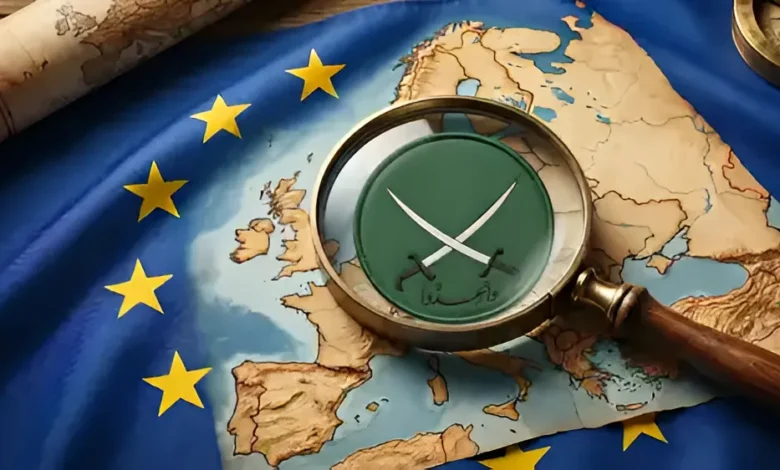
As the Muslim Brotherhood issue moves into the European Parliament’s chamber, the question facing Europe is no longer solely political. Behind calls to counter what is described as Islamist infiltration and the influence of the network associated with the Brotherhood lies a highly sensitive legal question: on what grounds can a movement, network or institution shift from being subject to political scrutiny to facing counterterrorism measures?
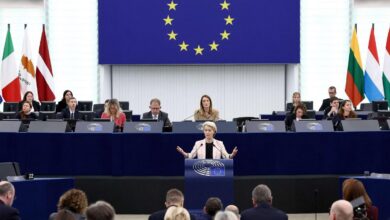
This question became more pressing after the European Parliament’s vote on 8 October 2026, which included a call for the Council of the European Union to assess whether entities or individuals linked to the Muslim Brotherhood should be placed on the list of terrorist organisations. The issue has thus moved another step towards institutions with legal powers different from Parliament’s.
One fundamental point, often lost in political rhetoric, must be emphasised: the European Parliament is not the institution that places organisations on the European terrorism list.
Parliament can adopt political resolutions, address requests to the Commission and the Council, and press for policy changes. It cannot, on its own, turn an organisation into a listed terrorist entity. The vote therefore does not mean that the Muslim Brotherhood has automatically become a terrorist organisation under European law.
This legal reality changes the nature of the next phase. After the vote come questions about evidence, criteria and procedures.
Which entity will be assessed? Does this mean the Muslim Brotherhood as a historical movement, specific entities, named individuals, or networks and associations believed to be connected to it?
This distinction is crucial because European law does not treat “ideas” in the same way as organisations proven to be involved in terrorism.
The disagreement was clearly visible during parliamentary discussions. The European Conservatives and Reformists group advocated a particularly tough position, calling for the Brotherhood and its network to be placed on the terrorism list. Other forces, including left-wing and green political currents, were more cautious, warning that terrorism concerns could be used to stigmatise Muslims or restrict civic activity.
The European People’s Party sought to formulate a position distinguishing Islam from political Islam. It stressed that religious freedom must remain protected while addressing what it considers ideological political activity threatening democracy.
This formulation exposes Europe’s real dilemma.
When a state seeks to confront a terrorist organisation, the legal route is relatively clear: establish a connection to terrorist acts, their financing or their facilitation, then apply the relevant legal procedures.
But how should a state respond to a movement that, in the case under discussion, is not engaged in direct terrorist activity across all its structures, while some components are accused of seeking to build long-term political or social influence?
Here, Europe enters more complex territory.
Terms such as “political Islam”, “Islamist infiltration” and “organisations linked to the Muslim Brotherhood” are not interchangeable legal concepts. An entity may face severe political criticism without necessarily meeting the conditions for inclusion on the terrorism list.
This makes statements by certain European officials important. Home Affairs Commissioner Magnus Brunner noted that member states do not apply the same criteria when assessing the Muslim Brotherhood. Some governments focus on links to violence and terrorism, while others also consider activities they regard as harmful to democracy, social cohesion and fundamental rights.
This difference is not a minor detail. It lies at the heart of the problem.
If the European Union wants a common strategy, it must first define the threat it intends to address.
Is the threat terrorism? If so, the priority must be evidence relating to violence, financing and facilitation.
Is it foreign influence? That requires transparency rules for funding and lobbying.
Is it ideology? This is more sensitive, because democratic systems cannot simply criminalise ideas unless they translate into legally prohibited conduct.
Warnings in European media are therefore significant. An analysis published by EUobserver cautioned that a broad use of the term “Islamist infiltration” could place Muslim civic activity under suspicion. It noted that the boundary between peaceful political activity and what some view as part of an ideological project is not always clear.
This debate will undoubtedly continue in the next phase.
Supporters of the measures respond that allowing organisations or networks to use democratic tools to build influence ultimately aimed at weakening democracy creates a serious vulnerability. They argue that defending democracy does not mean waiting for violence before acting.
This argument draws on a recognised principle in European democracies: protecting the democratic system against actors that exploit its mechanisms to undermine it.
Applying that principle requires safeguards, however. Not every conservative, religious or political current that rejects certain aspects of the political system constitutes a threat to democracy. Political opposition likewise cannot be treated as subversive activity.
Evidence will therefore remain decisive.
If an institution receives secret funding, accepts money from a banned entity or participates in terrorist financing, there is a legal basis for intervention. If the only evidence is the presence of someone whose ideas resemble those of a particular political current, the situation becomes more complicated.
The sensitivity is heightened when European Muslims are involved. Islam is practised by millions of European citizens, and Muslim organisations are part of civil society across EU countries. Imprecise political rhetoric can therefore create the impression that measures target religious identity itself.
Some lawmakers tried to avoid this by stressing that the target was not Muslims, but organisations and networks that authorities consider a threat to democracy or security.
Statements alone, however, are insufficient. The real test will be how the measures are applied.
European rules based on conduct, funding and organisational relationships may be legally defensible. If religious identity or Muslim civic activity becomes an indicator in itself, Europe will face a serious fundamental rights problem.
Terrorist designation also carries severe consequences. It does not simply place a name on a political list. It opens the way to freezing funds, prohibiting the provision of resources and restricting financial transactions, alongside broader effects on people and entities associated with the organisation.
Any call for designation must therefore undergo rigorous legal and security examination.
Calling for a designation may be politically straightforward. Justifying it before the competent institutions and European courts presents a different challenge.
This makes the next phase particularly important. The Council of the European Union will face a case requiring verifiable evidence, not merely parliamentary positions.
The European Commission must also determine how to implement any new strategy without violating the principle of proportionality. Measures must be appropriate to the risk and go no further than necessary to achieve their objective.
Recent developments suggest that the issue is moving along several tracks. One concerns the terrorism list, another European funding, and a third influence within institutions. There is also a security track focused on information sharing and preventing extremism.
Combining these approaches may be the most realistic route. Rather than reducing the issue to “Is the Muslim Brotherhood terrorist or not?”, Europe can develop a multilayered framework: counter terrorism where evidence exists, scrutinise funding where violations occur, strengthen transparency in political activity, and protect legitimate civil society.
This approach is more complex, but also more sustainable.
Its importance is also reflected in differing European positions. The Italian news agency ANSA reported that Parliament had called on the Council to assess the inclusion of entities or individuals linked to the Brotherhood on the terrorism list. It also described measures concerning the prevention of organisations associated with the Council of European Muslims from accessing European institutions.
Other sources, by contrast, focused on the need to avoid conflating counter-extremism efforts with fundamental freedoms.
The real disagreement within Europe therefore appears to concern different definitions of security, rather than a simple division between those who want security and those who want freedom.
One side believes security requires confronting influence networks before they become a direct threat. The other argues that security must not become a pretext for widening the scope of suspicion.
European institutions must demonstrate that the law can accommodate this complexity.
If the Union establishes clear criteria, it will have an opportunity to build a more effective policy towards extremist organisations and unlawful networks. If it relies on poorly defined political concepts, it may face legal challenges and disagreements between member states.
The 8 October vote is therefore not the end of the road towards designating the Muslim Brotherhood. It is a political step opening a new legal process.
The paradox is that its success will depend less on the severity of the language used against the movement than on European institutions’ ability to provide precise evidence, identify the targets, respect procedures and distinguish legitimate civic activity from conduct posing a genuine threat.
That is the next battle, and it is more difficult than any political speech in Parliament’s chamber.