The Muslim Brotherhood in Egypt and June 30: Three Decades After the Meeting That Led the Group to Its Final Downfall
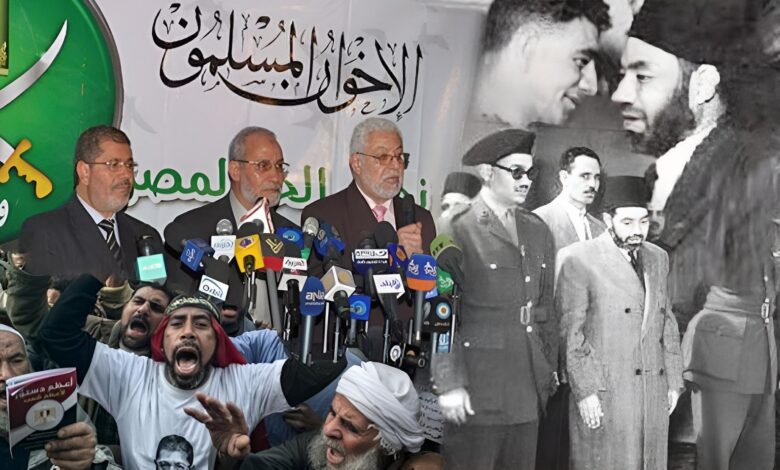
In 1995, the leaders of the Muslim Brotherhood gathered at the offices of Salsabil, a company owned by Khairat El-Shater, the Deputy Supreme Guide, to develop what they called the “empowerment” plan.
The empowerment plan was the most ambitious strategy in the Brotherhood‘s history, which had begun in Ismailia in 1928. Although the movement achieved unexpected successes over the following decades, its journey ultimately ended with many of its leaders behind bars or living in self-imposed exile, fleeing both the anger of the Egyptian people and court rulings in terrorism-related cases.
-
What is the Relationship between the Founding of the Muslim Brotherhood in Egypt, Iraq, Syria, and the Greater Israel Project?
-
“Year of Lies and Blood”: Major Terrorist Crimes Committed by the Muslim Brotherhood in Egypt
The opening stage of the plan, supervised by Khairat El-Shater—one of the Brotherhood‘s leading hardliners and a prominent figure of the Qutbist movement—began at Al-Azhar University. There, the Brotherhood committed what is widely regarded as its first historic mistake by staging a paramilitary-style military parade carried out by Brotherhood students. The display resulted in prison sentences for several leaders, including El-Shater himself.
The demonstration was viewed as a message directed at the Egyptian state, which responded swiftly and decisively. This prompted the Brotherhood to readjust its strategy by directing its leaders toward participation in professional syndicate and parliamentary elections.
-
A new slap to the Brotherhood in Egypt; The failure of calls November 11 marks the end of the terrorist organization
-
Rumors spread by Egypt’s Muslim Brotherhood ahead of January 25: a repeated tactic exposed by public awareness
The Brotherhood adopted a gradual and slow approach to achieving empowerment by systematically infiltrating state institutions. Consequently, when the popular uprising erupted in 2011, it hesitated for a considerable period before deciding to participate.
Over the years, the Brotherhood built a powerful and highly efficient electoral machine. However, its political discourse remained largely empty. As a result, once its propaganda apparatus brought the movement to power, its shortcomings quickly became evident, exposing its inability to govern the country. Within only one year, the Egyptian people’s June 30, 2013 Revolution removed it from power.
-
72 years since the dissolution of the Muslim Brotherhood: the story behind Egypt’s Revolutionary Command Council decision
-
Echo-less rumors: Egyptians’ awareness foils the Muslim Brotherhood’s plan ahead of the January 25 anniversary
Following the removal of former President Mohamed Morsi on July 3, 2013, the Muslim Brotherhood, designated as a terrorist organization in several countries, realized that its plan to dominate Egypt had completely failed after being rejected by the Egyptian people. The group subsequently devised a new strategy—not one of empowerment, but one centered on spreading chaos and seeking revenge.
During a series of meetings of the Brotherhood‘s Shura Council, supervised by three members of the Guidance Bureau, including Mohamed Kamal, who was killed during a confrontation with Egyptian security forces in 2016, the organization approved the August 2014 plan known as the “Exhaustion, Confusion, and Decisive Action” strategy. Its objective was to overthrow the Egyptian state and restore the Brotherhood to power through terrorism.
-
Muslim Brotherhood rumors in Egypt: public awareness thwarts the blank shots
-
The Muslim Brotherhood Has Betrayed the Egyptian Army Since the 1948 War… A Journalist Presents the Evidence
This strategy proved no more successful than its predecessor. It plunged the organization into unprecedented internal fragmentation and divisions, whose consequences spread to Brotherhood branches across the Arab world.
The State’s Battle Against Terrorism
After losing public support, the Brotherhood resorted to terrorism as its final option. Nevertheless, over the years, the Egyptian state succeeded in dismantling the organization’s plans through a long-term strategic approach. This included breaking apart the Brotherhood‘s organizational structure, preventing terrorist operations, neutralizing active cells, and developing a counter-narrative to challenge the Brotherhood‘s propaganda aimed at inciting public unrest, spreading rumors, and undermining national morale. At the same time, the government implemented a comprehensive economic strategy centered on major national projects designed to achieve sustainable development and modernize multiple sectors.
-
A Cross-Border Criminal Record: The Story of the Muslim Brotherhood Member Accused of Terrorism in Egypt and Jailed for Rape in London
-
Egypt and the Muslim Brotherhood: Talha’s Release Exposes Double Standards and Threatens Regional Security
A comparison between the Egyptian state’s efforts and the Brotherhood‘s activities shows that the organization has experienced a significant decline since 2013. Although it remained active in several governorates after its removal from power, benefiting from local supporters, it gradually lost both momentum and public backing until reaching its current state of internal fragmentation and conflict among rival factions.
Ahmed Hamida, a former Brotherhood member who left the organization several years ago, believes the group assumed it had gained control over Egypt’s key state institutions after coming to power in 2012. It therefore sought to expand its influence across all government institutions, but the constant vigilance of the state’s various agencies enabled them to thwart those plans.
-
Contradictions in the Egyptian Discourse: Between Declared Hostility Toward the Muslim Brotherhood and Implicit Cover for Affiliated Factions
-
Egypt’s Muslim Brotherhood and the Prisons: Rumors Without Keys and Lies That Won’t Overturn Sentences
Hamida explained that after the dispersal of the armed sit-ins at Rabaa Al-Adawiya Square in eastern Cairo and Al-Nahda Square in Giza, the Brotherhood adopted a multi-stage escalation plan consisting of exhaustion, confusion, sabotage, and ultimately decisive confrontation. To implement this strategy, it formed specialized operational cells trained in the use of weapons to confront state institutions and attempt to drag the country into civil war.
He stated that the Egyptian security services responded with exceptional professionalism, maturity, and responsibility by surrounding these groups and launching successive preemptive operations that either eliminated them during armed confrontations or led to their arrest.
-
Inside the Formation of Egypt’s Muslim Brotherhood Terror Cells: Revelations in a Podcast
-
From Hassm to Midan: Egypt’s Muslim Brotherhood attempts to reengage chaos
According to Hamida, the Brotherhood‘s schemes never ceased. It devoted substantial financial resources to establishing television channels and digital platforms that repeatedly targeted the Egyptian state by questioning national achievements, spreading rumors, fueling division, and attempting to undermine public confidence in the country’s leadership. The state countered these campaigns by exposing falsehoods, presenting factual evidence, and providing accurate information demonstrating the deceptive nature of the Brotherhood‘s propaganda.
Overall, Hamida believes the Egyptian state successfully removed the Brotherhood from the political arena by exposing its extremist ideology and exclusionary nature. Nevertheless, he argues that the organization’s conspiracies will continue, making it essential to confront its ideological foundations through profound intellectual engagement alongside continued security measures targeting its organizational structure.
-
Their Hands Stained with Egyptian Blood: Who Are the Muslim Brotherhood Figures Yahya Moussa and Alaa al-Samahi?
-
The Egyptian Media Syndicate responds to the Muslim Brotherhood’s lies about Egypt’s stance on the Palestinian cause
An Existential Battle
Sabra Al-Qassimi, a lawyer before Egypt’s Court of Cassation and an expert on Islamist movements, argued that the Brotherhood‘s downfall since the June 30 Revolution demonstrates that Egypt did not merely wage a conventional security campaign but rather fought a comprehensive existential battle on multiple fronts.
Al-Qassimi said Egyptian state institutions succeeded in deciphering the “code of chaos” and disrupting the plans of the Muslim Brotherhood‘s international organization through a three-dimensional strategy based on legal, security, and developmental pillars.
-
Media Recalls the Crimes of the Muslim Brotherhood and Their Attempt to “Burn Egypt”
-
An Expert Reveals the Plans and Names of Muslim Brotherhood Centers Targeting the Region and Egypt
He explained that the first pillar consisted of a firm legislative and legal response. The Egyptian state enacted decisive legal measures banning the Brotherhood and criminalizing its activities while establishing a strong legal framework for pursuing terrorist entities. Supported by the criminal courts and Egypt’s Court of Cassation, this framework succeeded in drying up the organization’s funding sources by confiscating the assets of associations and companies that served as fronts for financing violence against the country’s vital national interests.
Regarding the second pillar, Al-Qassimi emphasized that intelligence and security agencies thwarted plans devised abroad by the Brotherhood‘s international leadership. They also successfully confronted the group’s digital disinformation strategy, which relied on paid online networks operating from outside Egypt to spread daily rumors targeting various issues, particularly the economy and national development projects.
-
The Muslim Brotherhood and Lies: The group promotes old videos to deceive Egyptian public opinion
-
Rumors of the Muslim Brotherhood Reach Raba’a and Nahda… Egypt Denies
He added that the Egyptian state did not merely defend itself but actively dismantled the Brotherhood‘s digital propaganda networks and exposed the organization’s political and moral contradictions before both Egyptian and international public opinion, further increasing its political and popular isolation. According to him, realizing it had lost this battle, the Brotherhood shifted its attention toward recruiting younger generations, particularly Generation Z and Generation Alpha, who have limited knowledge of the organization’s history and primarily encounter its narratives through social media.
He noted that several teenagers and young people recruited online through groups administered by Brotherhood member Anas Habib and others became involved in terrorism-related cases and are currently facing trial before Egyptian courts.
-
Did the Muslim Brotherhood aim to destroy the Egyptian identity? Details
-
The “Hasm” movement of the Muslim Brotherhood aimed to overthrow the ruling regime in Egypt… How?
Concerning the third pillar of the state’s strategy, Al-Qassimi explained that it focused on sustainable development and public awareness. Egyptian authorities recognized that poverty and marginalization create fertile ground for terrorist organizations such as the Muslim Brotherhood. Consequently, Egypt launched major national development projects, particularly in infrastructure and social protection, as a central component of its broader effort to eliminate the conditions that enable terrorism to flourish.
Al-Qassimi concluded that Egypt’s success in thwarting the Brotherhood‘s plans since 2013 has not only safeguarded the country’s internal stability but has also contributed to raising international awareness of the dangers posed by the organization, which is designated as a terrorist group in several countries. According to him, this has inspired a growing number of Arab and European states, as well as the United States, to ban or seek to designate the Brotherhood as a terrorist organization, a process that continues to dismantle what remains of a movement that, by its own declared ambition, sought to dominate the world beginning with Egypt.
-
Lies and Allegations: The Muslim Brotherhood Exploits the Palestinian Issue to Undermine Egypt’s Image
-
From the Middle Leadership of the Muslim Brotherhood… Harsh Sentences Against a Brotherhood Cell Aimed at Striking the Egyptian Economy