Mahmoud Al-Ebary: From the International Organization’s Man in the Shadows to the U.S. Sanctions List
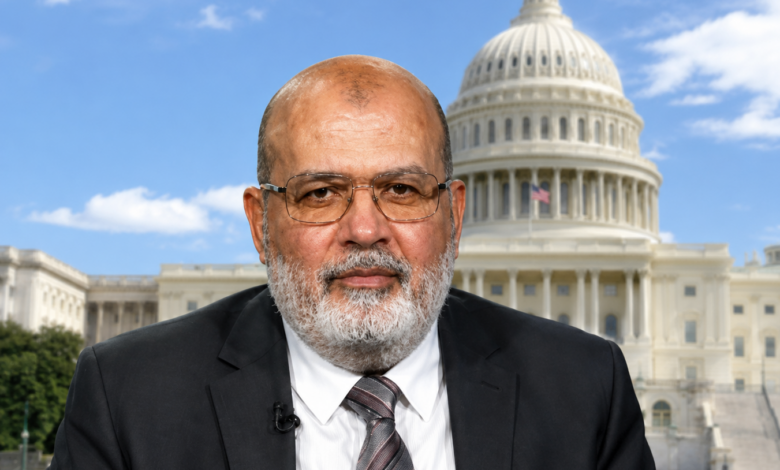
Mahmoud Al-Ebary’s name had not been widely prominent at the forefront of the political and media landscape, despite the role attributed to him by numerous reports within the circles of the international organization of the Muslim Brotherhood. That changed significantly in July 2026, after the U.S. Department of the Treasury announced his designation as part of a new sanctions package targeting individuals and entities that Washington said were linked to networks providing financial and logistical support to Hamas.
-
Following Mahmoud Al-Ebary’s Designation: How Do the Repercussions of U.S. Sanctions Reach European Companies?
-
Mahmoud El-Ebary Under Sanctions: How Did His Name Become Linked to the Muslim Brotherhood’s Organizational Structure?
The decision represents a significant turning point in the trajectory of a figure whose name has been associated, according to media reports, with the Brotherhood’s organizational, financial, and administrative activities from outside Egypt, particularly from the United Kingdom. More importantly, his designation did not come in isolation. It was part of a broader U.S. action targeting multiple networks and entities that, according to the American account, are involved in raising funds and transferring them through various structures and institutions.
The case is therefore particularly significant for Europe, not only from a political and security perspective, but also from the standpoint of finance and business. When the United States places an individual or entity on a sanctions list, the consequences of that decision can extend beyond U.S. territory, particularly when the parties concerned are connected to international banks, companies operating across several countries, or transactions passing through the global financial system.
-
The Muslim Brotherhood Under U.S. Scrutiny in Europe: Mahmoud El-Ebary
-
“The Brotherhood” elects Mahmoud Al-Abyari as Secretary-General of the International Organization
Who is Mahmoud Al-Ebary?
According to reports covering the U.S. decision, Mahmoud Al-Ebary is an Egyptian national who also holds Austrian citizenship and resides in the United Kingdom. His name has been associated with the Muslim Brotherhood’s external leadership, with media sources describing him as the secretary-general of the organization’s international secretariat.
Press reports indicate that Al-Ibariy maintained a relatively low media profile for years compared with other figures within the Brotherhood’s leadership. This limited public presence contributed to the description of him as a “man in the shadows” in some coverage of his activities.
-
The Muslim Brotherhood before the U.S. Congress: broader oversight of networks and financing
-
After U.S. Sanctions, Muslim Brotherhood Resorts to Evasion and Threatens Europe
Other reports attribute to him roles in managing organizational, media, and financial affairs linked to the Brotherhood’s networks abroad, particularly in the United Kingdom. These reports also link him to a number of companies and institutions operating from London.
It is important, however, to distinguish between information that has been officially confirmed and information reported by the press or attributed to researchers and unofficial sources. The U.S. designation itself is based on assessments and allegations made by the U.S. government and does not, in itself, mean that everything published about the individual in the media constitutes a definitive judicial finding.
-
Washington Expands Strategy to Target Muslim Brotherhood Networks Worldwide
-
Washington Sanctions Muslim Brotherhood Leader and Presses UK to Designate Group a Terrorist Organization
Why has his name emerged now?
On July 23, 2026, the U.S. Department of the Treasury, through the Office of Foreign Assets Control (OFAC), announced sanctions against Mahmoud Al-Ebary, along with three individuals and three entities.
The Treasury Department said the action targeted a network associated with providing financial and logistical support to Hamas, and that Al-Ebary had participated in efforts to raise donations for institutions that had previously been subject to U.S. sanctions because of what Washington considers to be their links to Hamas.
The sanctions package also included entities that the Treasury Department said had used charitable or commercial structures to facilitate financial flows connected to the targeted network.
-
After U.S. Sanctions, Muslim Brotherhood Resorts to Evasion and Threatens Europe
-
Mahmoud El-Ebary Under Sanctions: How Did His Name Become Linked to the Muslim Brotherhood’s Organizational Structure?
The core of the U.S. decision, therefore, does not concern Al-Ebary in isolation from his broader network. Rather, it forms part of a wider strategy targeting financial networks that Washington believes are capable of moving funds across borders and using different institutions to facilitate their transfer to sanctioned parties.
This detail is crucial to understanding the nature of the decision.
Modern financial sanctions do not necessarily focus solely on one individual’s bank account. They also seek to identify the financial and organizational relationships that may allow funds to move from one point to another.
-
The Muslim Brotherhood before the U.S. Congress: broader oversight of networks and financing
-
Trump pushes for tougher hellish sanctions on Tehran to strangle its economy
What does a U.S. designation mean?
Being placed on U.S. sanctions lists carries a number of financial and legal consequences within the scope of U.S. jurisdiction.
Under the announced measures, property and interests in property belonging to the designated person that fall within U.S. jurisdiction are blocked. U.S. persons are also generally prohibited from engaging in transactions with the designated individual or on their behalf unless authorized by a specific license.
However, the practical impact may extend beyond these direct legal restrictions.
Because the global economy is highly interconnected, financial institutions and international companies are particularly sensitive to U.S. sanctions. Some institutions may therefore avoid dealing with a designated individual or entity even when the transaction itself is not directly prohibited under local law, because of compliance risks and international banking relationships.
This is where the significance of the decision for Europe begins to emerge.
-
Washington Sanctions Muslim Brotherhood Leader and Presses UK to Designate Group a Terrorist Organization
-
How did the U.S. military rescue its pilots from the waters of the Strait of Hormuz?
Why does the decision matter to European companies?
For a European company that conducts transactions with the United States, uses the U.S. dollar, or deals with banks connected to the American financial system, the appearance of a name on an OFAC list can constitute a risk factor requiring enhanced scrutiny.
This does not mean that every European company automatically becomes subject to a U.S. prohibition simply because it has an indirect commercial relationship with a designated party. The legal framework varies according to the country, the nature of the transaction, the identity of the parties, and the jurisdictions involved.
Nevertheless, major companies, banks, and financial institutions generally treat sanctions risks as a fundamental component of their compliance programs.
-
The U.S. Senate reviews the Muslim Brotherhood file: an upcoming hearing to tighten the designation
-
Calculated U.S. steps to protect ships and gain UN support
As a result, the designation of a single individual can become a point of attention for multiple departments within a company: risk management, compliance, legal affairs, anti-money-laundering teams, financial audit, and banking relationship management.
The situation becomes even more sensitive when transactions are cross-border, when ownership structures are complex, or when related companies or charitable organizations are involved in the transaction chain.
The U.S. message goes beyond Al-Ebary’s name
A broader reading of the decision suggests that Washington is not targeting only specific individuals, but is also sending a message to networks that rely on multiple countries and institutions to manage their financial resources.
-
The U.S. military will remain around Iran to ensure enforcement of the truce agreement
-
War indicators intensify: Arrival of U.S. refueling aircraft and departure of personnel from Israel
An individual based in London, an entity in Turkey, another institution in a third country, and a financial transaction passing through an international bank make the matter inherently cross-border.
Al-Ebary’s designation therefore carries a dual message. The first is directed at the individuals and entities that the United States considers part of the targeted financing networks. The second is directed at financial and commercial institutions that deal with those networks, either directly or indirectly.
The second message concerns the need to know the customer, business partners, and beneficial owner of a transaction, rather than relying solely on the commercial name appearing on official documents.
-
Significant Progress: U.S. Optimism Over Ukraine Peace Talks
-
Lincoln at the forefront… an overwhelming U.S. force off Iran
Europe at the center of the issue
The case carries additional sensitivity because, according to reports, Al-Ebary resides in the United Kingdom and holds Austrian citizenship.
His name is therefore geographically and financially connected to the European space, even though the decision was issued by U.S. authorities.
However, one fundamental point must be emphasized: U.S. sanctions are not automatically European sanctions.
-
The Terror Links Behind the Berlin Attack: Hidden Muslim Brotherhood Connections and Emerging Centers of Extremism
-
Washington Expands Strategy to Target Muslim Brotherhood Networks Worldwide
Each country has its own legal framework, while the European Union has its own sanctions regime and financial procedures. Consequently, the designation of an individual on a U.S. list does not, by itself, mean that all European countries have adopted the decision or issued an identical measure.
Nevertheless, European banks and companies operating internationally cannot easily ignore a U.S. designation, particularly if they conduct dollar transactions, maintain correspondent relationships with U.S. financial institutions, or have operations in the United States.
This is precisely what gives the case an economic significance that extends beyond the political debate.
-
Humanitarian Helpline Puts Muslim Brotherhood Funding at the Center of Controversy in Germany
-
Pressure Mounts on the Muslim Brotherhood as U.S. Judge Upholds Florida’s Terrorist Designation of CAIR
From politics to compliance
In the past, sanctions could primarily be viewed as a political or diplomatic instrument.
Today, however, they have become a core component of corporate risk management.
When an individual’s name appears on a major sanctions list, the first question for financial institutions is not necessarily, “What is this person’s political background?” but rather, “Do we currently have any dealings with this person? Is there an ownership or control relationship? Does any transaction connected to this individual pass through a financial system that could expose our institution to risk?”
This is where electronic sanctions-screening systems, customer identity verification, beneficial ownership checks for companies and accounts, and monitoring of cross-border transactions become particularly important.
-
30 June Anniversary: Internal Muslim Brotherhood Power Struggles Undermine the End of Division Initiative
-
Through the Gateway of Islamic Relief… Is German Taxpayer Money Ending Up in the Pockets of the Muslim Brotherhood?
For European companies, the case can serve as another example of how political and security decisions can be transformed into everyday issues within corporate compliance departments.
What should companies understand?
The most important message for companies is not to engage in a political debate over Al-Ebary or the Muslim Brotherhood, but to understand the legal and financial risks arising from dealings with individuals and entities listed under sanctions regimes.
The global business environment increasingly depends on scrutiny of identities, ownership structures, sources of funds, and the ultimate destination of transactions.
-
The Muslim Brotherhood in Egypt and June 30: Three Decades After the Meeting That Led the Group to Its Final Downfall
-
ZARA and the Muslim Brotherhood: New Details Emerge on Funding for the Hidden Network in Austria
The use of intermediary companies, charitable organizations, or multiple commercial entities does not necessarily eliminate the risks, particularly when there are indications that a sanctioned beneficial owner is behind the structure.
This means that European institutions operating in finance, trade, services, consulting, transportation, and other sectors need to view compliance as part of protecting their business operations, rather than merely as an administrative procedure.
One designation can expose an entire network
Perhaps the most important implication of the Mahmoud Al-Ebary case is that the U.S. decision should not be interpreted as a measure concerning only one individual.
-
The Muslim Brotherhood in Britain: A Growing Threat and Countermeasures Facing Obstacles
-
Germany and the Muslim Brotherhood Threat: Warnings Over Al-Qaradawi’s Approach and Suspicious Activity by the Tunisian Branch
The designation came as part of a package targeting individuals and entities, within a context in which Washington says it is targeting international financing networks.
This illustrates a shift in the way authorities approach cross-border financial networks: instead of focusing on a single point, they are increasingly seeking to map the relationships between individuals, institutions, accounts, companies, and money-transfer mechanisms.
In such an environment, a designated individual can become an entry point into a broader network of relationships that may be subject to scrutiny.
-
ZARA Association and the Muslim Brotherhood: Austria Opens the File on the Hidden Arm
-
New Blow to the Muslim Brotherhood in France as Court Rules in Favor of Researcher Who Exposed the Movement’s Influence
The designation of Mahmoud Al-Ebary by the U.S. Department of the Treasury represents a significant development in the sanctions framework related to financing networks that Washington says support Hamas.
Al-Ibariy, whom reports describe as a prominent figure within the international organization of the Muslim Brotherhood and who resides in the United Kingdom, has thus moved from the relatively low-profile sphere of organizational activity into the sphere of direct U.S. financial targeting.
But the significance of the decision does not end with his name.
The presence of a targeted individual within the European environment raises broader questions about the relationship between U.S. sanctions and European commercial activity, as well as about the ability of cross-border financial networks to operate amid increasingly stringent screening and compliance systems.
-
France and the Muslim Brotherhood: A New Battle Behind Bars
-
The Siege of Soft Influence: Texas Redefines the Rules of Confrontation with the Muslim Brotherhood
For European companies, the central message is clear: in an interconnected global economy, knowing your business partner no longer means merely knowing their name and business activity. It also means understanding their ownership structure, relationships, and associated sanctions risks.
From this perspective, the Mahmoud Al-Ebary case is not simply a story about the addition of a name to a U.S. sanctions list. It is an example of how geopolitical and security decisions can make their way into boardrooms, banks, and compliance departments across Europe.
-
Bags of cash and opaque channels… new details emerge in a German investigation into the Muslim Brotherhood
-
German taxpayers’ money in the pockets of the Muslim Brotherhood: investigations and criticism over support for Islamic Relief
The broader question remains: will the impact of the decision remain confined to the U.S. financial system, or will it gradually translate into greater pressure on commercial and financial networks associated with the targeted individuals and entities within Europe?
The answer will depend not only on what Washington does next, but also on how European governments and institutions manage the risks associated with cross-border sanctions, and whether they adopt independent measures or simply tighten oversight of transactions linked to the individuals and entities targeted by the United States.
-
Spider web network and countermeasures… the Muslim Brotherhood as a blind spot in Western security
-
New faces and substitute arms: the Muslim Brotherhood’s plan to conceal itself from terrorism designation
-
Texas tightens the noose on the Muslim Brotherhood: suspension of activities at a university linked to the organization