The Rise of Hamza-1 Reflects Growing Military Convergence Between Egypt and Turkey Amid Regional Rivalry
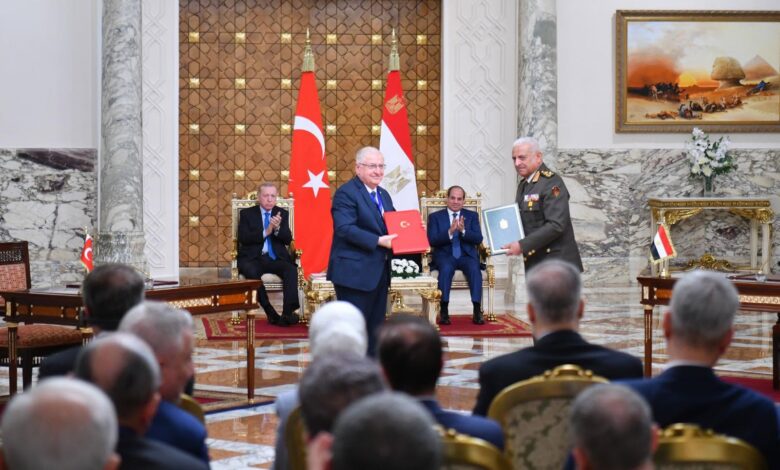
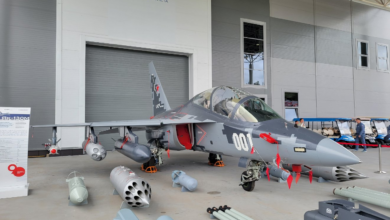
Turkish company HAVELSAN and Egypt’s Arab Organization for Industrialization have reached an agreement to sell the “Hamza-1” unmanned aerial vehicle, indicating that this military cooperation has entered a commercial and profit-generating phase.
Turkish company HAVELSAN and Egypt’s Arab Organization for Industrialization have reached an agreement to market the “Hamza-1” drone, which was jointly developed by the two sides, amid a struggle for regional influence in the face of the Israeli-Greek alliance.
-
Drones and ambitions: how Egypt and Turkey seek to control Sudan through secret bases
-
The return of ambassadors and the summit between el-Sisi and Erdogan.. Egypt and Turkey initiate steps towards reconciliation
The agreement marking the drone’s entry into the sales phase was announced during the 2026 Egypt International Airshow in El Alamein, held in northern Egypt from September 8 to 10.
The agreement builds on the strategic cooperation deal signed by the two companies on August 26, 2025. The agreement includes the joint production in Egypt of autonomous drones capable of vertical takeoff and landing.
The “Hamza-1” stands out as an important example of HAVELSAN’s engineering expertise and technological capabilities in autonomous systems being applied within the framework of international cooperation.
-
Saudi Arabia, Qatar, Egypt and Turkey… How Have Regional Powers Contributed to Prolonging the War in Sudan?
-
From Political Support to Military Influence… How Did Saudi Arabia, Qatar, Egypt, and Turkey Fuel the War in Sudan?
The “Hamza-1” program combines the technical expertise the Turkish company has acquired through the drones it developed for various missions, such as “BAHA,” “BÖZBEY,” “POYRAZ,” and “BULUT,” with Egypt’s local manufacturing capabilities.
The “Hamza-1” drone was first unveiled at the EDEX 2025 defense and security industries exhibition, held in Cairo in December 2025.
With the signing of the sales agreement, the “Hamza-1” program has moved from the joint-production phase into the commercial phase. The agreement is expected to include the delivery of drones to different users.
The program reflects the development of cooperation between Turkey and Egypt in defense-industry technologies, as well as HAVELSAN’s approach based on joint production and localization through international partnerships.
-
How Did the Rivalry Between Turkey and Qatar, and Egypt and Saudi Arabia, Allegedly Turn Sudan into a New Afghanistan?
-
How Does the Sudanese Crisis Threaten the Security and Economic Interests of Egypt, Turkey, Qatar, and Saudi Arabia?
This development is part of a broader trajectory of military cooperation between Cairo and Ankara. In recent months, the two countries have moved toward expanding the scope of their defense coordination to include joint exercises, exchanges of expertise, and the development of military capabilities and defense industries. Joint drone manufacturing gives this rapprochement a more strategic dimension, as it is based not merely on purchasing equipment but also on technology transfer, localization of production, and the development of capabilities that can be further advanced domestically.
This comes as Greece and Israel are moving in the same direction to deepen their defense partnership, with an increasing focus on building integrated military systems covering air and missile defense as well as counter-drone capabilities. The Israeli-Greek agreement to establish a multilayered air-defense system is one of the most prominent manifestations of this cooperation, bringing together several Israeli systems within a single network capable of addressing different types of aerial threats.
-
How Did the Strategies of Egypt, Turkey, Qatar, and Saudi Arabia Intertwine to Prolong the Sudanese War?
-
Has Turkey distanced itself from the Muslim Brotherhood, and why did it seek Egypt? A political thinker responds
The significance of this cooperation extends beyond conventional arms deals. Athens is seeking to build an advanced defensive shield, while Israel provides expertise in missiles, radars, counter-drone systems, and command and control. This reflects a move toward building an interconnected military capability between the two countries in a region experiencing growing competition over influence as well as security and strategic interests.
By contrast, closer ties between Egypt and Turkey give Cairo and Ankara greater room to build defense influence based on industrial and military cooperation. Turkey has advanced expertise in developing drones and autonomous systems, while Egypt possesses a broad military-industrial base that can provide an environment conducive to manufacturing, localization, and the expansion of production capacity.
-
After the withdrawal of Hussein’s nationality… Will Turkey hand over members and leaders of the Muslim Brotherhood to Egypt?
-
Turkey and Egypt are on the way to completing procedures to improve relations – Details
This competition takes on even greater importance in the Eastern Mediterranean, where security, energy, maritime routes, and border demarcation issues intersect with military calculations. The shift in Egyptian-Turkish cooperation from military exercises and coordination toward joint production and the commercial marketing of defense equipment therefore points to an effort to build a more deeply rooted partnership—one that extends beyond military use to the creation of a shared defense-industrial base.
On the other side, Israeli-Greek cooperation is consolidating the positions of Athens and Tel Aviv within an expanding defense network, particularly in the field of air defense, which has become one of the region’s principal arenas of military competition as threats from missiles and drones continue to grow.
-
Turkey is seeking relations with Egypt along the lines of the UAE and Saudi Arabia
-
Egypt comments on “Turkey’s dealings with the Brotherhood” and puts another condition
The regional landscape thus appears to be developing along two parallel tracks: an Egyptian-Turkish rapprochement increasingly focused on military cooperation and defense industries, and an Israeli-Greek partnership expanding its advanced defensive capabilities.
Between these two tracks, a struggle for influence is taking shape that depends not only on political alliances, but also on the ability to produce, develop, and export military technology and to build joint defense networks.
-
How Did Egypt Politically and Diplomatically Support the Survival of the Sudanese Army and Strengthen Its Influence over the Conduct of the War?
-
Turkey and Weapons in Sudan: How Have Drones Helped Change the Course of the War?