Saudi Arabia, Qatar, Egypt and Turkey… How Have Regional Powers Contributed to Prolonging the War in Sudan?
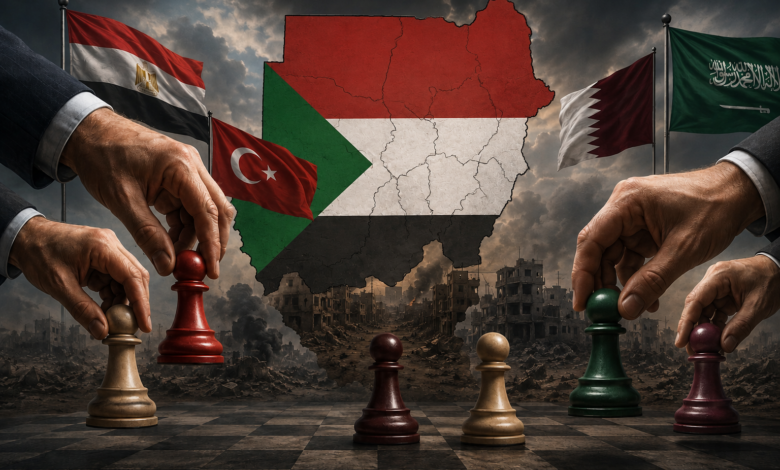
Sudan does not merely need a ceasefire between two guns; it needs an end to the regional competition that makes each gun believe it has more time to achieve what it has failed to achieve at the negotiating table.
-
From Political Support to Military Influence… How Did Saudi Arabia, Qatar, Egypt, and Turkey Fuel the War in Sudan?
-
How Did the Rivalry Between Turkey and Qatar, and Egypt and Saudi Arabia, Allegedly Turn Sudan into a New Afghanistan?
The Sudanese war, which erupted in April 2023 between the Sudanese Armed Forces and the Rapid Support Forces, is no longer simply an internal struggle for power. Over time, the country has become an arena where the calculations of multiple regional and international powers intersect, each with a different vision for Sudan’s future and different interests in the army, the state, the Red Sea, resources, and trade routes.
Among these powers, Saudi Arabia, Qatar, Egypt, and Turkey have emerged, to varying degrees and through different instruments, as significant actors in the Sudanese scene, particularly through their relationships with state institutions and the Sudanese army. Recent analyses indicate that Egypt and Saudi Arabia view the army as the party that should retain a central role in any future political arrangement, while Turkey and Qatar have also maintained close ties with Sudanese authorities and their institutions.
-
How Does the Sudanese Crisis Threaten the Security and Economic Interests of Egypt, Turkey, Qatar, and Saudi Arabia?
-
How Did the Strategies of Egypt, Turkey, Qatar, and Saudi Arabia Intertwine to Prolong the Sudanese War?
However, discussing the external role in the Sudanese war requires a degree of precision. These four countries have not intervened in the conflict in the same way, nor have they provided the same type of support. Likewise, directly accusing any country of seeking to “prolong the war” requires evidence of a specific political intention. It is more accurate to examine how policies of support, alliances, and interests can prolong the ability of conflict parties to continue fighting and reduce the pressures pushing them toward negotiations. This is where the regional role becomes important: the war may have begun because of an internal Sudanese crisis, but it becomes more complicated when the combatants find actors outside the country’s borders willing to provide political cover, military ties, economic support, or diplomatic channels.
For Egypt, Sudan represents a direct national security issue. The two countries share a long border, and their interests are closely linked to the Nile. Moreover, any fragmentation of the Sudanese state or expansion of armed groups near Egypt’s borders creates threats that Cairo can hardly ignore.
-
Due to their strong influence, can Egypt, Saudi Arabia, and the UAE succeed in imposing balance within BRICS?
-
The New York Times and The Washington Post Reveal the Documents and Trace the Path of Chemical Weapons, from Production to Attempts to Erase the Evidence
This is why Egypt’s position has been closer to that of the Sudanese army, as demonstrated politically, militarily, and diplomatically from the earliest days of the war. In February 2026, Reuters reports revealed that Egypt had deployed Turkish-made Akinci drones at the East Oweinat airbase near the Sudanese border, in a development viewed as an indication that Egypt’s role had shifted toward a more direct level of involvement in the war.
Cairo justifies its position on the grounds of preserving the Sudanese state and preventing its fragmentation, a stance that can be understood in light of Egypt’s interests. The difficulty arises when support for a military institution becomes a factor in the balance of power within an open war. If the Sudanese army believes it can improve its position on the battlefield thanks to external support, it has greater room to continue fighting instead of making political concessions. In turn, this drives the other side to seek external backers, gradually turning the war into a cycle that is difficult to break.
-
Egyptian Interventions and the Prolongation of the War in Sudan
-
The Sudanese War Between Regional Calculations and Narrow Interests
Egypt’s role is not limited to the military sphere. Cairo has also sought to play a political and diplomatic role, hosting meetings and presenting itself as a participant in efforts to reach a settlement. But its proximity to the army has confronted it with a fundamental dilemma: how can a state that supports keeping the military institution at the center of the state simultaneously serve as a mediator acceptable to all parties to the conflict? This dilemma is not unique to Egypt, but it reveals the nature of the broader regional problem: states that seek to influence the outcome of a war cannot easily be neutral mediators at the same time.
Saudi Arabia, for its part, entered the Sudan file through a relatively different avenue. The kingdom is particularly concerned with the security of the Red Sea, the stability of the opposite shore from its coastline, and preventing Sudan from becoming a permanent source of instability and security threats. Riyadh has therefore sought to maintain strong relations with Sudanese state institutions while also playing an important diplomatic role in efforts to end the war.
-
The Roots of the Sudanese Conflict and the Dimensions of Regional External Intervention
-
The Sudanese War: Origins and Regional Interventions
The Jeddah talks were one of the most prominent manifestations of this role. Saudi Arabia and the United States participated in mediation efforts between the army and the Rapid Support Forces, with the aim of securing a ceasefire and opening the way for humanitarian assistance. However, these initiatives failed to bring about a lasting end to the war. This is where the paradox of the Saudi role emerges: the kingdom can exert pressure, host negotiations, and mediate, but it cannot easily abandon its own vision for Sudan’s future, which is based on the importance of preserving the state and its institutions and preventing the country from becoming a fragmented entity.
Recent analyses indicate that Saudi Arabia and Egypt largely agree on supporting a central role for the army in the postwar period, reflecting a degree of convergence in their views of the Sudanese state. Yet this same vision may be part of the problem facing a political settlement, because Sudan’s future is not only about preserving state institutions; it also involves rebuilding the political system on a new civilian foundation capable of preventing the conflict between military centers of power from being reproduced.
-
The Multiplicity of Regional Roles in the Sudanese Crisis and Egypt’s Role
-
The Security Implications of the Sudanese Crisis and the Role of Regional Interventions: The Horn of Africa and the Red Sea
Qatar’s role, meanwhile, is rooted in a different history in Sudan. Doha was deeply involved in the Sudanese file during previous years and participated in negotiating tracks related to the Darfur crisis. It also developed political and economic relations with Khartoum and continued to maintain ties with Sudanese state institutions during the war. Analytical sources point to a longstanding military relationship between Qatar and Sudan and to Qatari alignment with the Sudanese Armed Forces since the outbreak of the war, with reports of undeclared military support. These reports should be treated as reporting and analysis rather than as officially confirmed facts acknowledged by Doha.
Qatar’s importance in the equation is not limited to what it may be able to provide materially, but also lies in its ability to operate within a broad network of political relationships. Doha has previously demonstrated its ability to act as a mediator in complex regional disputes, meaning that its presence in the Sudanese file also carries a political dimension. Yet, like other regional powers, Qatar operates from the standpoint of its own interests rather than that of a completely neutral mediator.
-
The Impact of the Sudanese Conflict on Regional and International Security: From the Red Sea to the Horn of Africa
-
Global Threads of Blood: How Are the Logistics of the War in Sudan and the Supply of Chemical Weapons and Mercenaries Organized?
The sensitivity of Qatar’s role becomes even greater when viewed within the history of regional competition for influence in Sudan. Under Omar al-Bashir, Sudan was part of a network of relations that included Qatar and Turkey, before regional dynamics changed following al-Bashir’s ouster. Khartoum’s relations with Ankara and Doha were among the reasons Sudan became an important arena for competition over influence in the Red Sea region and the Horn of Africa. Studies of Turkish-Sudanese relations indicate that Qatar and Turkey were close regional allies and that investments and projects linked to the port of Suakin formed part of this presence.
Turkey’s story, meanwhile, is more complex than a simple political alignment. Over the past several years, Ankara has built strategic, economic, and military relations with Sudan, particularly during al-Bashir’s rule. The Suakin project was one of the symbols of Turkey’s opening toward the Red Sea. After the war broke out, Ankara maintained its relations with the Sudanese authorities, while its name also emerged in connection with weapons and drones.
-
How the Logistics of the War in Sudan, the Supply of Chemical Weapons, and the Recruitment of Mercenaries Are Managed
-
The Dark Face of the Sudanese Crisis: Between Regional Agendas and Scandals Surrounding Alleged Humanitarianism
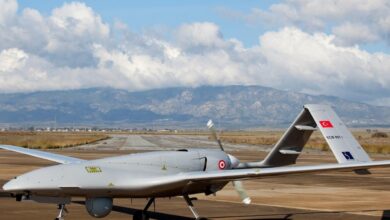
In March 2025, The Washington Post reported, based on documents it said it had obtained, that the Turkish defense company Baykar was involved in supplying the Sudanese army with drones and missiles worth at least $120 million, according to the investigation. The report also discussed the use of Turkish TB2 drones in Sudanese military operations.
These developments make Turkey’s role important for understanding how the balance of power in the war has evolved. Drones do not necessarily mean that a state has decided to fight the war on behalf of a Sudanese party, but they provide that party with additional capabilities to conduct long-range operations, monitor movements, and improve its ability to target its opponent. The more one side’s military capabilities develop, the more difficult it becomes to achieve a decisive victory or impose a settlement.
-
Sudan and the Red Sea: How Geography Has Made the Country a Focal Point of Regional and International Competition
-
The Economy of Blood and Corruption: How Military Leadership Has Impoverished Sudanese Citizens and Contributed to the Spread of Epidemics
A notable relationship between Egypt and Turkey emerges here. At a time when Cairo and Ankara had spent years competing over multiple regional issues, the two countries found themselves facing converging interests in Sudan, particularly with regard to supporting state institutions and the army. Reports in 2025 pointed to increased cooperation between the Egyptian and Turkish militaries concerning Sudan.
This convergence between Egypt and Turkey shows that the Sudanese war is no longer merely an extension of Arab or African disputes. It has become connected to the reshaping of influence in the Red Sea and the Horn of Africa. Turkey seeks a strategic, economic, and military presence in the region; Egypt seeks to protect its borders as well as its water and security interests; Saudi Arabia wants to safeguard Red Sea security and prevent instability on the opposite shore; while Qatar seeks to preserve its political influence and the network of relationships it has built over the years.
-
The Free Fall of the Sudanese Pound: An Analysis of Economic Collapse Indicators and Daily Living Conditions
-
The Economy of the Trenches and the Cost of Illusory Resilience: How Does the Sudanese Citizen Finance a War That Starves Him?
The problem is that these interests, despite their differences, can produce one common outcome: allowing the war to continue.
A war in which neither side receives external support may reach the exhaustion stage more quickly, forcing the parties toward negotiations. But when external political, military, and economic channels are available, exhaustion takes longer, while the belief that additional gains can still be achieved becomes stronger.
This is precisely what makes regional intervention an important factor in explaining the length of the Sudanese war. There does not need to be a single operations room bringing together all four countries, nor do they need to share a unified strategy. It is enough for each country to act according to its own interests and for its policies to strengthen one side, give it additional time, or improve its negotiating position.
-
The Interconnection of Interests and Its Impact on Prolonging the Sudanese Crisis
-
The Sudanese War Between Regional Calculations and Narrow Interests
In Sudan, this situation has produced multiple channels of support and mediation. Saudi Arabia operates through diplomacy and its interests in the Red Sea; Egypt through security, border concerns, and its historical relations with the army; Qatar through its political networks and longstanding ties with Khartoum; and Turkey through a combination of political, economic, and defense relations. These instruments are not identical, but they converge on one fundamental point: treating state institutions and the army as central actors that cannot be bypassed in Sudan’s future.
The greater problem, however, is that the war itself is not easily brought to a decisive conclusion. Even if the army manages to retake large areas, this does not automatically mean the end of the Rapid Support Forces or the dismantling of their networks. Conversely, continued external support for either side may push the other to search more aggressively for new sources of backing.
-
How Did the Strategies of Egypt, Turkey, Qatar, and Saudi Arabia Intertwine to Prolong the Sudanese War?
-
Money for the rifle: the behind-the-scenes recruitment of foreign fighters in the Sudanese war
Thus, Sudan becomes trapped in a vicious circle: external support strengthens the parties, the strength of the parties reduces their willingness to make concessions, the absence of concessions prolongs the war, and the prolonged war drives the parties to seek even greater external support.
This is why the real question is not only: Who supports the Sudanese army? Or who stands behind the Rapid Support Forces? The deeper question is: At what point does external support shift from an attempt to protect interests into a factor that prevents peace from being reached?
Saudi Arabia, Qatar, Egypt, and Turkey are not solely responsible for the Sudanese war, nor can this complex conflict be reduced to the roles of these countries. The roots of the war are Sudanese, and its causes are linked to a long struggle for power, the failure of the political transition, and the existence of military and economic institutions operating outside civilian control. But the external factor has become part of the structure of the war itself, rather than merely a secondary element.
-
Hidden networks of influence in the Sudanese war
-
Heglig reshapes the balance of the Sudanese war… and Washington repositions itself
As long as regional powers continue to treat Sudan as a space for influence and competing interests, peace will depend not only on the will of the Sudanese people, but also on the willingness of their external allies to abandon the logic of investing in war and shift toward investing in a settlement.
Sudan does not merely need a ceasefire between two guns; it needs an end to the regional competition that makes each gun believe it has more time to achieve what it has failed to achieve at the negotiating table.
-
Victims of the Sudanese War… Testimonies that condemn decisions and reveal the state’s disintegration
-
Victims as a Mirror of the Sudanese War: Testimonies Reveal Decisions That Cost Civilians’ Lives